Israel’s Bid to Join the African Union: A Conflict of Interests, Jurisdictions, and Principles

Israeli efforts to join the African continental organization in an observer capacity have not ceased since its founding, whether during the era of the “Organization of African Unity” (OAU), or under the “African Union” (AU). In recent years, Israel succeeded in obtaining observer status in 2021. However, it soon lost that status after the decision was suspended and its delegation was subsequently expelled from the Union. Although Israel maintains official diplomatic relations with most of the countries of the continent, it attaches exceptional importance to the question of membership in the continental organization, as it promotes a narrative to the effect that it had held observer status in the Organization of African Unity until its transformation into the African Union in 2002, and it takes that narrative as a foundation for its persistent efforts to restore this institutional positioning.
However, there are multiple factors that have formed an obstacle before those Israeli efforts, and with the outbreak of the genocide against the Gaza Strip since October 2023, and the transformations and Israeli policies that accompanied it, the question of Israel’s accession to the organization has become more complex and further from realization.
Accordingly, this article addresses, first, the founding historical paradox between the Israeli narrative about its continental legacy and the actual procedural status since the 1960s, to reveal that every subsequent endeavour rests on a false premise. Proceeding from this basis, the moment of 2021 is read as a structural revealer rather than an exceptional event; for it showed how procedural flexibility, when it overrides value-based firmness, does not produce a sustainable breakthrough, but rather an immediate exposure of the internal contradiction of the institution. From this revelation, the paper moves to an analysis of the functions that Israel seeks to achieve from observer status—to clarify, finally, the limits of this endeavor in the face of a system of accumulated obstacles that make the reopening of the file a political cost that any commission chairperson would find difficult to bear.
Against this backdrop, this paper first examines the foundational historical paradox between Israel’s narrative of its continental heritage and its actual procedural status since the 1960s, demonstrating that subsequent efforts have been premised on a fundamentally false assumption. Building on this premise, the article interprets the events of 2021 not as an exceptional episode but as a structural moment of revelation, showing how procedural flexibility, when divorced from normative consistency, fails to produce a lasting breakthrough and instead immediately exposes the institution’s internal contradictions. It then analyses the strategic functions Israel seeks to achieve through observer status before concluding by examining the limits of this strategy in the face of an accumulated set of political and institutional obstacles that make reopening the issue politically untenable for any President of the Commission.
Israel in the Continental African Organization: From “Guest” to “Expulsion”
Israel’s efforts to secure an institutional foothold in the African continent date back several decades, for the Israeli push toward the African Union in recent years cannot be properly understood in isolation from an extended historical trajectory that originated in the 1950s and 1960s. Following the wave of African decolonisation, Israel engaged with the continent by presenting itself as an alternative model of development to the former European colonial powers. This engagement was driven by two closely intertwined objectives: to counter Egypt’s diplomatic influence in Africa during the era of Gamal Abdel Nasser and to break the regional isolation imposed by the Arab boycott following the establishment of Israel in 1948.
This engagement was later framed through a historical fallacy and misrepresentation advanced by the Israeli Ministry of Foreign Affairs and promoted by Prime Minister Benjamin Netanyahu during his 2016 tour of Africa, suggesting that Israel had previously held observer status in the Organization of African Unity. However, former Israeli ambassador Aryeh Oded explicitly refutes this claim, affirming that Israel’s presence during the 1960s was limited to the lower-ranking protocol status of “Invited Guest.” According to Oded, this status permitted Israeli diplomats to attend only the opening and closing ceremonies of continental summits, without the right to participate in the organization’s formal deliberations or address its meetings. This limited status remained in place until 1970, when sustained Arab diplomatic pressure succeeded in excluding Israel and abolishing the arrangement altogether.
By contrast, the Palestine Liberation Organization officially obtained “Observer Status” in the Organization of African Unity in 1974, following the organization’s adoption of a decisive historical resolution stipulating that the Palestinian cause is an African cause. This gradual erosion of Israeli legitimacy on the continent in the early 1970s soon turned into a comprehensive dramatic collapse under the weight of the military variables at that time, as the October 1973 war constituted a moment of complete geopolitical rupture, which entered Israel into a phase of imposed isolation described as the collective Diplomatic Quarantine, as well as continental Pariahtude; that is, a sweeping, accelerating Galloping Isolation.
Under the influence of mutual pressures to preserve the African consensus and to avoid the division and fragmentation of the continent, the overwhelming majority of the countries of sub-Saharan Africa, with the exception of South Africa in the era of apartheid, Malawi, Eswatini, Lesotho, and Mauritius; severed their official relations with Tel Aviv in protest against the continued occupation of the Arab territories. This collective turn deepened through the shocking economic repercussions resulting from the rise in oil prices during the war; as the African capitals sought to secure their vital interests through political solidarity with the Arab side. This continental orientation continued to be embodied in the declaration of the Organization of African Unity in 1975 that “the racist regime in occupied Palestine and the racist regime in Zimbabwe and South Africa have a common imperialist origin, form a single whole, and have the same racist structure.”
Since the transformation of the Organization of African Unity into the African Union in 2002, Israel’s repeated requests to obtain observer status were rejected, specifically in the years 2013 and 2016; based on the conflict of Israeli policies with the spirit of the founding charter and with the African Charter on Human and Peoples’ Rights.
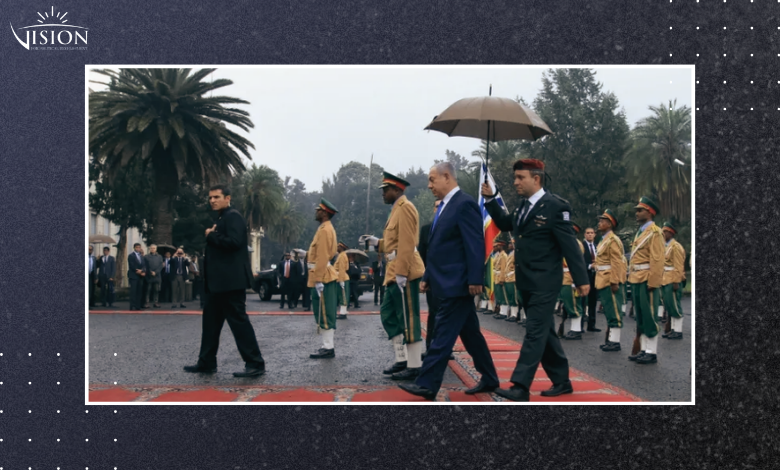
On the twenty-second of July 2021, the former Chairperson of the African Union Commission, Moussa Faki Mahamat, took a unilateral decision to grant Israel observer status.[1] This decision, which was described as having “divided Africa,” was not an isolated bureaucratic incident, but rather a culmination of an Israeli diplomatic effort that extended for nearly two decades, and was reinforced by Benjamin Netanyahu’s visits to East Africa in July 2016, where he specifically chose Ethiopia, Kenya, Uganda, and Rwanda, then his visit in 2017 to address the leaders of the Economic Community of West African States (ECOWAS). These are visits that come amid a long diplomatic trajectory that bore fruit in Israel’s weaving of relations with forty-six countries out of fifty-five in the continent, within a network of interests that Israel seeks to obtain from the African continent. Yet this bureaucratic breakthrough did not hold for long; as around seventeen countries out of the fifty-five member states in the African Union expressed their rejection of or reservation about the decision.
South Africa’s position in particular reveals the depth of the problem; as it described Faki’s decision as shocking, indicating that its granting came at a time when the oppressed Palestinian people are being subjected to destructive bombardment and illegitimate settlement. In the depth of the problem, the legal structure intersects with the political position; as “the accreditation-granting system in the African Union” permits the Chairperson of the African Union Commission to consider the requests of non-African states, taking into account the supreme interest of the Union and the known positions and concerns of the member states, and the request is not approved except in the case that the Chairperson of the Commission is convinced that there are no impediments preventing its approval.
As a result of this tug-of-war, the African Union decided at the Addis Ababa summit (the 35th summit), in February 2022, to suspend the decision to grant Israel observer status. At the February 2023 summit, the Chairperson of the Commission announced the continued suspension of the status; which practically led to the expulsion of the Israeli delegation from the meeting hall for the absence of an official invitation.
Following the seventh of October 2023, the African Union settled its position at the February 2024 summit, in which it condemned the Israeli aggression and demanded an end to all forms of exchange with Israel, affirming that the file has become completely closed and the status has effectively been withdrawn.
Why Does Israel Want Observer Status in the African Union?
Despite the fact that Israel enjoys diverse relations with the majority of African countries, it remains keen to obtain observer status, as there is a set of interlocking functions that this status performs, which can be extracted at the following levels:
First: Disabling the African voting bloc in the international forums: The fifty-five African countries represent the largest voting bloc in the United Nations General Assembly, and they often vote in a near-unified manner in favour of the Palestinian cause. Therefore, Israel aims, through observer status, to induce the African countries to support its positions in the international organizations, or at the minimum to abstain from voting or to be absent. This reading agrees functionally with what the Institute for Security Studies concluded, that Israel’s diplomatic victory in the African Union rearranges the balances of voting in its favour.
Second: Counter-membership in the face of the institutional Palestinian presence: The African Union granted the Palestinian Authority observer status in 2013, while Israel remained outside this space; the matter that grants the Palestinians a continental platform comprising 55 countries to present their narrative, to secure political and diplomatic support, and to employ the platform to produce solidary continental positions in the summits and periodic meetings. Israel views this differentiation as a dangerous diplomatic gap, which the Palestinians invest to deepen the African bias toward their cause. And because of Israel’s inability to exclude the Palestinian presence from this space, presence alongside them, even in an observer capacity—becomes a tool to reduce the cumulative impact of the Palestinian narrative, to possess the right of institutional address, and to build reverse networks of influence within the continental bureaucracy.
Third: Normalizing the institutional presence in Africa to restore Israeli legitimacy: Under the genocide against the Gaza Strip, Israel has become in urgent need of rebuilding its legitimacy before the Global South, of which the African Union represents the most prominent node. The institutional presence in Addis Ababa, the seat of the Union, allows Israel to build communication networks with the continental bureaucracy and the political elites in a regular manner; which subsequently makes it more difficult to take collective continental decisions opposed to it. For since October 2023, the African continent has turned into one of the most prominent fronts for encircling Israeli legitimacy, led by South Africa, which filed on 29 December 2023 a case before the International Court of Justice accusing Israel of committing genocide in Gaza. The matter did not stop at the individual position of Pretoria; rather it extended to turn into a continental institutional position when the International Court of Justice granted the African Union, in February 2025, official permission to participate in the advisory proceedings relating to Israel’s obligations in the occupied Palestinian territories.
Fourth: Confronting Turkish, Egyptian, and Iranian influence in the African continent: This dimension re-links the Israeli endeavour to a broader narrative of re-engineering the region, in which Israel aims to counter the roles and the escalating influence of a number of powers in the region, particularly the Turkish in Somalia, Ethiopia, and the maritime corridors, in addition to countering the Egyptian role in the Nile Basin and the Red Sea. According to the Israeli narratives, alongside the Egyptian and Turkish influence in Africa, Iran emerges as a pivotal actor that works intensively to tighten the economic siege on Israel through expansion in the Red Sea and the Horn of Africa, and the opening of lines for smuggling weapons to Hamas via Sudan and Eritrea, and expansion in Mali and Niger to reach the uranium resources necessary for its nuclear program, in addition to investing the relationship with South Africa; to undermine Israeli diplomatic efforts, particularly within the multilateral African frameworks. In the same context, the security reports monitor a parallel activity of Hezbollah in Africa, represented in its building of wide financing networks and diamond trade in the west of the continent that can be converted into platforms for targeting Israeli interests at the moment of confrontation.
The Obstacles to the Israeli Breakthrough
The Israeli calculations in the African continent collide with a system of accumulated obstacles that exceed mere transient political positions, to be formed into a solid structure distributed across ideological, political, legal, and field levels.
First: The Ideological Structure of the Founding Charter
The Constitutive Act of the African Union is founded on the rejection of colonialism and apartheid as two red lines, which makes the acceptance of Israel a contradiction with the institutional identity itself, especially after major human-rights organizations, among them the Israeli B’Tselem, described Israeli policies toward the Palestinians as amounting to the crime of apartheid. This characterization is not marginal in the African discourse; for South Africa, which leads the opposing campaign, invokes its own experience with apartheid as an ideological reference that makes acceptance of Israel a prejudice to its national identity, in addition to the continental identity of the Union.
Second: The Wall of Continental Resistance and the Afro-Arab Veto Bloc
Another obstacle emerges that played a pivotal role in obstructing Israel’s accession in an observer capacity, represented in the cumulative joint diplomatic resistance led by weighty regional powers, foremost among them Algeria and South Africa in coordination with the Palestinian side. A close examination of the African Union’s internal dynamics demonstrates that opposition to legitimising Israel’s presence did not emerge in 2021 but represents the continuation of a long-standing strategy of resistance. As a study by the Mitvim Institute notes, Algeria and Sudan spearheaded a coordinated diplomatic effort from 2016 onwards to obstruct Israel’s campaign for observer status and to consolidate a continental consensus against its attempts to leverage expanding bilateral relations with African states to secure institutional recognition.
This sustained coordination, which also encompassed South Africa’s active engagement within the African Union Commission and President Mahmoud Abbas’s diplomatic visits to coordinate a common continental response, laid the foundations for the rejection bloc’s rapid and coordinated reaction. It enabled opponents of Israel’s accreditation to transform what had begun as a unilateral and unexpected procedural decision into a highly visible contest over the legitimacy of Israel’s institutional presence within the African Union.
Within this institutional line, the Algerian Ministry of Foreign Affairs issued a strongly worded statement on 26 July 2021; in protest against the decision to grant Israel observer status, considering that the step was taken without prior broad consultations with the member states, and does not reflect the principles and objectives of the Constitutive Act of the African Union. The matter was not confined to the individual Algerian position; as that was followed by the submission of a joint memorandum of protest on 29 July 2021 from eight Arab and African embassies in Addis Ababa (among them Egypt, Tunisia, Djibouti, Libya, and the Comoros). And following the issuance of a clarifying statement from the Chairperson of the Commission Moussa Faki on 6 August 2021 in which he defended his step, a broader continental movement crystallized on the very next day (7 August 2021); as 14 African countries among them (South Africa, Nigeria, Senegal, Tanzania, Zimbabwe, and Mali) activated an organized diplomatic bloc aimed at cancelling the acceptance of Israel.
Third: The Genocide in Gaza
The genocidal onslaught against the Gaza Strip since October 2023 constituted a decisive turning point. The genocide did not only produce a wave of African popular solidarity, but rather produced South Africa’s case before the International Court of Justice, which turned into a continental reference that any African regime would find difficult to bypass without an internal cost. In February 2026, the Chairperson of the African Union Commission Mahmoud Ali Youssouf opened the proceedings of the thirty-ninth summit in Addis Ababa with a highly significant declaration, when he said that “the extermination of the Palestinian people must stop,” demanding the lifting of the Israeli siege on Gaza, and reminding those present that “international law and international humanitarian law are the foundation of the international community.” Since October 2023, the legal rulings against Israel accumulate; from the arrest warrants of the International Criminal Court against Netanyahu and Gallant, and the advisory opinion of the International Court of Justice ruling on the illegitimacy of the occupation in its entirety, and the participation of the African Union itself as a supporting party in those proceedings. Accordingly, any decision to normalize the Israeli presence in the Union becomes an explicit contradiction with the legal positions that the Union itself took before the international judiciary.
Fourth: The Israeli Role Destabilizing Continental Stability
A new field obstacle emerges, represented in the Israeli role that has come to be viewed as an element destabilizing continental stability. The Israeli recognition of Somaliland in late December 2025 raised structural fears relating to the principle of the inviolability of the borders inherited from colonialism; which is the fundamental pillar upon which civil peace in the continent is founded. The African Peace and Security Council held an emergency session in January 2026; in response to the Israeli recognition of Somaliland; and the Chairperson of the Union Commission described the recognition as “carrying the risks of establishing a dangerous precedent with far-reaching repercussions for peace and stability in the continent.” The African Union Commission did not suffice with that, but rather issued in April 2026 an additional statement condemning Israel’s decision to appoint a diplomatic envoy to Somaliland, in a public institutional escalation of the African position. For Israel is no longer merely a state that violates the rights of a people outside the continent, but rather has turned into an actor that threatens African national security at its core through the encouragement of separatist tendencies.
Conclusion
The successive decisions of the African Union since 2021 are presented as an expression of a transformation deeper than mere foreign policy toward Israel in the familiar sense, for they are not a series of circumstantial positions so much as they are successive stations in which the Union found itself compelled to answer a founding question that touches its very identity: what allows an institution that arose upon the opposition to colonialism and apartheid to host, in its representative structure, a state that the major human-rights organizations describe as practicing apartheid? In this sense, the Union was not managing a sectoral dispute with Tel Aviv, but rather was re-recognizing itself through the position toward it.
Within this framework, it appears that there is an existing tension; namely the tension between the procedural flexibility that the powers of the Chairperson of the Commission allow, and the value-based firmness that the Constitutive Act of the Union imposes. For Faki’s decision activated the procedural flexibility and took the bilateral relations as a reference, so its contradiction with the value-based firmness was exposed immediately. And the Union, when it suspended, did not take a positive decision in the precise sense, but rather bridged the gap between what it claims and what it does. For the African Union is not a homogeneous actor, but rather an umbrella for fifty-five states whose bilateral relations with Israel vary greatly. For forty-six African countries maintain bilateral diplomatic relations with Tel Aviv, and some of them, such as Rwanda, Kenya, Uganda, and Ethiopia, intersect in terms of interests with Israel in the files of security, technology, and investment.
This structural contradiction between the bilateral and continental dimensions is what allows Israel to maintain a margin of maneuver through investing the bilateral relations to pressure the continental institution, while it allows the African Union in turn to preserve its principled position without costing its members the severance of their relations. Hence, observer status remains a subject of tug-of-war that is not finally resolved for either of the two parties, but rather remains suspended in a grey area as a tool of mutual pressure. In conclusion, with the accumulation of the international judicial rulings since 2023, and the escalation of the destabilizing Israeli engagement in the Horn of Africa, the balance appears to be tilted, even if slowly, toward the consolidation of exclusion rather than its easing.
[1]See the source report on the granting of observer status.
NOTE: This text is adapted from original Arabic article.