Palestinians in the 1948 Territories: The Historical Context of the Struggle Against the Colonial System

For decades, a widely circulated narrative has held that “the Arabs inside [Israel] have their own particularity,” an argument often invoked to detach them from the historical trajectory and collective destiny of the wider Palestinian people on the basis of their Israeli citizenship. Yet this claim is only valid in reverse. The “particularity” of the Arabs inside is a particularity from Israel’s perspective, which sees them simultaneously as its “citizens” and as its “potential enemies.” It is not a Palestinian particularity, because there is no unified Palestinian condition that leaves the Arabs in the territories occupied in 1948 on its margins. Rather, the Zionist entity fragmented Palestinian geography into separate territorial units, resulting in the colonial redefinition of those who inhabit them according to the legal status that Zionism forcibly imposed upon them. Thus, the Arabs inside are citizens of the so-called “State of Israel”, while the Jerusalemites; the Arab residents of East Jerusalem, have been classified as “residents” since the occupation of Jerusalem in 1967. Palestinians in the West Bank and Gaza Strip are citizens of a Palestinian state that has yet to come into existence. Meanwhile, the people of Gaza, after enduring two years of attempted annihilation, are being pushed, together with their territory, toward a separate and uncertain political and administrative future.
The “Arabs in the territories occupied in 1948” were born into a contradictory duality between their Arab-Palestinian identity and their Israeli citizenship, a contradiction produced by the Nakba of 1948, about which much has been written. Yet the decisive moment when the Arabs inside became the focus of attention and questioning by other Palestinians and Arabs generally came with what is known in the political vocabulary of the الداخل (inside) as the “October 2000 Uprising.” This coincided with the outbreak of the Second Intifada, the “Al-Aqsa Intifada,” when angry demonstrations erupted in several Arab towns and villages within the territories occupied in 1948. The protests were triggered by the Al-Aqsa Massacre committed by Israeli forces following the entry of then-Likud leader and former Prime Minister Ariel Sharon into the Al-Aqsa Mosque compound in Jerusalem in late September 2000, an act that ignited the Second Intifada.
This was not the first time that the Arabs inside had risen up in protest against Israeli government policies, but it was the first time that they joined in direct solidarity and confrontation alongside the rest of their people in Jerusalem, the West Bank, and Gaza. During the October 2000 Uprising, thirteen martyrs from different Arab towns and villages inside Israel were killed by the security forces of the Israeli Labor Party government led by Ehud Barak. It would not be the last such event, but it marked the beginning of a new chapter in the life of Arab society within the 1948 territories.
Historical Context
The Arabs who remained and survived the ethnic cleansing carried out by the Zionists during the Nakba were subjected to military rule from 1948 until 1966, after they had become a minority in their own homeland. They were granted Israeli citizenship as a compromise that allowed them to remain there.[1] This period is worth recalling because of its importance in laying the foundations of a system of surveillance and control exercised by the Zionist military-security establishment. Researcher Ahmad Sa’di devoted his book “Comprehensive Surveillance” to this topic, tracing the roots of the security doctrine that the Israeli establishment developed and implemented politically and militarily toward the Arabs inside.[2]
Although fear and disorientation, amounting at times to submission, governed the relationship between the Arabs inside and the Israeli establishment throughout the period of military rule, this did not prevent episodes of collective protest that occasionally reached the level of direct confrontation with the security apparatus of the Zionist entity. While these incidents were sporadic and localized, confined to a village here or a town there rather than broad popular uprisings, they nevertheless established a memory of protest and resistance against the policies of the Israeli establishment, under security and legal conditions that made organization and collective action extremely difficult.
The most famous of these incidents occurred in the Galilean town of Shefa-‘Amr in 1959 and became known in Palestinian dialect as the “Bus Fight” (Toshat al-Basat). Researcher Khaled Anabtawi wrote a three-part series entitled “The Bus Uprising…” on the Arab 48 website. The protests began when workers from Shefa-‘Amr objected to the Israeli bus company Egged, which transported them daily from their town to workplaces in Haifa and the Jewish coastal settlements. The buses were insufficient to accommodate all the workers, preventing many from reaching their jobs. This led to a series of sit-ins and protests against the company, culminating on 9 November 1959, when Israeli police intervened to disperse a demonstration by workers and their families using live ammunition. On that day, Muhammad Abu Ra’d was killed.
The security forces of the military administration occupied the town of Shefa-‘Amr and arrested dozens of workers in the days following the sit-in. It is no coincidence that this local uprising was connected to buses and the question of mobility under a military regime in which movement required permits issued by the authorities. Catching the bus and boarding it was, at the time, inseparable from securing one’s livelihood.
Toward the Defining Event: Land Day
The true historical turning point, however, came when the Arabs in the territories occupied in 1948 mobilized collectively as a political community and as a national-civic minority on 30 March 1976, nearly a decade after the lifting of military rule. Land Day is regarded as the unifying event upon which all political and national forces in the 1948 territories agreed and as the first violent confrontation with the ruling authorities. The events of Land Day began in what became known as the “Land Day Triangle” in the Galilee; the three villages of Sakhnin, Arraba, and Deir Hanna, in response to the policy of confiscating Arab land in the Galilee, a policy pursued by successive Israeli governments since the early 1950s. Land confiscation intensified in the late 1960s and early 1970s under what Zionist discourse termed the “Judaization of the Galilee” project.
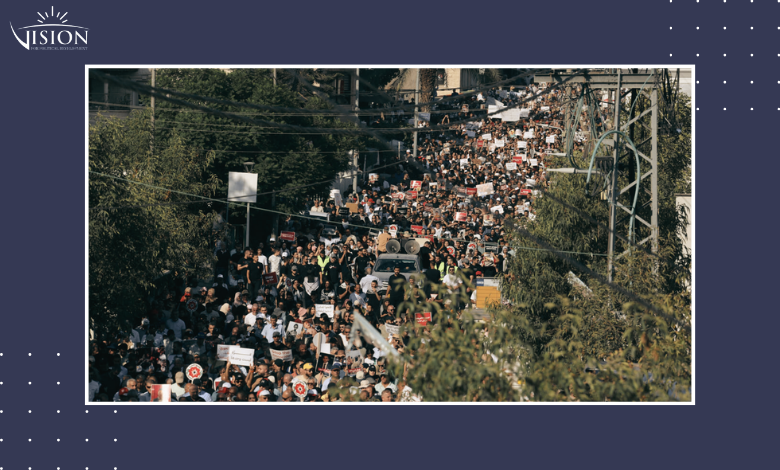
The demonstrations and protests of 30 March spread throughout Arab towns and villages across the Palestinian interior after a general strike was declared that day, taking the form of civil disobedience in some localities. Protesters clashed with Israeli police and security forces, leading to the deaths of six martyrs in the villages of Sakhnin, Arraba, Kafr Kanna in the Galilee, and Taybeh in the Triangle region. The issue of land alone united the Arabs inside politically and socially at that moment, while simultaneously reconnecting them to their natural and historical unity with their people across all of Palestine. This transformed Land Day into an occasion that transcended the geography of the interior and entered the collective Palestinian consciousness as an annual commemoration observed by Palestinians everywhere.
“On Land Day, the Arabs in the territories occupied in 1948 felt strong, but they were afraid of their own strength and feared moving further forward. The lesson drawn from that day was that it should not be repeated except as an annual commemoration,” says Dr. Azmi Bishara in his book The Truncated Political Discourse.[3] The Israeli establishment, in cooperation with local Arab political forces, quickly moved to contain the phenomenon and prevent its recurrence; not by abandoning the policy of land confiscation, which continued unabated, but through a strategy of containment and the improvement of citizenship conditions for Arab citizens in various fields, particularly the economy and public services. The Arab mass institutions that had led Land Day became ends in themselves. Rather than developing organized popular protest and civil action, local and national bodies of a primarily local character emerged alongside them.[4] This was intended to prevent any broad, unifying mass movement among Arabs inside Israel and to block any trajectory that might establish the idea of Arabs mobilizing as a political-national collective.
The pattern of “taking one step back” after every mass uprising would remain the recurring logic governing the behaviour of the Arabs inside, in their uprisings and mobilizations from Land Day onward. This article seeks to ask why Palestinians inside Israel fear their own collective mobilization whenever they engage in it. Every national-popular uprising in which the Arabs inside act as Palestinians and confront Israeli security forces is quickly contained and repositioned under the framework of Israeli citizenship. This process is carried out by the ruling establishment in cooperation with local political forces, which have consistently assumed the task of bringing people politically back from the street to the sidewalk. The same pattern would recur in later events such as the October 2000 Uprising and the May 2021 Uprising: daring to engage in collective action and advance forward, only to take a step back afterward.
A Parallel—Erased—History
The protests of the Arabs inside, which took various forms ranging from civil protest and localized sit-ins during the period of military rule (1948–1966) to broad mass uprisings that reached their peak on Land Day in 1976, and the subsequent political consumption of Land Day as an annual commemoration by political parties and movements from the late 1970s through the early 1990s, constitute a collective memory that remains present in cultural folklore. Yet this memory has been stripped of its political efficacy up to the present day among Palestinians inside Israel.
However, the period stretching from the 1950s to the early 1990s also contains a parallel history of struggle alongside the mass civil movement inside Israel, a history that has been erased from the memory of its sons and daughters. This concerns “the armed struggle of some Palestinians inside Israel under Israeli citizenship,” which took the form of individual initiatives or small cells in the Galilee and the Triangle. Some of these groups carried out operations against Israeli targets at various stages throughout the second half of the twentieth century.
The most famous of these armed resistance groups was what became known as “Group 778” or the “Akka 778 Group,”[5] founded in the city of Acre as a fedayeen organization during the 1960s. One of its most prominent founders was Fawzi al-Nimr, a native of Acre, who was arrested in late November 1969 after a series of operations targeting Israeli public facilities and objectives between Haifa and Acre.
Hardly a city, town, or village inside Israel lacks a story about one of its sons who joined the Palestine Liberation Organization from the 1960s through the early 1990s, or who organized with the PLO while secretly working on its behalf from within. This is in addition to the stories of fugitives and fedayeen, some of whom were killed and others imprisoned, in a history that remains absent from the collective memory of Palestinians inside Israel, or has been deliberately erased by the ruling political-security system using the same local instruments. Some local Arab political forces and leaders who acted, in effect, as agents of containment for popular protests and mass uprisings, disciplining them within the framework of citizenship, meaning citizenship on Israeli-Zionist terms, were the same actors who worked to erase from public memory every story of resistance and rebellion that existed outside the accepted rules and conditions of political action inside Israel.
With the end of the First Intifada in the early 1990s, which produced the greatest turning point in Palestinian history, namely the Oslo Accords of September 1993, a new chapter in the political and popular movement of Palestinians inside Israel began. This would make them the subject of greater scrutiny and questioning than ever before, in the eyes of both Palestinians and Israelis alike.
[1] For further reading, see: Grace, Sabri, *The Arabs in Israel*, Palestine Liberation Organization – Research Center, 1st ed., 1967, Vol. 1. See also: Bishara, Azmi, *The Arabs in Israel: An Insider’s View*, Center for Arab Unity Studies, 2nd ed., Beirut, 2000.
[2] Saadi, Ahmad, Total Surveillance: The Origins of Israeli Policies on Population Management, Surveillance, and Political Control of the Palestinians, trans. Al-Harith Muhammad al-Nabhan, Arab Center for Research and Policy Studies, 1st ed., Beirut, 2000. See also: Matza, Doron, “Israel’s Policies Toward Its Arab Citizens: The Roots and Evolution of Security Thinking,” trans. Muhammad Qa’dan, Israeli Issues Journal, No. 84, pp. 118–125.
[3] Bashara, Azmi, *Theses on the Stalled Renaissance and Other Studies*, Palestinian Institute for the Study of Democracy, 1st ed., Ramallah, 1998, p. 34.
[4] Ibid., p. 34.
[5] For more on this, see: Fayyad, Tawfiq, *The Acre Collection 778*, Palestinian Ministry of Culture, 3rd ed., 2000.
Note: This article consists of two parts and will be published serially.
This text is adapted from original Arabic article.