Monitoring European and Russian Political Views on the Palestinian Question: The Attacks on Foreign Witnesses in the West Bank and the Israeli Government’s Responsibility
Weekly report, 14–19 October 2026 — Monitoring prominent European political views on the Palestinian question: Britain, Germany, France, Belgium and Russia

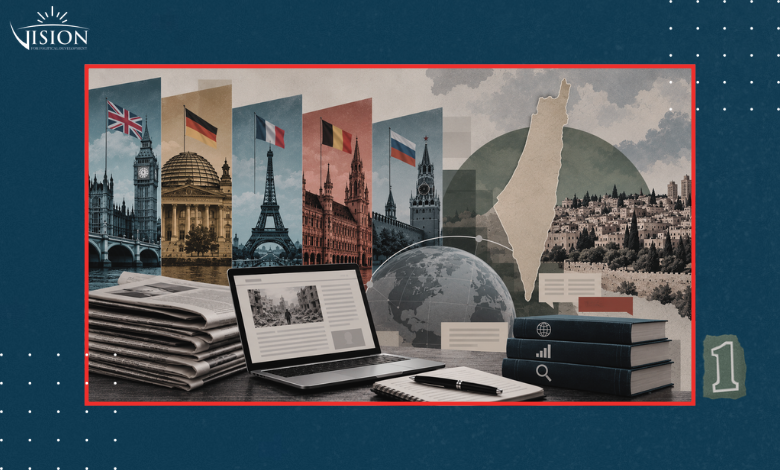
This report monitors what writers at British, German, French, Belgian and Russian think tanks and political platforms said between 14 and 19 October 2026 about developments in the Palestinian question and the practices of the Israeli occupation. This week’s main issues centred on the attacks on foreign witnesses in the West Bank, the Israeli government’s responsibility for settler violence, and the European and American positions on it; the situation in Gaza a year after the ceasefire was announced; the Israeli election held on 27 October; and the repercussions of the Palestinian question for the judiciary, the media and political parties in Europe. It concludes with a review of the findings of studies and polls cited by the writers.
The report is based on the processing of 443 items published by 90 platforms in Britain, Russia, Germany, France and Belgium.
Conclusions
- The writers see the two attacks, on the American photographer and on the European delegation, as a sign that settler violence is spreading beyond farmers to reach foreign witnesses, and that international presence has lost its deterrent function during the harvest season.
- The writers hold the Israeli government responsible in three ways: casting doubt on documented attacks, sponsoring the settlers for electoral reasons, and an impunity that makes the cost of violence almost nil.
- The European Union’s response is likely to remain confined to statements and condemnations as long as it stays divided; the writers read condemnation without sanctions as entrenching impunity.
- The writers attribute Gaza’s crisis more to political decisions than to the effects of the war, above all Israeli restrictions on the movement of goods and on reconstruction, along with declining donor support — which has made the cut in World Food Programme operations the first real test of the post-truce phase.
Key Opinions
The Attacks on Foreigners in the Villages of Abu Falah and al-Taybeh
Writers on various platforms, among them Thomas Hofnung (La Croix) and a writer at the Frankfurter Rundschau, see the attack on the American photographer Heidi Levine near Abu Falah on 16 October, followed by the attack on a European diplomatic delegation in al-Taybeh the next day, as an escalation targeting those who document settler violence.
In the assessment of Emma Graham-Harrison (The Guardian), the presence of Israeli activists, diplomats, senior clergy and journalists is no longer enough to deter extremist violence. She bases this on the attack on consuls, on a French mayor wearing his official sash, and on the Archbishop of Cambrai. In her article published on 18 October, she argues that the attackers seemed determined to force the foreigners to flee and to make them pay for joining Palestinians on their land.
Writers on British, German, French and Russian platforms, among them Christian Meier (Frankfurter Allgemeine Zeitung) and Emmy Sasipornkarn (Deutsche Welle), analyse this season’s settler violence as an effort to prevent Palestinians from harvesting their olives, while a writer at Britain’s Channel 4 sees it as a campaign to steal Palestinian land.
In the reading of William Christou (The Guardian), the attacks were a coordinated movement of at least eighty settlers in Abu Falah, some carrying firearms and clubs, who pelted farmers with stones in full view of army vehicles.
Netanyahu’s Response and the Calculations of the 27 October Election
Israeli Prime Minister Benjamin Netanyahu met the documented settler attacks with doubt. Writers such as Knut Mellenthin (junge Welt) criticise statements from Netanyahu’s office that treated the attacks as unproven rumours, even though the army and Foreign Minister Gideon Sa’ar confirmed that they had happened and criticised them. In the same vein, Graham-Harrison argues that the office cast doubt on the integrity of the diplomats and clergy who witnessed the attack on the delegation, drawing on what The Guardian documented and filmed in the town of al-Taybeh.
Meier argues that Israeli officials are trying to shift responsibility onto others, noting that Netanyahu’s description of the incident as an “alleged attack” requiring “convincing evidence” points in this direction. The Frankfurter Rundschau writer recalls Netanyahu’s statement that “coordinating visits with the army is standard procedure in war zones and areas at high risk of terrorism, and the West Bank is not a war zone,” and responds that this amounts to Netanyahu insinuating that those attacked share responsibility because they did not coordinate their visit with the army.
Netanyahu’s stance as head of government sends a message that the government is reluctant to hold settler attackers to account, in the assessment of Graham-Harrison, who regards the prime minister’s turning of the methods of doubt used against Palestinians onto senior diplomats from allied European states as “a new embrace of isolationist extremism.” The Frankfurter Rundschau writer argues that the cover Netanyahu gives far-right gangs emboldens them, which could bring further diplomatic tension with the European Union.
Writers on various platforms link the violence, and Netanyahu’s response to it, to the 27 October election. Luis Reygada (L’Humanité) argues that the settlers are multiplying their abuses, emboldened by an authority seeking to consolidate its pro-settlement base before the vote.
Settler Influence, the Army and Impunity
In the assessment of writers on various platforms, Netanyahu’s government is a mainstay of the settlers. Meier argues that the residents of the settlement outposts in principle enjoy the support of the current government, even though their outposts are illegal even under Israeli occupation law itself. Bel Trew (The Independent) points out that the settler ministers Bezalel Smotrich and Itamar Ben-Gvir have openly accelerated annexation efforts and make no secret of their wish to “kill the idea of a Palestinian state,” while a writer at Deutsche Welle argues that the settlement movement’s influence over West Bank policy is far wider than that of the two ministers.
Writers on British and French platforms argue that settler violence goes unpunished, under policies of near-total impunity. A writer at Radio France Internationale relays from its Jerusalem correspondent, Michel Paul, that suspects were systematically released for lack of evidence and prosecution, while a writer at Middle East Eye points out that the Israeli authorities issue administrative orders against Palestinians when evidence is lacking but do not apply them to settlers.
Meier argues that the army plays an ambiguous role. He cites numerous reports that soldiers do not intervene in settler attacks or even back the settlers, and notes that soldiers in the army’s operations centre ignored distress calls during the al-Taybeh attack. A writer at RT argues that the army, usually present, took little action against the settlers.
By contrast, in the view of a writer at Jüdische Allgemeine, the Israeli security forces face a dual challenge: the writer claims they repeatedly evacuate illegal outposts and prevent attacks on Palestinian farmers, while also having to confront Palestinian “terrorism.” Citing sources, the writer claims the army coordinated the harvest at 85 sites, 65 of them under soldiers’ protection.
Europe and Washington: Condemnation Without Cost
In the assessment of writers on German, French and British platforms, the European and international response to the attack on French, Belgian and Polish diplomats remained condemnation without consequences. A writer at the Institute for International and Strategic Affairs (IRIS) argues that symbolic condemnations keep coming without tangible sanctions, so impunity continues, and the Channel 4 writer argues that the outside world responded to the rise in settler attacks with condemnation — this time including the United States — and little action.
Mellenthin judges that the European Union has once again shown the Israeli government that it faces a party that condemns itself to impotence through its internal divisions: no immediate joint response was issued, even though the foreign ministries of the three countries swiftly condemned the attacks. He attributes Brussels’ hesitation mainly to German obstruction. Reygada argues that Western governments are allies of the Netanyahu government’s policy of genocide, if not, in some cases, accomplices in it.
In the view of a writer at RT, Washington is sending mixed messages: the US administration urges Israel to crack down on extremist settler violence, while Donald Trump gives Netanyahu his “complete and total endorsement” ahead of the election. Sam Mednick (The Independent), in an Associated Press piece, notes that US Ambassador Mike Huckabee, in his recent remarks, condemned settler attacks on American citizens but not their attacks on Palestinians generally.
European countries, Britain among them, have been increasing their sanctions on Israel for months over violence and incursions in the West Bank, as Sophie Clarke (LBC) observes. She expects the British sanctions, not yet fully announced, to cover companies involved in settlement activity, to criminalise British ownership of property in the settlements, and to ban trade in settlement products.
Gaza a Year After the Ceasefire: Hunger, Trump’s Stalled Plan and the Reckoning of the War
Writers on British and French platforms attribute worsening hunger in Gaza, or the faltering delivery of aid, to Israeli restrictions, in a week when the World Food Programme announced cuts to its assistance because of a funding shortfall. In her report published in The Guardian on 19 October, Graham-Harrison argues that restrictions on aid shipments have been the main driver of hunger and malnutrition for three years, and that Israeli shipping controls make humanitarian work costly, worsening the funding gap.
Sam Metz (The Independent) argues that halting the entry of commercial goods would immediately reduce supplies, and that COGAT’s estimate of the Strip’s needs at about 250 trucks a day is far below the minimum of 600 trucks a day stipulated in the agreement.
Writers on various platforms attribute the shortfall to donors cutting their contributions. Graham-Harrison argues that the Trump administration has gutted the US Agency for International Development, that other donors have cut spending under the pressure of cost-of-living crises, and that many have lost interest as Gaza has dropped out of the headlines under a nominal ceasefire. Simon Ormiston (Euronews) argues that the relief programme’s resources have declined partly because of Trump’s sharp cuts to US contributions to UN agencies, and a writer at Der Spiegel argues that rich countries are helping less and less.
Graham-Harrison warns that the cut could push families with no other source of food and no income back to dangerous levels of malnutrition, and judges that a fresh flow of funds might not allow the programme to reverse it immediately.
Writers on British and French platforms argue that the ceasefire is nominal: the Israeli army has repeatedly violated it, according to Joshua Carroll (Novara Media), and Israel has violated it thousands of times, according to a writer at Middle East Eye. A writer at L’Humanité argues that the genocide continues through bombs, siege and the passivity of the international community.
In the assessment of several writers, Israel holds the reins of the post-war process. A writer at Middle East Eye argues that Israel’s refusal to allow construction of an initial base for the International Stabilization Force, which the writer relays from The Guardian, shows who controls the “Board of Peace.” Leonardo Kahn (Handelsblatt) argues that reconstruction is advancing only in sewage and waste, because Israel permits it where the humanitarian problem has become a security risk to Israel itself, while obstructing everything else.
Writers contend that reconstruction has still not begun a year after the truce. Elizabeta Ranxburgaj (The Mirror) argues that Trump’s promise to develop the Strip “to improve the lives of its residents” has not been fulfilled, and that 80% unemployment puts what food is available out of reach for most people. A writer at Middle East Eye argues that the “New Gaza” plan leaves property deeds and housing allocation unresolved, and that the fact that only $280 million has actually been committed, according to the Board of Peace, shows the gap between pledges and available funds.
Writers on British platforms consider the testimonies of Israeli soldiers in the documentary Naza credible. Paul Wood (i news) argues that the film paints a picture in broad strokes, without specific dates or locations, but he found its picture of the targeting process convincing and the soldiers’ testimonies believable, and notes that bombing Hamas members in their homes after identifying them with artificial intelligence multiplied civilian casualties. Annie Kelly (The Guardian) argues that these systems led directly to the slaughter of civilians, contrary to the army’s claim that it does not kill them deliberately.
The Israeli Election: Responsibility for 7 October and the Iran Card
The question of Netanyahu’s responsibility for the 7 October failure returned to the forefront ahead of the 27 October Knesset election, as writers on Belgian, French and Russian platforms observe. In the reading of a writer at RT, who adopts the description of the channel’s correspondent Charlotte Dubenskij, the failure has become a political burden weakening Netanyahu in the final weeks of the campaign.
Netanyahu has kept the events of that day shrouded in ambiguity and for three years refused to set up a national commission of inquiry. Vincent Braun (La Libre Belgique) points to the defamation suit filed against him by former Shin Bet chief Ronen Bar less than two weeks before the vote, which cites at least twenty warnings sent to the prime minister’s office in the hours before the attack, and which may finally allow the courts to establish that responsibility.
Sabine Brandes (Jüdische Allgemeine) argues that a new strike on Iran before the vote could strongly affect both the Israeli and the American elections, and that the chief of staff faces a dilemma, because some Israelis might see such a strike as a political manoeuvre by Netanyahu, undermining trust in an army regarded as above politics. She cites a report by Israel’s Channel 12 that Netanyahu urged Trump to resume fighting before the election.
In the reading of Andrei Nikolaev (Pravda), military preparations are confined to the Israeli side. He cites Defence Minister Israel Katz’s threat to advance as far as Beirut if Hezbollah joins Iran, and argues that Israeli society fears any escalation could become a pretext for postponing the election.
In the view of a writer at IRIS, a change of government would probably not end settlement activity even if it ousted Netanyahu, because the opposition rejects his authoritarianism at home but its positions on the Palestinian question are close to his.
Freedom of Expression, the Press and the Law in Europe
Matthias Monroy (nd) argues that voices critical of Israeli crimes in Gaza, of its wars and of its aggression against neighbouring states are being silenced in Germany, and that journalists work on this subject with only limited freedom. He draws on a study by a team from the Free University of Berlin with Reporters Without Borders, in which two-thirds of respondents say press freedom has declined since 7 October, a third feel the need to censor themselves, and two-thirds name pro-Israel lobby groups as a source of threat.
Writers on German and French platforms regard Israel’s barring of European correspondents from entering its territory as a restriction on press freedom. A writer at die tageszeitung (taz) questions the stated reason for revoking the residence of the paper’s correspondent Serena Bilanceri and barring her entry, namely, that she had called for a boycott of Israel, which the correspondent denies — and points to her repeated reporting on settler violence and the army’s involvement in it. Rosa Moussaoui (L’Humanité) argues that the refusal to admit her paper’s special envoy to cover the election is a “clear-cut obstruction” of press freedom, part of a pattern that includes barring foreign media from Gaza since 7 October 2023.
In the assessment of Thuraya Kishtwari (Novara Media), Britain is seeing a pattern similar to what she observes in France, of prosecuting protesters under terrorism laws: widespread opposition to the ban on Palestine Action has led to a 1,553% rise in “terrorism” arrests, 94% of which, in the year ending June 2026, were linked to the ban, according to her figures.
Dipesh Gadher (The Times) argues that pro-Palestinian activists have escalated their tactics by targeting employees and executives of defence manufacturers at their homes, a shift away from attacking manufacturing sites that recalls the tactics of animal-rights extremists in the 2000s.
In Kishtwari’s view, the trial of MEP Rima Hassan, which began in Paris on 19 October on a charge of glorifying terrorism, targets political speech: the French state, as she sees it, is dragging Hassan through the courts with its full apparatus over a quotation she posted. She cites the opening of 22 legal proceedings against Hassan in two years over her political views.
A writer at L’Humanité argues that the trial puts freedom of expression in the dock, and that the accusation that Hassan possessed drugs was false information spread through police leaks to the press, and by Interior Minister Laurent Nuñez himself, according to the programme Complément d’enquête.
European Parties and Israel: The British Greens and the Berlin Left
Writers on British and German platforms argue that the motion at the British Green Party conference declaring Zionism a racist movement poses a threat to the party and to its prospects of cooperation with Labour. Franziska Hoppen (Tagesschau) argues that the Greens are endangered by the decision at a time when Labour is winning back left-wing voters. Kiran Stacey (The Guardian) argues that the party’s popularity has fallen in recent months under the weight of questions about its leader Zack Polanski’s tax affairs and after a public dispute with the police, as well as the row over his position on Zionism.
In the assessment of Jane Prinsley (The Jewish Chronicle), British Prime Minister Andy Burnham’s refusal of any partnership with the Greens as long as they stand by the motion could upset Labour’s calculations and results at any coming general election, especially if Labour fails to win a decisive majority, since the Greens could become the kingmakers in forming a government.
Writers on German platforms, among them Paul Hergert (Focus Online) and a writer at Die Welt, argue that the Berlin Left Party deputy Vanessa Emde implicitly denied Israel’s right to exist. Hergert cites her statement that “states have no right to exist; people have a right to exist,” and argues that her inclusion in the Left’s parliamentary group threatens an alliance of the Social Democrats, the Left and the Greens in Berlin.
A writer at Middle East Eye argues that the document the Social Democrats and Greens made a condition for the Left is unbalanced: it supports the Palestinians’ right to self-determination and the two-state solution, but declares Israel’s right to exist non-negotiable without any equivalent declaration of a Palestinian state’s right, and acknowledges Palestinian suffering without naming who inflicts it.
By Vision Center for Political Development · 30 October 2026 · Original Arabic report