Time Spent in Detention: The Economic Cost and Social Consequences

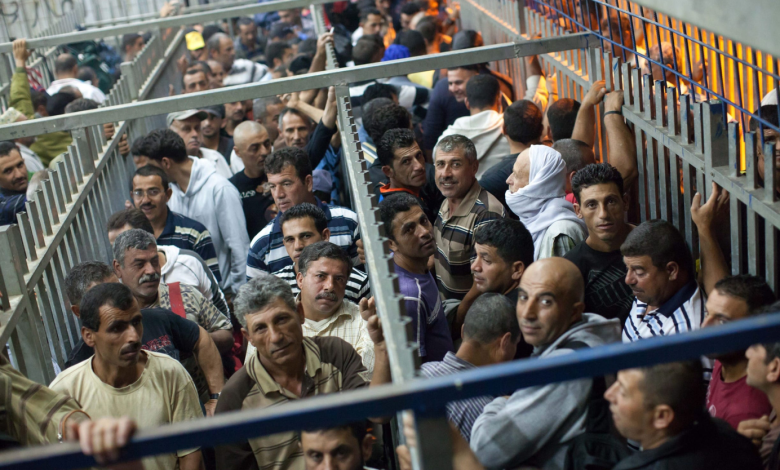
Palestinians in the West Bank face long hours of waiting at Israeli military checkpoints during their daily commute to work; this turns the journey between home and work into a journey of unknown duration and cost. Forced waiting at permanent and temporary (mobile) checkpoints makes travel prohibitively expensive and unpredictable, draining people’s time and doubling the costs of transport, labour and trade, as well as disrupting access to markets, services and production sites. Thus, the dispossession of time becomes a mechanism of economic impoverishment, undermining Palestinians’ ability to cope, work, and maintain their social and spatial ties.
This article aims to analyse the economic losses resulting from time wasted at checkpoints, tracing the extent of their impact from individuals to economic enterprises, the labour market and the local economy, whilst also addressing their social repercussions as an extension of colonial control over movement and the minutiae of daily life.
Firstly: Checkpoints and the Entrenchment of Colonial Control
Checkpoints entrench the Israeli occupation in everyday life by subjecting Palestinian movement and time to a precarious, selective and unpredictable system of control. This system is based on a monopoly over the power to open and close checkpoints, and on determining the conditions of passage and the duration of searches according to a unilateral will. Consequently, control stems from keeping the individual in a state of constant waiting and readiness; they are forced to reorganise their schedule, route, work and studies to accommodate the possibility of closures, delays or the appearance of a ‘pop-up’ checkpoint. Thus, the impact of the checkpoint extends beyond its physical location, becoming a constant spectre that guides every decision relating to travel and movement.
This system reshapes the geography within which Palestinians can actually live. The United Nations Office for the Coordination of Humanitarian Affairs documented 925 obstacles to movement in the West Bank by the end of 2025, representing a 43 per cent increase on the annual average recorded over the previous two decades. Around half of these obstacles hinder access between Palestinian towns and villages and the main roads, forcing residents to use longer, secondary routes. In the same context, the occupying forces have erected more than 120 new road gates in the space of a single year and have deployed an average of 15 mobile checkpoints per week. These restrictions have a direct impact on choices regarding work, study and housing, as individuals are forced to adapt these choices to minimise the exorbitant cost of crossing. As these responses accumulate, spheres of movement, work and social relations shrink, and the isolation of Palestinian communities within separate enclaves deepens. In this way, the checkpoints contribute to turning geographical fragmentation into a daily reality, weakening communication between Palestinian areas and reinforcing the trajectory of colonial control and de facto annexation of the land.
Secondly: The Impact of Time Lost at Checkpoints on the Palestinian Economy
Labour market: Checkpoints have a direct impact on the number of actual working hours and on the regularity with which workers reach their places of work. A recent study estimated the time lost due to checkpoints in the northern and central West Bank at approximately 191,146 working hours per day, at a cost of $764,600 per day and $16.8 million per month. This finding is consistent with a survey by the International Labour Organisation which showed that 51 per cent of workers in the West Bank who retained their jobs experienced a reduction in working hours, whilst 62.8 per cent saw their wages fall as a result of the tightening of lockdowns and movement restrictions during the war.
Goods and Transport Movement: Transport volumes in the northern and central West Bank fell by 51.7 per cent after October 2023, as a result of checkpoints, route changes and longer waiting times. The Nablus Governorate serves as an example of this, with the average journey time out of the governorate increasing by around 42 minutes, equivalent to 77.9 per cent of the original journey time. Furthermore, detours and waiting times have increased fuel consumption by the equivalent of $19,203 per day, or around $6 million per year. Added to this is the damage to vehicles and the rise in maintenance costs resulting from them being forced to travel longer distances and use alternative routes that largely lack adequate infrastructure.
These burdens are compounded by rising global energy prices driven by geopolitical tensions, disruptions to oil flows through the Straits of Hormuz and Bab al-Mandab, and the disruption to the Saudi East–West pipeline. The Palestinian market is also characterised by additional vulnerability stemming from its dependence on Israeli suppliers, the fact that fuel supplies are subject to Israeli commercial terms, and the link between payment settlements and clearance revenues, the transfer of which is controlled by the occupying power. The rise in the price of diesel by more than 40 per cent during April 2026 led to an increase in public transport fares of between 15 per cent and 25 per cent, and added further costs to transport, freight and distribution, thereby raising the cost of getting goods to market and increasing the inflation of their final prices.
Trade and Markets: Road blockades and unpredictable delivery times weaken the links between production centres and Palestinian markets. An OCHA report notes that 459 Israeli checkpoints have been designed to obstruct access by towns and villages to main roads. Consequently, the Palestinian market suffers from difficulties in the movement of goods between West Bank governorates, a narrowing of the geographical area within which businesses can market their products, restrictions on the movement of buyers, and the separation of central markets from their consumer base in surrounding villages and towns.
A field investigation has documented how a dairy factory in Nablus was forced to abandon its customers in Ramallah and Salfit due to rising transport costs and difficulties in meeting delivery deadlines, whilst two lorries designated for distribution were taken out of service as a result of falling demand and mobility restrictions, Furthermore, the detention of a milk consignment from this factory at an Israeli checkpoint for five hours resulted in the spoilage of around 10 tonnes, representing a loss of nearly 20,000 shekels ($6,000). In the city of Hebron, checkpoints and the closure of the city’s entrances prevented shoppers from towns across the governorate from reaching its markets. One trader estimated that commercial activity had fallen by around 80 per cent, leading to a slump in sales and a build-up of stock among traders.
Agriculture: The impact of barriers is linked to access to land at the times when landowners need to reach their land for the purposes of cultivation, harvesting and marketing. At least 20 per cent of recorded barriers hinder access to agricultural land, whilst 98 Palestinian communities across nine governorates in the West Bank are subject to prior coordination arrangements imposed by the occupation to access land near settlements, on average twice a year. Furthermore, access to land isolated behind the Wall is via some 62 gates, the majority of which remain closed throughout the year; during the 2025 olive harvest, 74 per cent of them were open for only a limited number of days. The limited access periods and delays in transporting crops lead to reduced production and income, and undermine farmers’ ability to continue farming their land.
Small Enterprises: A survey of enterprises conducted by the World Bank in collaboration with the Palestinian Central Bureau of Statistics in 2025 showed that around two-thirds of enterprises in the West Bank recorded a decline in sales, although more than 97 per cent of them remained in operation. A survey by the International Labour Organisation also reported that 65.3 per cent of West Bank enterprises had reduced their workforce. Checkpoints are one of the main causes of this decline, as they restrict access for workers and customers, delay the delivery of inputs and distribution, and increase transport and operating costs. Small businesses bear a heavier burden due to limited liquidity and their reduced ability to absorb the consequences and losses resulting from delays or the reorganisation of supply chains.
Macroeconomic Indicators: The effects of the checkpoints are reflected in macroeconomic indicators through reduced working hours and output, lower employment, income and demand, higher transport and distribution costs, and a reduction in businesses’ ability to invest, expand and trade between governorates. These effects are evident in an economy where the West Bank’s GDP in 2025 is 13 per cent lower than its 2023 level, whilst consumption falls by 12 per cent, and output in the construction, manufacturing and services sectors declines by 29 per cent, 21 per cent and 12 per cent respectively, before the West Bank economy records a further contraction of 8 per cent in the first quarter of 2026 compared with the previous quarter. Unemployment also reached 28.5 per cent in 2025, and purchasing power declined as a result of rising prices and falling wages against a backdrop of shrinking employment opportunities. Consequently, restrictions on time and movement translate into losses in output and labour productivity, leaving the Palestinian market fragmented into economic cantons with high production costs.
Thirdly: The Impact on Palestinian Families
The checkpoints go beyond restricting movement to serve the function of controlling Palestinian society and manipulating its geography within the framework of settler-colonialism. Control over routes and crossing times determines an individual’s ability to access work, education, medical treatment, land and family ties, thereby severing the bonds between towns and villages. As the costs of waiting and the difficulties of travel mount, individuals are forced to change where they live or work, or to reduce their ties to their land and places of residence, thereby gradually affecting population distribution and controlling their stability. Thus, the checkpoints serve to impose control over the territory and its inhabitants, fragment Palestinian society into isolated enclaves, and shape the geography to facilitate further settlement expansion and annexation.