The Palestinian Question in French Politics Ahead of the 2027 Election

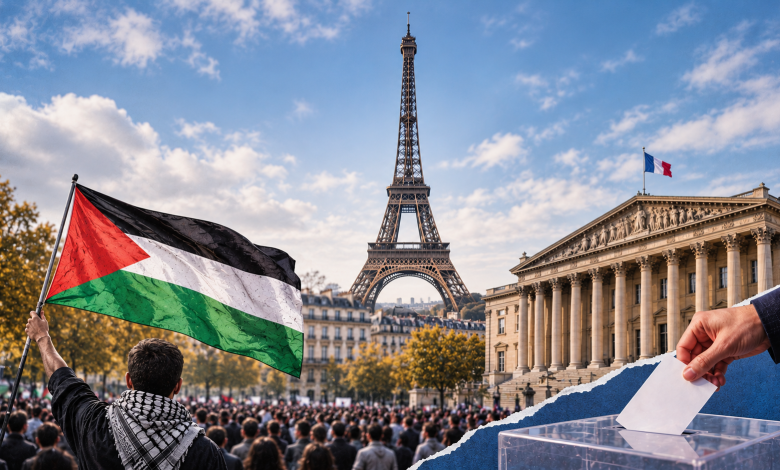
Central question: How have terminological disputes over the Palestinian question become entangled in the French left’s struggles over identity, legitimacy and alliances ahead of the 2027 presidential election?
As the 2027 presidential election approaches, the Palestinian question has become a significant source of division within the French left. The paradox is that left-wing parties broadly agree on fundamental principles: all supported the recognition of a Palestinian state before the 2024 European elections, a step France took in September 2025, and all call for pressure on Israel, though to different degrees. Yet their disagreements centre on political language: how to characterise Hamas, whether to call the war crimes in Gaza a genocide and how to respond to accusations of antisemitism. This paper examines how these disputes have become entangled in struggles over political identity, legitimacy and electoral alliances within the French left ahead of 2027, often drawing attention away from concrete measures to uphold Palestinian rights and end the occupation.
The French left is made up of four main forces. La France insoumise (LFI, France Unbowed), led by Jean-Luc Mélenchon, is the radical left; the Parti socialiste (PS, Socialist Party) and its ally Place publique (Public Square), led by Raphaël Glucksmann, form the social-democratic pole; Les Écologistes (the Ecologists) and the Parti communiste français (PCF, French Communist Party) complete the picture. In the 577-seat National Assembly, as of late October 2026, the La France insoumise–Nouveau Front populaire (LFI-NFP) group holds 70 seats, the Socialists and affiliated deputies 68, the Ecologist and Social group 38, and the Gauche démocrate et républicaine (GDR, Democratic and Republican Left) group, which brings together Communists and other left-wing deputies, 17. Together, they hold 193 seats, roughly a third of the chamber and more than the Rassemblement national’s 121, although their collective political influence depends on cooperation between groups of almost equal weight. In the 2022 presidential election, Mélenchon came third with 21.95%, narrowly missing the run-off.
The far right, by contrast, is united and dominant. An Ifop-Fiducial survey for LCI, Le Figaro and Sud Radio, conducted between 25 and 29 September 2026, placed Marine Le Pen of the Rassemblement national (RN, National Rally) first in every scenario tested, with 31% to 36% of first-round voting intentions. Mélenchon stood at 14% to 17%, Glucksmann at 9% to 13%, Marine Tondelier of the Ecologists at 3% to 6%, and Fabien Roussel of the PCF at 2% to 3.5%.
On the left, Mélenchon’s position rests on a distinctive electorate. LFI’s electoral appeal is particularly pronounced among younger voters, a constituency central to Mélenchon’s strategy. According to an Ipsos-BVA survey published in September 2026, he attracted 41% of voting intentions among voters under 25 in one presidential scenario. The Palestinian question has also become part of LFI’s engagement with this generation, notably through Franco-Palestinian activist Rima Hassan, whose inclusion on the party’s list for the 2024 European elections made Palestinian solidarity a prominent campaign issue. Her support for the pro-Palestinian student mobilisation at Sciences Po Paris in April 2024 further illustrated the connection between LFI and youth activism around Gaza. Critics interpreted the party’s emphasis on Palestine as an attempt to mobilise younger and previously abstaining voters ahead of the European elections.
The Palestinian question also played a significant role among Muslim voters in the 2024 European elections. According to an Ifop survey for La Croix, 62% of Muslim voters who participated supported LFI, while 74% voted for left-wing lists. The Palestinian-Israeli conflict was an important factor in the vote of 83% of Muslim respondents, compared with 25% of voters overall. However, substantial abstention and differences in age, social class and political preferences caution against treating Muslim voters as a homogeneous electorate or attributing their electoral choices solely to Palestine.
7 October and the collapse of NUPES
In October 2023, the main left-wing parties were united in the Nouvelle Union populaire écologique et sociale (NUPES, New Ecological and Social People’s Union), an alliance already weakened by disputes over leadership, economic priorities and political strategy. The Hamas attack of 7 October turned these tensions into a rupture. In its initial statement, LFI described the attack as an armed offensive by Palestinian forces led by Hamas, placing it within the context of Israeli occupation. The statement deplored Israeli and Palestinian deaths but did not explicitly condemn Hamas’s attacks against civilians or characterise them as terrorist. Roussel called LFI’s refusal a “fundamental rupture”, and on 17 October Socialist leader Olivier Faure announced a moratorium on the PS’s participation in NUPES, accelerating the break-up of an already fragile alliance. Other left-wing parties were explicit from the outset. Glucksmann described Hamas’s attack as terrorist in a Le Monde op-ed of 25 October 2023, while the Ecologists’ March 2024 platform described the 7 October attacks as terrorist and denounced the destruction of Gaza.
LFI subsequently modified its language. On 12 October 2023, Mélenchon described Hamas’s actions as war crimes, arguing that this characterisation provided a legal basis for accountability. By July 2024, he explicitly acknowledged that attacking civilians at a music festival constituted a terrorist act, while maintaining his refusal to classify Hamas itself as a terrorist organisation. The distinction became clearer in LFI’s statement a year after the attacks. Hamas remains designated as a terrorist organisation under the European Union’s sanctions framework, as reaffirmed in the Council’s July 2026 review of its terrorist list. The split reaches voters too: an Ipsos survey for the Representative Council of French Jewish Institutions (CRIF), conducted in September 2024 among 1,000 adults, found that 60% of LFI sympathisers considered Hamas a terrorist organisation, compared with 83% of Socialist sympathisers and 77% of respondents overall.
Despite this rupture, LFI, the Socialists, the Ecologists and the Communists reunited under the Nouveau Front populaire (NFP, New Popular Front) ahead of the June 2024 snap legislative elections. However, this unity proved short-lived: the urgency of confronting the far right temporarily outweighed their disagreements, which soon resurfaced as the parties positioned themselves for the 2027 presidential election.
The dispute over Hamas reflects competing interpretations of resistance, international law and France’s political history. LFI deputy Danièle Obono described Hamas as a “mouvement de résistance” against occupation on Sud Radio on 17 October 2023, while Socialist group leader Boris Vallaud argued in the National Assembly that “terrorism liberates no one; it oppresses”. LFI instead emphasised international humanitarian law: Mathilde Panot, president of the (LFI) parliamentary group in the French National Assembly, condemned Hamas’s “appalling war crimes” while characterising the conflict as a “colonial war”. This choice rests on the absence of a universal definition of terrorism in international law, a notion that, as the international law professor Olivier Corten argues, “adds only a little from a legal perspective”. Panot also invoked Jacques Chirac and Dominique de Villepin, both figures of the French right, quoting de Villepin’s description of Gaza as “an open-air prison” and accusing the government of having abandoned “France’s historic position”. In doing so, she drew on a Gaullist diplomatic tradition rooted in Charles de Gaulle’s reorientation of French policy towards the Arab world after 1967. Chirac later defended Palestinian self-determination and statehood, notably in his speech in Ramallah in October 1996.
The genocide debate and divisions within the Socialist left
The debate over whether to characterise Israeli war crimes in Gaza as genocide has exposed divisions within the social-democratic camp. LFI has used the term genocide since late 2023. In an extensive interview with Orient XXI, Jean-Luc Mélenchon described Israel’s military offensive in Gaza as “not self-defence, but genocide”, while emphasising international law as the basis for addressing the conflict. The PCF and the Ecologists subsequently also adopted the term.
Yet the term remained contested among Socialists. During the September and October 2026 presidential primary debates, Faure and Ségolène Royal defended its use, while Raphaël Glucksmann and Socialist deputy Jérôme Guedj rejected it. On France 2, Faure invoked the 1948 Genocide Convention, while Glucksmann argued that war crimes and crimes against humanity were the appropriate legal characterisations.
Historically, French Socialists maintained close ties with Israel, particularly through the Israeli Labour Party. In October 1976, François Mitterrand, leader of the French Socialist Party and later President of France (1981–1995), acknowledged these special relations during a visit to Israel. Although Socialist positions subsequently evolved towards support for Palestinian statehood, as Mitterrand himself declared before the Knesset in March 1982, the current disagreement reveals that a common position on recognition does not necessarily translate into a shared interpretation of Israeli war crimes in Gaza.
On 11 October 2026, Glucksmann won the social-democratic primary with approximately 66% of the vote, consolidating a candidacy opposed to cooperation with Mélenchon’s movement. The result did not settle the disagreement over genocide.
Conclusion
The Palestinian question has long reflected divisions within French politics, but the political fault lines have shifted. Historically, French Socialists maintained closer ties with Israel, while Communists and much of the radical left were more closely associated with the Palestinian cause, as Denis Sieffert shows in his book, Israel–Palestine: A French Passion (2004). At the state level, Charles de Gaulle’s diplomatic reorientation after 1967 established a more independent French approach towards Israel and the Arab world, later associated with the recognition of Palestinian national rights. Today, LFI invokes this Gaullist diplomatic heritage, while the most visible divisions within the left increasingly concern their relationship with the other parties.
These developments illustrate how Palestine has become a means through which the French left expresses and negotiates its internal political divisions. Disputes over Hamas, genocide and antisemitism have acquired significance beyond the Palestinian cause itself, becoming intertwined with questions of political legitimacy, electoral competition and alliances ahead of 2027. Yet the prominence of Palestine in French electoral debates does not necessarily translate into concrete measures addressing Palestinian rights. Recognition of Palestinian statehood does not, in itself, end the occupation, establish sovereignty on the ground or halt settlement expansion in the occupied West Bank. As long as the left’s debates centre on vocabulary rather than means, its solidarity with Palestinians is unlikely to translate into concrete changes in France’s policy.