Why Did Netanyahu Thank Uganda at the United Nations?

General Muhoozi Kainerugaba, commander of the Uganda People’s Defence Forces and son of President Yoweri Museveni, has become one of the loudest and most unconventional voices on the African scene. On 26 March 2026, as the US–Israeli war on Iran broke out, he wrote on X: “Any talk of destroying or defeating Israel will bring us into the war… on Israel’s side!” He justified his position by saying that “Uganda stands with Israel because we are Christians,” and that Israel “stood with us when we were nothing in the 1980s and 1990s.”
It did not stop at those statements. On 10 April he announced that he was ready to deploy 100,000 Ugandan soldiers to Israel “under my command… to protect the Holy Land, the land of our Lord Christ,” and added in a later post that he had “some 500,000 young men hungry for war… all they want is money, and they will eat Tehran for free.”[1] In the same vein, he escalated his rhetoric against Türkiye, demanding $1 billion as a security dividend for Uganda’s role in Somalia, as well as the most beautiful woman in Türkiye as his wife, and threatening to close the Turkish embassy and ban Turkish Airlines flights if his demands were not met. Then in September he returned to announce the suspension of all forms of defence and military cooperation with Ankara.
These positions were reinforced by two prominent symbolic and political steps. On 1 August 2026, marking the fiftieth anniversary of the Entebbe operation, Kainerugaba unveiled a monument to Yonatan “Yoni” Netanyahu in front of the old Entebbe airport terminal. He described Idi Amin’s government as “a brutal dictatorship that did not represent the Ugandan people,” stressing that the monument was “more than stone and bronze… and carries a meaning that goes beyond honouring one brave individual.” Just five days later, on 6 August, the Ugandan parliament approved the deployment of troops to the Gaza Strip as part of the International Stabilization Force.
It was in precisely this climate that Benjamin Netanyahu stood before the 81st session of the UN General Assembly on 24 September 2026, in a nearly empty hall after the delegations of some seventy countries had walked out or stayed away from the session in protest at Israeli policies in Gaza and the wider Middle East.
In this context, Netanyahu devoted part of his speech to the story of his older brother, Yonatan “Yoni” Netanyahu, who led the assault force in the hostage-rescue operation at Uganda’s Entebbe airport on 4 July 1976 and was the only Israeli soldier killed in it. “I would like to thank Uganda again for recently erecting a statue of Yoni at the place where he fell,” Netanyahu said. He then recalled what he said was his brother’s reply to him five days before the outbreak of the 1967 war — “We will win, because we have no other choice” — and turned the phrase into a central refrain of the speech, repeating it at several points. Uganda’s delegation was among the few that stayed in the hall to listen to Netanyahu’s speech.
In this context, this article aims to unpack the dimensions and motives behind Israel’s invocation of Uganda in Benjamin Netanyahu’s address to the UN General Assembly. It does so by tracing the roots and shifting trajectory of relations between Tel Aviv and Kampala, then analysing the complex intersection of security, political and symbolic calculations that make Kampala an Israeli anchor point in East Africa, and finally examining the challenges and constraining structures that limit the potential of this Israeli bet.
Roots of the Relationship Between Tel Aviv and Kampala
Israeli–Ugandan relations have gone through sharp shifts over the past decades. Israel trained and armed the Ugandan army after independence in 1962 and built close ties with Idi Amin after his 1971 coup, before Amin cut relations with Tel Aviv in March 1972 and turned towards rapprochement with Libya.
According to the Israeli diplomat Arye Oded, Muammar Gaddafi offered Amin generous financial aid in return for breaking off relations with Israel and expelling Israelis from Uganda. A US State Department document confirms that Libya, in return, gave Amin military support, including the dispatch of some 400 troops and quantities of military equipment, in the context of Uganda’s pledge to expel the Israelis and adopt a position supportive of the Palestinian cause. Israeli–Ugandan relations reached their lowest point with the Entebbe operation in 1976, and diplomatic relations between the two countries were restored only in 1994, under Yoweri Museveni.
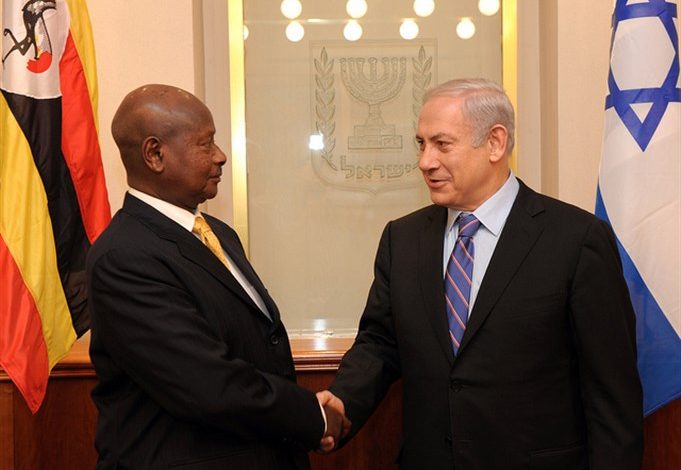
Over the past decade, Uganda has served as Netanyahu’s gateway to Africa. In July 2016 he began there the first African tour by an Israeli prime minister in decades, marking the fortieth anniversary of the Entebbe operation, and held a summit there with several East African leaders.
In February 2020, Museveni hosted an unprecedented meeting at his residence in Entebbe between Netanyahu and Abdel Fattah al-Burhan, chairman of Sudan’s Sovereignty Council, which later paved the way for Sudan to join the normalisation track. This trajectory culminated in the signing of a memorandum of understanding on defence cooperation in 2022, to train the Ugandan army in Israeli combat doctrines and counter-insurgency and to modernise its capabilities against the Allied Democratic Forces (ADF), active in Uganda and Congo, which an analysis published in the Times of Israel links to Iranian networks of influence.
Why Is Israel Praising Uganda?
Netanyahu’s praise for Uganda from the UN podium reveals an intersection of complex Israeli calculations that go beyond mere symbolic gratitude. The reference came at the height of the mass walkout from the hall, to which Netanyahu responded by calling those who left “moral cowards.” He thereby sought to offer a counter-narrative to the image of an isolated Israel: an African country that was once an ally of the hijackers now honours, on its own soil, the commander of the hostage-rescue operation. The message gains weight given the participation of at least 28 African states in the walkout or absence, which makes Uganda a model that Israel wants to promote against a broad African bloc critical of it. This brings to mind the expulsion of the Israeli delegation from the African Union summit in February 2023.
This external investment cannot be separated from calculations of electoral mobilisation inside Israel. Invoking Yoni’s story goes beyond its emotional dimension to form part of a political narrative that links the battles of 1967, Entebbe, the events of 7 October 2023 and the war on Iran as episodes in a single battle for “survival.” The aim is to cement Netanyahu’s image as a historic leader fighting a war on seven fronts on the eve of the Knesset election scheduled for 27 October 2026.
In addition, the Israeli commendation coincided with progress on Uganda’s path towards taking part in the “International Stabilization Force” proposed by the “Board of Peace” chaired by US President Donald Trump. Estimates point to plans for a border base accommodating up to 1,200 Ugandan soldiers, within a force meant to comprise 20,000 troops under the command of US General Jasper Jeffers. This does not necessarily mean that Israel accepts the force itself; what most likely matters to Israel is the identity of the contributors, should the force come into being, that it include countries Israel is not uneasy about, rather than countries it regards as hostile, such as Türkiye. Reinforcing this, military officials from Uganda and Burundi visited Israel in August 2026 to discuss the deployment. Kainerugaba summed up the position: “We Ugandans accepted the Gaza mission because everyone else was running away from it.”
This bet on the ground rests on deeper security and intelligence foundations. Leaked documents published by Drop Site News reveal that the relationship goes beyond symbolism to a long-running Elbit Systems programme supplying the Ugandan army with Hermes drones. The programme includes a $52.1 million contract in March 2024 for four Hermes 900 aircraft fitted with wide-area surveillance systems, along with SkyStriker loitering munitions and electronic intelligence systems. The beneficiaries of these systems are military intelligence and the Special Forces Command, which is responsible for protecting the Museveni family and was once led by Kainerugaba himself. This means that Israel has tied its partnership to the ruling establishment and to the likely heir, which explains the latter’s enthusiasm for it.
This security positioning dovetails with a revival of Israel’s “periphery doctrine,” aimed at building a belt of partners to the south against Iranian influence in the Red Sea and the Bab al-Mandab. This presence also complements other steps, most notably Israel’s recognition of Somaliland on 26 December 2025, which gave it a diplomatic and political foothold in the Horn of Africa. It is further reinforced by Uganda’s escalation against Ankara, which peaked when the Ugandan army announced on 19 September 2026 the suspension of all forms of defence and military cooperation with Türkiye — just five days before the Netanyahu speech in which he attacked Turkish President Recep Tayyip Erdoğan by name. In this context, Uganda, with its extensive military experience of regional deployments in Somalia, the Democratic Republic of the Congo and South Sudan, can be seen as a potential anchor point in a security network that is taking shape.
Israel’s relations with Uganda also extend to development, particularly in agriculture. In 2005, the Agrostudies International Training Center began working with Uganda. It is an Israeli programme of hands-on agricultural training for university students from developing countries, especially in Africa, Southeast Asia and South America, under the supervision of Israel’s foreign and agriculture ministries. Through it, Ugandan students take part in practical training on Israeli farms in irrigation techniques and protected agriculture. Notably, Uganda’s exports to Israel reached about $25 million in 2024. MASHAV, Israel’s development agency, also invested around $45.5 million between 2009 and 2021 in water, health and agriculture projects in Uganda and a number of other African countries.
The Limits of Israel’s Bet on Uganda
Despite the symbolic and strategic gains Israel seeks from its partnership with Kampala, the bet on Uganda faces a number of constraints that may limit its durability and its ability to achieve its aims. The most important are:
1. The erosion of Uganda’s image of neutrality in Gaza:
Uganda’s participation in the International Stabilization Force faces a credibility dilemma: a force that is supposed to enjoy the trust of all parties would be led by an army whose commander has openly declared his partisanship for one side. In this context, Asuman Kiyingi, Uganda’s former Minister of State for Foreign Affairs, warned that honouring the commander of the Israeli force that carried out the 1976 Entebbe operation, and violated Ugandan sovereignty in doing so, sends a political message that could make it difficult for Palestinians, Arab states and members of the Organisation of Islamic Cooperation to see Uganda as a neutral guarantor.
Ugandan MP Hassan Kirumira raised the same question in parliament, calling on the government to clarify which side Ugandan forces would be fighting alongside in Gaza, and pointing out that his country’s membership of the Organisation of Islamic Cooperation, which includes Palestine, could create diplomatic problems if the nature of the mission was not made clear.
2. The relationship’s dependence on Kainerugaba personally and on his volatility:
Uganda’s accelerating moves towards Israel come within Uganda’s domestic political context. Kainerugaba is widely seen as a likely successor to his father, who won a seventh term at the start of this year. With his announcement that he will run for the presidency in 2031, he appears to be seeking to strengthen his position by building a network of external support, including in Washington, and the relationship with Israel is, naturally, one of the most important routes to American support.
General Kainerugaba’s growing role, however, raises questions about the stability of the partnerships tied to him. In April 2026 he demanded $1 billion from Türkiye as a security dividend for Uganda’s role in Somalia, before escalating his dispute with Ankara. In June he announced the cancellation of a $3 billion contract with the Turkish company Yapı Merkezi to build a railway line. These events reveal a confrontational approach that could unsettle Kampala’s foreign-policy calculations, though they are not sufficient on their own to judge the direction of its official policy. The stability of the Ugandan–Israeli partnership therefore depends not only on the general’s positions but also on the balance of power within Uganda and on how its future political transition is managed.
3. The gap between political rapprochement and stalled implementation on the ground:
Political rapprochement between Kampala and Tel Aviv does not guarantee that pledges will turn into a workable security partnership, as developments around the International Stabilization Force in Gaza show. On 20 August 2026, the office of Prime Minister Benjamin Netanyahu denied that the political echelon had approved the force’s entry into the Strip, stressing that reconstruction would not begin before Hamas was fully disarmed. The broader picture, roughly a year after US President Donald Trump’s plan was launched, shows continued stalling: Monte Carlo Doualiya reported on 6 October 2026 that the force had still not been formed, despite the appointment of an American commander and pledges by six countries, including Uganda, to contribute personnel. Disputes over Hamas’s disarmament and Israeli withdrawal also continued to block the move to the later phases of the plan, while the Palestinian technocratic committee charged with administering the Strip had not entered Gaza. Uganda’s participation thus remains a pledge that has not yet become an actual deployment, and whether it can be carried out depends on resolving disputes that go beyond the bilateral relationship between Kampala and Tel Aviv.
Conclusion
This conspicuous Israeli bet on Kampala remains hemmed in by structural limits and challenges. Turning the defence and symbolic partnership into roles on the ground, such as participation in the International Stabilization Force in Gaza, runs up against the erosion of Kampala’s supposed neutrality in the eyes of Arab and Palestinian parties, Kainerugaba’s political volatility, and the complex stalling of the patchwork plans in Gaza itself. The Ugandan pattern thus shows once again that penetrating the African periphery may give Israel a functional safety net and tactical spheres of influence for dealing with its crises of isolation, but it remains unable to make up for the structural decline in its international standing, or to address the real roots of its strategic and moral crisis in the region.
On the other hand, it shows how assiduously Israel works to strengthen its networks of influence and external relations, to invest in right-wing figures at the international level, and to deploy an array of political, economic and security tools. Although Uganda remains a marginal case in the international system, its importance lies in its being a model of the mechanisms by which relationships and partnerships are built and put to use.
[1] This rhetoric finds an enormous echo in a country where Christians make up 82% of the population, and where Pentecostal pastors such as Pastor Robert Kayanja of the Miracle Centre Cathedral lead huge popular gatherings to press the government to vote consistently in Israel’s favour at the United Nations and the African Union.
By Ramez Salah · Vision Center for Political Development · 27 October 2026 · Original Arabic article