American Evangelicals After the Genocide: Cracks in the Wall of Absolute Loyalty to Israel
Series: America and Israel After 7 October and the Genocide (5)

White evangelicals have been one of the most important social pillars of the US–Israeli relationship. Their support for Israel has been bound up with an interweaving of religious frames of reference and conservative political identities, and has become part of Israel’s presence within broad sections of the American right. As debate grows over the nature of this support and its justifications, it becomes important to examine how stable Israel’s standing within this base is, and whether current shifts point to changes in the positions that have governed the relationship for decades.
This is the fifth article in a series tracking indicators of change in the pillars of the US–Israeli relationship. The four previous papers dealt with trends in American public opinion, shifting political and partisan positions in Congress and in American elections, and the Israel lobby. This paper focuses on the white evangelical base as one of the social components that shape American support for Israel.
White Evangelicals: From Religious Commitment to Political Partnership
White evangelical Christians are one of the most important social bases of support for Israel in the United States, a position they acquired through a historical path that combined religious belief and political action. Evangelical support for Israel was not a product of developments in contemporary American politics; it predates the establishment of the “State of Israel” itself, having been tied to religious roots in “Christian Zionism.” This outlook spread through evangelical circles with the rise of dispensationalist theology in the nineteenth century, and linked the return of the Jews to Palestine with the fulfilment of biblical prophecy. The current rests on a literal reading of scripture holding that God gave the Land of Israel to the Jewish people, and that their return to it and the establishment of their state are part of the biblical prophecies tied to the history of salvation and the return of Christ. This outlook made Israel a matter of religious standing for broad sections of evangelicals before it became an issue of American foreign policy. It helped entrench Israel’s place in the religious consciousness of broad sections of American evangelicals, gradually turning into a basis for political mobilisation, with Israel becoming one of the central issues in the movement’s political discourse.
With the rise of the Christian right in the United States from the 1970s, these religious convictions in favour of Israel moved into the political arena. The Reverend Jerry Falwell, together with the Moral Majority, which he founded in 1979, played a prominent role in merging religious issues with political action on the conservative right, and Israel became one of the central issues in this current’s discourse. During the 1980s, support for Israel became increasingly tied to electoral mobilisation within the Republican Party, in parallel with the growing political presence of white evangelicals. By the turn of the millennium, white evangelicals made up about 26% of American adults and accounted for nearly 40% of the votes won by President George W. Bush in the 2004 election. This gave their positions on Israel growing weight in American political life and made them one of the most important electoral bases supporting the US–Israeli relationship.
The development of this relationship was not confined to the American side. From the late 1970s, Israeli governments began to recognise its importance and to treat evangelical leaders as political partners inside the United States. This became evident when Menachem Begin became prime minister in 1977 and established direct relations with several leading figures of the evangelical right, foremost among them the Reverend Jerry Falwell. In 1980, Begin received Falwell in Jerusalem, and the following year awarded him the Jabotinsky Award in recognition of his support for Israel, one of the first instances of official Israeli honours for a non-Jewish American religious leader. Sources also report that Begin called Falwell after the bombing of the Iraqi nuclear reactor in 1981 and asked for his help in explaining Israel’s position to the American public, recognising his ability to influence the evangelical base and conservative media. These events reflect the relationship’s shift from mere religious sympathy to a direct political channel that Israel used to influence the American domestic environment.
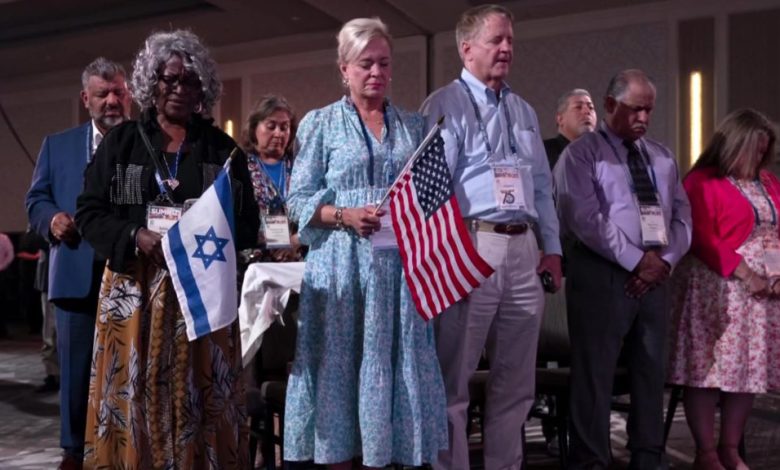
The relationship expanded in the following decades, moving from contact with particular evangelical leaders to a more institutional partnership between Israel and American evangelical organisations. This was embodied most clearly when Pastor John Hagee founded Christians United for Israel (CUFI) in 2006, which describes itself as the largest pro-Israel organisation in the United States and says its membership exceeded ten million in 2022. Since its founding, the organisation has become one of the main channels of political communication between the conservative evangelical base and Israel: it holds an annual conference in Washington attended by members of Congress and American and Israeli officials, with the aim of raising political money and mobilising support for pro-Israel policies. Benjamin Netanyahu has also been careful to maintain a direct relationship with this base, addressing the organisation’s conferences or sending it messages, and has described them as among “Israel’s best friends” — an expression reflecting Israel’s awareness of this base’s standing and political role in the United States. The white evangelical base thus became more than a religious group sympathetic to Israel: it became one of the social and political pillars on which the relationship rested, as a political and social network able to influence the American public sphere.
Cracks in the Certainties: Christian Zionism Facing Doubt on the American Right
In June 2025, the conservative broadcaster Tucker Carlson confronted Republican Senator Ted Cruz over the biblical basis of his support for Israel. Cruz said he had learned in Bible study that “those who bless Israel will be blessed, and those who curse Israel will be cursed,” adding that Christians are “biblically commanded to support Israel.” Carlson questioned this reasoning, asked him where the phrase appears in the Bible and what “Israel” means in the text, and then pressed him on whether the state led by Benjamin Netanyahu is the same one the Book of Genesis speaks of. Although Cruz answered yes, he did not cite his scriptural source.
The significance of the exchange lies in Carlson’s questioning of the scriptural authority relied on by one of the most prominent Republican defenders of Israel, and his demand for an explanation of the basis for linking the religious text to the modern state. The dispute thus moved from debating the usefulness of the alliance with Israel to questioning the religious interpretation offered to justify supporting it, and whether such support should be considered a duty imposed by Christian faith.
Carlson extended his questioning to the territorial consequences of this interpretation in an interview with Mike Huckabee, the US ambassador to Israel, in February 2026. The conversation turned to the biblical promise of the land stretching from the Nile to the Euphrates, and Carlson asked Huckabee whether it gives Israel a religious right to the whole region. Huckabee replied: “It would be fine if they took it all.” Carlson then pressed him on the boundaries of the land covered by this right, pointing to the changes in Israel’s borders and to the territories it occupied in 1967. The significance of the exchange lies in the shift from the religious basis of support for Israel to questioning its consequences — namely, the possibility of using biblical interpretation to justify territorial claims beyond the borders of the existing state.
In an interview with The New York Times in May 2026, Carlson said he “shouldn’t have” described Christian Zionism as a “brain virus,” while maintaining his objection to its substance. “Christians can never support the killing of innocents,” he said, adding: “Find the place where Jesus says, ‘These people are annoying, kill them all.’ It’s not there. So where are you getting this?” He also said he wanted Christians to stop supporting Israel in the way they do, and demanded an explanation of the basis on which supporting the Israeli government is considered a religious duty. His remarks reveal his rejection of turning a religious interpretation into a binding political obligation, and his insistence on subjecting that interpretation to scrutiny.
In the same vein of questioning the religious basis for supporting Israel on the American right, Republican Representative Marjorie Taylor Greene said in an interview with POLITICO in December 2025 that a decades-long propaganda campaign had convinced American Christians and politicians that there was a country they had to serve. She based her position on her reading of the Bible, saying: “The secular Israeli government is not the Israel of the Bible.” The statement reveals an objection to equating the modern Israeli state with biblical Israel, and to turning that equation into a religious obligation that steers American political positions.
On 9 February 2026, this dispute surfaced within the Religious Liberty Commission established by the Donald Trump administration, during a session devoted to antisemitism in the United States. In an exchange with participants, Carrie Prejean Boller, a commission member and conservative Catholic activist, objected to equating opposition to Zionism with antisemitism, saying: “I am Catholic, and Catholics do not embrace Zionism,” and then asking: “So does that mean all Catholics are antisemitic?” She also said she saw in the modern Israeli state no significance relating to the fulfilment of biblical prophecy. On 11 February, Dan Patrick, the commission’s chair and lieutenant governor of Texas, announced her removal from it, justifying the decision on the grounds that her interventions had turned the session into a platform for her personal and political agenda. This showed the dispute over the religious basis for supporting Israel moving inside an official American body.
These events therefore reveal a dispute that goes beyond objecting to Israeli government policies to questioning the religious justifications that give support for Israel the character of a Christian obligation. They reopen a question that has long held an entrenched place among sections of the American Christian right, which could open the door to this questioning widening and spreading — especially given the range of positions held by those voicing these views, across the media, politics, and religious and official institutions.
The Evangelical Base and Israel: Continued Support and the Beginnings of Differentiation
Despite the growth of negative attitudes toward Israel in American public opinion since the outbreak of the Gaza war, white evangelical Protestants have remained among the American religious groups most supportive of it. In a Pew Research Center survey conducted in 2024, 74% of them said Israel had valid reasons for fighting Hamas, and 61% considered the way it was conducting the war acceptable, including those who saw it as somewhat or completely acceptable. A Pew survey conducted in 2026 showed this tendency continuing: 74% of white evangelical Protestants expressed a favourable view of the Israeli people, against 57% for the Israeli government. These results point to continuing support for Israel within this group, with a clear distinction between views of Israeli society and views of its government — an important difference when assessing the nature of this support and how far it extends to the government’s policies and leadership.
The most notable indicator of change, however, appears not in the overall level of support but in changes within the base itself. Although Israel retains its central place within the white evangelical base, some indicators point to internal changes in the structure and cohesion of this base, especially along generational lines. A survey conducted in 2021 showed that younger evangelicals (aged 18–29) had become less attached to the traditional pro-Israel position than older generations: only 33.6% said they sided with Israel, while the share who said they sided with the Palestinians rose to 24.3%. This was a major shift compared with 2018, when 69% of young evangelicals supported Israel and only 5.6% sided with the Palestinians. Although the different sample sizes call for caution in making a direct comparison, the results indicate that the generational divergence in attitudes toward the conflict was apparent years before the Gaza war, and that traditional support for Israel was not uniform across generations within this religious group. What is striking in all of these figures is that they do not measure an attitude toward a particular Israeli government; rather, they point to a change in Israel’s place within the younger evangelical generation’s view of the conflict itself.
Pew data also point to this generational gap in its 2026 survey. While white evangelicals remained the American religious group most positive toward Israel, at 65%, the report revealed clear age differences within the conservative camp itself: Republicans over 50 had more confidence in Israel and its leadership than younger Republicans. For example, 58% of older Republicans expressed confidence in the Israeli prime minister’s handling of affairs, compared with only 30% of Republicans under 50 — which means that generational shifts will not spare even the political environments that have historically been most supportive of Israel.
These indicators derive their importance from the place that support for Israel has occupied within a religious and political system formed over decades, and from the role white evangelicals have played in entrenching that support in American politics. Continued high support coexists with divergent attitudes toward the Israeli government and the conflict, with generational divergences, and with differences emerging in the wider Republican base, as the first and second papers showed. Internal differentiation, even with support remaining high, therefore carries strategic significance: one of the most stable pillars of the relationship faces generational shifts that may affect its ability to play the same role in future as a unified political and social base supporting Israel within the United States, without this yet meaning a comprehensive decline in evangelical support for Israel or the formation of a unified alternative position.
Conclusion
The preceding indicators gain significance from the fact that they are reflected in Israeli moves aimed at preserving evangelical support and strengthening the presence of pro-Israel messaging in the United States. In October 2025, Pastor Robert Stearns, founder of Eagles’ Wings, warned that evangelical friendship with Israel could no longer be taken for granted, and called on the Israeli government to allocate resources, budgets and programmes to strengthen its ties with the Christian community. In the same month, reports revealed that the Israeli Foreign Ministry had hired three American public relations firms to improve Israel’s image. One of these engagements included Show Faith by Works, a $3.2 million digital campaign targeting churches and evangelical audiences that seeks to build positive associations with Israel.
In December 2025, Israel hosted some one thousand American evangelical pastors and leaders on a six-day trip under the banner of the Friends of Zion Ambassador Summit. According to a report published by The Washington Post in January 2026, the Israeli Foreign Ministry helped fund the trip, which came as part of its organisers’ efforts to counter what they described as declining support for Israel among sections of young evangelicals, amid growing criticism of Israel from influential figures in American conservative media. The report conveyed the concern of Israeli officials and American evangelical leaders that the relationship was becoming less firmly rooted, and noted that Prime Minister Benjamin Netanyahu and other Israeli officials met some forty American evangelical leaders while Netanyahu was in Florida in December 2025.
These events therefore indicate that shifts within the evangelical base have become a matter of concern in Israeli calculations, alongside the changes affecting the political and partisan environments and bases that support Israel and sustain the US–Israeli relationship. Their significance lies in an Israeli awareness that the durability of one of its traditional sources of support may be declining. What these developments reveal, then, are indicators of change within the support base itself, which should be read as part of the broader trajectory of shifts in the pillars of the US–Israeli relationship, without assuming that this base is collapsing, or declining to the same degree across all generations and currents.
By Iman Badaawi · Vision Center for Political Development · 27 October 2026 · Original Arabic article