The “Al-Karameh” Bridge: The Keys to the West Bank’s Gateway to the World Are in Shlomo’s Hands

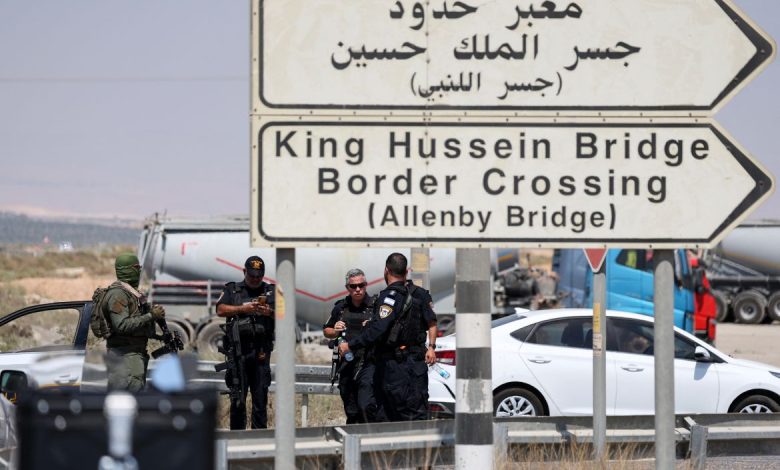
“The Bridge”— known as the Karameh Crossing, the King Hussein Bridge, or the Allenby Crossing, its names varying depending on the perspective and what it symbolizes, is the only lifeline connecting the residents of the West Bank to the outside world. This has made it one of the most consequential instruments of Israeli control over Palestinian life. The crossing has long been marked by crises and Israeli restrictions that have turned it into a tool of control and collective punishment against the Palestinians of the West Bank.
Palestinians grew used to calling it “the Bridge” because it really was a bridge once, when the Jordan River was truly a river, before the occupation authorities drained it. Little remains of the river now beyond its name and a small stream of water that serves as a reminder of the occupation’s environmental crimes. The word “bridge,” meanwhile, describes an arrangement as deceptive as the name itself, for it is made up of three crossings. The first is the Palestinian Authority station, which is in fact located in Jericho, not on the border with Jordan. The second is the Israeli crossing, which is the actual border gate and where it is decided who travels and who is barred. The third is the Jordanian crossing, the West Bank population’s gateway to the world. Across these three stations lie details and stories, waiting, crises, closures, and much more besides.
Although the crossing crisis is not new, it worsened to an unprecedented degree after 7 October 2023, turning from a problem of congestion and management into a means of collective punishment and abuse whose effects have fallen on hundreds of thousands of travellers each year. This article sheds light on what is known locally as “the Bridge crisis,” tracing its development and formation, its escalation after 7 October, and the effects and consequences that have followed from it.
A History of Colonial Control and Permanent Crises
Within the framework of the Oslo Accords, PLO Chairman Yasser Arafat envisioned and aspired for Palestinians to control the Jericho and Rafah crossings, regarding control over border crossings as a defining feature of Palestinian statehood. Israel, by contrast, insisted that these crossings were integral to its security. Ultimately, Israel prevailed. The Authority’s presence was reduced to a nominal role at what Palestinians call the “Jericho Rest Station” (the Karameh Crossing), which amounts to no more than a station for sorting travellers’ papers and luggage. The Authority has no stamp of its own on the Palestinian passport issued in its name; it confines itself to counting the number of people departing and arriving.
Under the Oslo II Accord, signed by the Palestinian Authority and Israel on 28 September 1995, Israel retained security responsibility for the entire crossings area (Rafah and Allenby), and the agreement stipulated that an Israeli director-general would be responsible for running the terminal and its security. The Palestinian role, by contrast, was confined to managing the Palestinian wing within these arrangements. More importantly, the text of the agreement does not merely speak of “control” in general terms; it specifies it at three distinct levels: security, management of the terminal, and exclusive management of the Israeli wing. Within this agreement, Israel arranged every detail that tightened its grip, including the crossing’s operating schedule, the number of working days and hours, religious holidays, and so on.
Accordingly, the movement of Palestinians from the West Bank to Jordan was made subject to prior coordination, and passage through Karameh/Allenby became part of a wider system of permits and coordination. This shows that reaching the crossing does not necessarily mean being free to cross. The Israeli occupation thereby secured exclusive control over the Karameh Crossing, the only border outlet for West Bank residents towards Jordan, which is crossed annually by around 1.6 million travellers, an average of roughly 4,500 a day in both directions.
This absolute control gave Israel a free hand to regulate, prevent and restrict Palestinian movement, whether across the board or in individual cases. The occupation authorities deliberately impose travel bans on thousands of Palestinians, on security pretexts or as a form of long-term punishment. A travel ban can fundamentally alter the course of a Palestinian’s life by depriving them of opportunities for education, work, medical treatment and necessary visits to relatives and family. Often, a Palestinian discovers they are banned from travelling only after arriving at the crossing.
A report by the Israeli human rights organisation HaMoked, issued in January 2017, indicated that 13,937 Palestinian residents of the West Bank were on travel-ban lists for security reasons; the number later fell to 10,594 at the beginning of 2021.
By virtue of their control over the Bridge, the Israeli authorities play the decisive role in determining travel to and from the West Bank, including the crossing’s working hours, the number of travellers, crossing procedures and closure decisions. Although Palestinian and Jordanian bodies operate on either side of the crossing, their ability to keep travellers moving remains dependent on the Israeli side’s decisions.
The occupation authorities close the Bridge to travellers on numerous occasions, particularly during Jewish holidays. Disruption to traffic through Allenby is not limited to holidays and official occasions, however; at various times the crossing has seen closures or sudden changes to its working hours for a range of reasons. It may be closed, for example, because of a staff strike or maintenance work, in addition to unilateral closures for which the occupation authorities gave no adequate explanation, or which were not announced far enough in advance for travellers to rearrange their journeys.
As for the Karameh Crossing’s working hours, although the Oslo II Accord set its operating hours as running until midnight from Sunday to Thursday, the actual hours have been repeatedly amended and cut over the years, especially during holidays and special occasions. The Bridge saw periods of extended, round-the-clock operation between 2017 and 2019, and this pattern returned for limited periods before 7 October 2023. After that, the operating pattern changed markedly, amid repeated closures, reduced hours and sudden changes. This situation continued through 2024 and 2025, while the hours announced for 2026 point to a limited schedule, usually from 8 a.m. to 2 p.m., with the crossing closed on Saturdays.
The occupation’s exclusive control over the running of the Bridge has given it a means of using the crossing as an instrument of collective punishment ever since it began operating with the establishment of the Palestinian Authority. This pattern emerged with particular clarity after 7 October 2023, though it has always been established Israeli policy.
Among the earliest closures of the Bridge was in February 1995, when the occupation closed the city of Jericho and the Bridge on the pretext of foiling a plot to detonate a car bomb at the Allenby Bridge. Closures reached their peak frequency during the years of the Al-Aqsa Intifada, between 2000 and 2005. In June 2014, the occupation authorities took more sweeping measures following the disappearance of three Israeli settlers near Hebron: they barred Palestinian men aged 20 to 50 from travelling to Jordan via the Bridge, as part of a policy of collective punishment.
Solutions That Only Make Matters Worse
As the Bridge crisis escalated into a chronic burden on Palestinians; particularly after 7 October 2023, amid repeated closures and reduced hours, as well as sudden closures and the sealing of Jericho’s entrances, without which the Bridge cannot be reached even when it is open, the hardship deepened and the forms of “torment” multiplied. This hardship ranges from waiting for long hours in inhumane conditions, to bearing additional costs, to many people being forced to travel days before their flights to make sure they arrive on time, which doubles their costs, not to mention the suffering of patients, students and families.
Congestion and overcrowding also increased on both the Palestinian and Jordanian sides, exceeding the capacity of the Bridge’s stations, as a result of closures and shortened hours and of travellers having to compete every day for limited time and space. Frequently, large numbers of incoming travellers have had to go back from the Bridge to Amman and spend a day or more waiting to cross. If the global norm is for a traveller to head to the airport three hours before a flight to complete procedures without missing the plane, at the Jordan bridge a traveller must set off three days before a flight from Queen Alia Airport; where travelling one day ahead used to be enough, it no longer is. All of this adds to the toll of hardship, time and money that Palestinians pay in order to travel.
These conditions prompted the Jordanian authorities to introduce an advance booking system for travellers coming from Jordan, through the JETT company’s platform, in an attempt to regulate passenger numbers and spare them from being trapped in crowds and crushes. At first, the system helped organise traveller movement and limit the numbers in each batch, partly easing the crisis. But it soon opened a new door to exploitation, with the emergence of a black market in bookings and the sale of appointment slots for extra money, turning the securing of a bus seat into an opportunity for brokering and bribery.
Instead of ending travellers’ hardship, the booking system added a new burden: in some cases travellers have had to pay extra to secure travel on the date they need. Often, some travellers are forced to book in the business-class (VIP) wing in the hope of avoiding congestion, delays and losing their place in the booking queue. This is costly: a VIP ticket is estimated at ten times the price of a regular ticket, at This comes on top of the departure tax imposed by the occupation authorities, plus the fees collected by the Jordanian side and other expenses, which exceed $100 at the very least.
Yet the VIP service, which has effectively become compulsory for large numbers of Palestinians, has lost its advantage amid the congestion and the stifling crisis: travellers in this category must also wait for long hours, and sometimes lose their place.
The most serious problem, however, emerged with what has come to be known as the “booking trade.” A traveller trying to reserve a seat on the JETT platform is surprised to find no bookings available for a month. This opens the way to the black market, bribery and other practices that only add to the hardship and the cost. And if a traveller, especially one heading into the West Bank cannot find a booking, they are forced to stay in Jordan for days on end waiting their turn, incurring heavy additional costs and expenses.
Timid Palestinian Steps with High Political Risk
Amid this escalating crisis, which has come to place a double burden on Palestinians in the West Bank, in addition to the hundreds of checkpoints, gates, and barriers that divide the West Bank and rob people of their lives as they waste away waiting, and the accompanying settler violence, humiliation, and mistreatment of citizens at the checkpoints, the Palestinian Authority has been conspicuously absent from the scene.
In June 2026 the Palestinian Authority agreed with Jordan to form a joint committee to follow up on the file of travellers using the Karameh Bridge and to deal with day-to-day issues and humanitarian cases. However, the committee was formed only after three years of suffering by Palestinian travellers, and its declared tasks focused mainly on addressing operational obstacles, improving the flow of movement and developing infrastructure. More importantly, this approach was limited to certain technical aspects and ignored the heart of the problem: the occupation. It is true that some technical aspects can be addressed through contact with the Jordanian side, something the Authority came to very late, but such measures will not amount to a radical solution to the crisis.
Perhaps the most politically dangerous aspect is that, through this conduct, the Authority has left the field open for the Palestinian private sector to take on a responsibility that is political in essence. This abdication of political powers feeds the plan to weaken the Authority itself and leads to the empowerment of non-political local forces to take its place — the very path the occupation wants, and which Israeli ministers and officials openly declare.
The Palestinian Private Sector Coordinating Council petitioned the Israeli Supreme Court, demanding better operating conditions at the Karameh Crossing and an extension of its working hours. In July 2026, the court issued a decision on the petition, obliging the Israel Airports Authority to submit an updated report by 1 November 2026. Notably, the council’s chairman, Nassar Nassar, stated: “The council submitted the petition out of its awareness of the need to fill the vacuum left by the official Palestinian leadership.”
Months after that episode, Prime Minister Mohammad Mustafa held a meeting on 31 January 2026 to follow up on the development of the crossings system. It discussed developing the Karameh Crossing’s infrastructure, automating procedures and services, building staff capacity and raising readiness to deal with congestion, as well as stepping up contacts with the various parties with the aim of extending the crossing’s working hours for individuals and goods.
This approach, however, raises a question about the extent to which the Authority is focused on treating the symptoms of the crossing crisis rather than its root cause, and about its lagging behind the Palestinian private sector. The Authority’s efforts thus look more like an attempt to improve the management of the travel experience within the space in which it is permitted to act, without being matched, to the same degree, by open and sustained pressure to address the restrictions that Israeli control imposes on Palestinians’ movement.
Regardless of those timid steps by the Authority, official Palestinian efforts, on the basis of publicly available information, show no serious endeavour or sustained pressure to tackle the root of the problem, or even to ease its severity. The efforts of the government or the Palestinian Authority — whether through the diplomatic track with Jordan or through civil coordination with the occupation authorities — have not risen to the scale of the existing hardship so as to change working hours and ease travel procedures. Consequently, Palestinians have felt no noticeable improvement in how this crisis is managed. And if its echo has temporarily faded, it will soon resurface, particularly in summer, during the Hajj and Umrah seasons, and in similar peak periods when traffic on the Bridge is at its heaviest.
Conclusion
In conclusion, the Karameh Crossing crisis is not merely an operational fault or a passing administrative obstacle. It is part of a wider system through which Israel controls Palestinians’ movement and mobility, turning the crossing into one of its instruments of pressure, with consequences that fall directly on the Palestinian traveller. Every closure, cut in working hours or sudden change in crossing procedures means more than a delayed journey: it imposes an additional cost on travellers and deepens the uncertainty that surrounds their travel. Addressing these repercussions therefore cannot be limited to improving the management of the crossing on the Palestinian side. It requires tackling the restrictions that Israeli control places on crossing, and ensuring that the crossing operates on more stable and consistent hours, so that Palestinians can exercise their right to freedom of movement without their travel remaining hostage to decisions that change from one day to the next.