Gaza’s Crumbling Buildings: The Looming Threat of Mass Graves in the Making

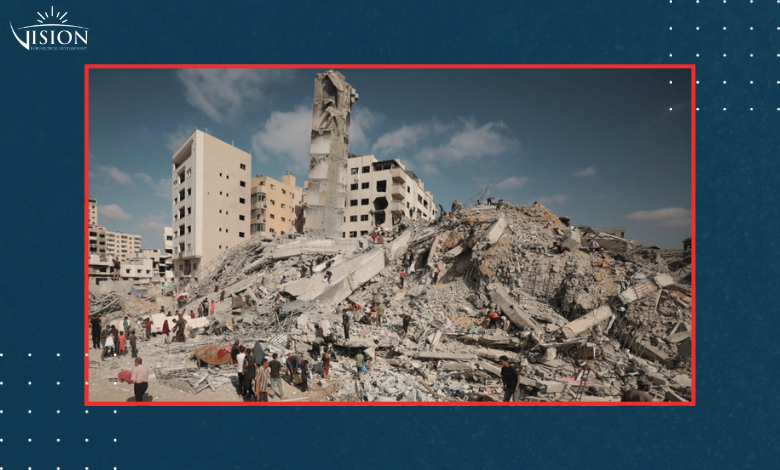
In the darkness of the night of 19 September, residents of the al-Sina’a (Industrial) area of Gaza City woke to muffled screams and a sudden, violent shaking that broke the stillness of the place. In the first moments, everyone held their breath, fearing the sounds came from a swift assassination operation or a surprise Israeli strike, the kind of bombardment that has never once stopped and has never ceased tearing at the bodies of Gazans, even under what is falsely called a “ceasefire.” This time, however, the catastrophe had a different taste: walls that had given way after being worn down by repeated bombardment stretching over the past months.
The six-storey “al-Saada Building” suddenly came down on the heads of its residents. It was more than blocks of concrete. It was a warm home and a refuge of necessity, sheltering dozens of displaced people from the Sa’da, al-Ajla, Hillis and Adas families, who had fled death in the east of the Strip, as well as dozens of wretched tents spread around it and clinging to its walls in search of a scrap of safety. The rubble of the six floors settled on the bodies of the sleeping and the waking alike. The catastrophe left 21 martyrs and more than 45 others with serious injuries and disfigurements,[1] while dozens of the missing remained under the rubble, which the exhausted civil defence teams struggled to recover with primitive tools.
The al-Saada Building was not the only case in which ruined structures have collapsed on the heads of those sheltering in them. It was preceded by similar tragedies that the Strip recorded in much blood, such as the collapse of the buildings of the al-Kahlout family and the al-Madhoun family in the winter of 2025, which turned from refuges of necessity into death traps amid the successive low-pressure weather systems of last winter.
This in-depth research report does not approach these disasters through the logic of “humanitarian crises.” What the Gaza Strip is witnessing is not a sudden crisis or a natural disaster that can be resolved with temporary relief solutions. It is a living and blatant embodiment of an ongoing policy of genocide.
Total Disfigurement and Suspended Structures
For three years, the systematic destruction carried out by the Israeli occupation army in the Gaza Strip has not stopped, until it has wiped out entire cities and left not a single stone standing in them. This is especially true of the cities of Rafah and Beit Hanoun and the eastern areas of the Gaza Strip that lie within what is known as the “Yellow Line,” after they were subjected to more than 230,000 tonnes of various explosives,[2] from warplane missiles weighing one tonne each and from booby-trapped vehicles each carrying 6–7 tonnes of explosives.
According to the Euro-Mediterranean Human Rights Monitor, the Israeli occupation army destroys some 300 housing units every day in Gaza City and the town of Jabalia, wholly or partially, using about 15 booby-trapped vehicles carrying close to 100 tonnes of explosives, in order to destroy and erase the residential neighbourhoods of Gaza City, “for Israel is determined to carry out its plan to wipe the city out of existence,” as it did in the cities of Rafah and Beit Hanoun.
According to the latest assessment by the United Nations Operational Satellite Applications Programme (UNOSAT), based on analysis of satellite imagery captured on 16 June 2026, 201,290 structures across the Gaza Strip have been subjected to urban erasure, about 82% of the estimated total number of structures in the Strip. This includes structures that were completely levelled and structures that suffered severe or moderate destruction.
At the level of housing, a statement by the Government Media Office showed that around 510,000 housing units were completely crushed,[3] while others suffered severe or moderate destruction. This reflects how widely homes were lost or damaged across all the governorates of the Gaza Strip, beyond any single geographical area. It means that the effects of the destruction were not confined to buildings that collapsed entirely. They also included homes that remained partly standing but were damaged to the point of being uninhabitable, or that need repair and reinforcement before their residents can return.
These data do not stop at the limits of mute numbers. They translate into an extremely harsh reality on the ground. The Director General of Reconstruction and Governorate Affairs at the Ministry of Public Works and Housing[4] points to more than 3,000 remaining housing units in the west of the Gaza Strip that still appear to be standing but are losing their structural balance and lack the most basic elements of structural safety. They have become real death traps, inhabited by people with no alternative options. He confirms that some 250 of these buildings have been classified as extremely dangerous hotspots requiring immediate evacuation and demolition because of their complete structural failure, after their cracks and crumbling columns turned into disasters that have already happened, causing successive collapses that claimed dozens of lives and left the injured under rubble that no one is able to lift.
The tragedy of the destroyed buildings does not end at the moment they are targeted. The destruction in the Gaza Strip has left hundreds of buildings that have turned from homes and occupied buildings into sources of danger for those living in them or around them. The figures issued by the Ministry of Public Works and Housing[5] reflect the scale of the visible catastrophe amid an almost complete absence of the means to intervene. Some 880 buildings are classified as hotspots of sudden death that need urgent evacuation until their parts at risk of falling are removed, along with 1,100 dangerous buildings from which huge concrete blocks hang, threatening their residents and the entire surrounding residential area, while 870 other buildings await their turn on the assessment and inspection lists. These figures, for all their horror, reflect only the tip of the iceberg in a grieving Strip where residents are left to manage their own survival, each on their own, under rubble that besieges them on every side, amid the complete paralysis of the civil defence and the municipalities, which have been stripped of their equipment and heavy machinery.
According to the Ministry of Public Works and Housing, 880 destroyed and dangerous buildings need temporary evacuation in preparation for removing parts of them, while 1,100 other buildings contain dangerous structural blocks that may threaten their residents and the buildings around them, and a further 870 buildings are still under study and assessment to determine their level of danger.
Thus, the impact of the bombardment extends beyond buildings that have collapsed or been destroyed to those that remain standing but whose walls, roofs and damaged structures conceal a persistent danger to residents. With limited capacity to evacuate residents, clear debris and reinforce weakened structures, the destruction continues to threaten lives long after the bombardment has ceased, leaving residents exposed to danger even in areas where the attacks have stopped.
The danger of these buildings is compounded by the total paralysis of safety and rubble-removal operations. According to Civil Defence spokesman Mahmoud Basal,[6] there is an acute shortage of the heavy machinery and specialised equipment needed to demolish and remove buildings at risk of collapse. He says, “We are working with two excavators in rescue operations and the recovery of victims,” which leaves these crumbling structures hanging in the urban space, awaiting an imminent catastrophe.
In an engineering reading that unpacks this compound tragedy, the head of the Engineers’ Syndicate, Prof. Dr. Mohammed Arafa,[7] points out that these buildings are not collapsing because of natural factors or age. They are collapsing as a result of a “slow death” caused by the accumulated destructive force of the Israeli occupation’s bombardment. The blast waves and violent concussive vibrations that hit residential neighbourhoods created deep fissures and hidden cracks in the main concrete foundations and columns, so that these structures remain standing in form but have lost their structural balance and await the moment of a sudden fall without warning.
Arafa adds that the corrosion of reinforcing steel and the crumbling of concrete already stressed by the war, under a tight blockade that has prevented any restoration and insulation materials from entering for years, turn these roofs into masses liable to cave in at any moment. The rainy seasons and low-pressure weather systems then come as the final trigger for disaster. Water seeps into the cracked walls and is absorbed by the damaged concrete, multiplying the structural loads on worn-out structures stripped of any support, until they fall on the heads of those living in them.
The Forced Choice Between Two Deaths
Behind the figures and engineering data lie extremely harsh human stories. The crisis of homes at risk of collapse has become a daily psychological test for more than 350,000 families in the Gaza Strip,[8] caught between the exposure of tents that protect from neither heat nor cold and staying under crumbling roofs that could collapse at any moment. Citizens find themselves trapped between two choices, the better of which is death.
The testimony of citizen Dareen Arafat[9] sums up the compound tragedy of families forced to stay in buildings at risk of collapse despite warnings about the danger, because there are no housing alternatives that guarantee a minimum of safety and dignity. She says: “About 40 to 50 of us live in a building whose foundations and columns were damaged. Parts of it have sunk until the fourth floor is almost level with the first, and the building leans so visibly that entering it can make a first-time visitor dizzy. We live in constant fear, especially after the collapse of the al-Saada Building, and we know we live in an unsafe place, but this fear has become part of our daily lives, because we have no other choice.”
If daily fear were burden enough, the rainy seasons and low-pressure weather systems are a real nightmare for the people living in these houses. Water seeps through the cracks and weighs down the fractured roofs, and the concrete, once it has soaked up the water, turns into a fragile mass closer to a pile of sand than to cement. The tragedy of this shows in the living testimonies of families unable to leave their deferred graves.
Mahmoud Abu Zanada[10] lives in a crumbling building whose ten concrete columns were destroyed and which now rests on six cracked columns with the steel mesh showing inside them. In his testimony he says: “Thirteen of us live in this house, which is an open grave that could close its doors at any moment. Yesterday stones and sand fell on us from the roof, and when it rains our belongings are flooded by the torrents pouring through the cracks. The Ministry of Public Works informed us that the building is at risk of collapse and asked us to evacuate it, but the lack of an alternative kept us from carrying out the decision.”
Hala Issa’s situation is not much different.[11] She lives with her family, three households crowded into a small apartment whose ceiling, wrecked in an earlier strike, has become an open risk to their lives. She says: “Ever since the Gaza Municipality engineer came to inspect the damage, I have died dozens of times a day from grief and anguish. He asked us to leave immediately because the building is so dangerous. The inspection found that the fifth-floor columns are badly damaged, while two floors above us remain without any safety guarantees and could collapse on our heads at any moment, especially as winter is at the door, when rain leaks through the ceiling like a river inside the house. The engineer confirmed that this speeds up the erosion of the cement and adds weight to our apartment, which has no reinforcement at all.” She adds: “We hear cracking sounds, and stones fall in the living room whenever a strike shakes the building. The municipality told us the solution is to remove the two upper floors, but that is impossible because there is no equipment, and there are 12 of us… so where do we go?”
The testimonies above agree that living in such a crumbling house is better than living in a tent “that protects neither from the heat of summer nor the cold of winter, nor even from the rainwater that flooded many tents and ruined their occupants’ provisions, their clothes and the only blankets they own. Death is possible on both sides. Here it is a quick death, and there it is a slow death.”
In this context, psychologist Hala Sukkar[12] argues that the danger of houses at risk of collapse is not limited to the possibility that they will fall and the losses that may follow. It extends to undermining residents’ sense of safety and leaving them, in many cases, to “choose between two dangers.” This produces psychological pressure that develops into a sense of helplessness, resignation and the erosion of hope, while children may show signs such as fear of sleeping alone, excessive attachment to their parents, and declining concentration and school performance.
Stalled Reconstruction and Closed Crossings
The tight closure of the crossings and the strict restrictions on bringing in building materials and fuel have a direct effect on the reality on the ground in the Gaza Strip. Attempts at early recovery and self-repair now run into a complicated economic equation that turns any repair work into a fanciful project, high in cost and low in quality and benefit.
Based on a joint assessment published by the United Nations, the European Union and the World Bank in April 2026, Gaza will need $71.4 billion to fund recovery and reconstruction over the next decade. That work was supposed to begin when the ceasefire was announced in October 2025, but the Israeli occupation army’s continued closure of the crossings and its restrictions on the entry of equipment and building materials stand in the way. According to a statement by UN spokesperson Stéphane Dujarric, rubble-removal efforts in Gaza remain limited because of restrictions on the entry of heavy machinery, spare parts, lubricants and other vital supplies. The continued ban or restriction on shipments of cement, reinforcing steel of all sizes and insulation materials also prevents citizens and implementing agencies from carrying out any real reinforcement of threatened columns and walls.
The dilemma deepens when some areas cannot be reached, or dangerous buildings cannot be removed, because of restrictions on the ground. In many cases this makes evacuation the most available measure, even though it offers no lasting solution. Evacuating a family from a home threatened with collapse does nothing for the building and does not necessarily provide a stable place to live. It moves the family from the danger of a possible collapse into the reality of displacement and temporary shelter.
In this context, homes at risk of collapse do not appear to be merely an engineering file separate from the effects of the genocide. They are an extension of it. The danger moves from the moment a building is targeted into the post-destruction phase, when residents find themselves facing threatened buildings, limited means of dealing with them, and a reconstruction environment still unable to turn the scale of the destruction into a response that matches it.
Conclusion
The horrifying engineering data and the death traps standing under cracked roofs in the Gaza Strip confirm a structural truth that cannot be ignored. The Israeli occupation was not content with the machinery of direct bombardment. It has left the people of this land to be torn at and carried off by multiple agents of genocide that complement one another. Prominent among them is the cascading, self-propelled collapse of buildings and facilities it had already targeted. The structures still standing no longer need new missiles to fall. They now come down on their own, through silent structural erosion, shaking foundations, gusting winds and falling rain, while the occupation continues to block the entry of cement, steel and everything needed to build and repair. Paralysing the capacity for urban rescue is therefore not an isolated administrative behaviour. It is a core pillar of the ongoing crime of genocide, which aims to destroy the basic conditions of life and turn the entire geographical space into an environment that drives out human existence.
[1] Mahmoud Basal, spokesperson for the Civil Defense in Gaza, in an interview conducted by the researcher on September 26, 2026.
[2] Government Media Office, “Statistics on the Genocide Three Years After the Massacre,” (October 7, 2026).
[3] Government Media Office, same source.
[4] Director General of Reconstruction and Provincial Affairs at the Ministry of Public Works and Housing, interview conducted by the researcher on September 26, 2026.
[5] Director General of Reconstruction and Provincial Affairs at the Ministry of Public Works and Housing, previously cited source.
[6] Mahmoud Basal, op. cit.
[7] Prof. M. Mohamed Arafa, President of the Engineers Association, interview conducted by the researcher on September 27, 2026.
[8] Government Media Office, “Statistics on the Genocide Three Years After the Massacre,” (October 7, 2026).
[9] Dareen Arafat, a woman living in a dilapidated house in the Al-Shati neighborhood of Gaza City, interviewed by the researcher on September 27, 2026.
[10] Mahmoud Abu Zinada, a resident living in a dilapidated house in the Sheikh Radwan neighborhood of Gaza City; interview conducted by the researcher on September 27, 2026.
[11] Hala Issa, a resident living in a dilapidated house in the Al-Rimal neighborhood of Gaza City, interviewed by the researcher on October 28, 2026.
[12] Hala Sukkar, psychologist, interview conducted by the researcher on September 27, 2026.
NOTE: This text is adapted from original Arabic article.