United States and Israel After October 7 and Genocide

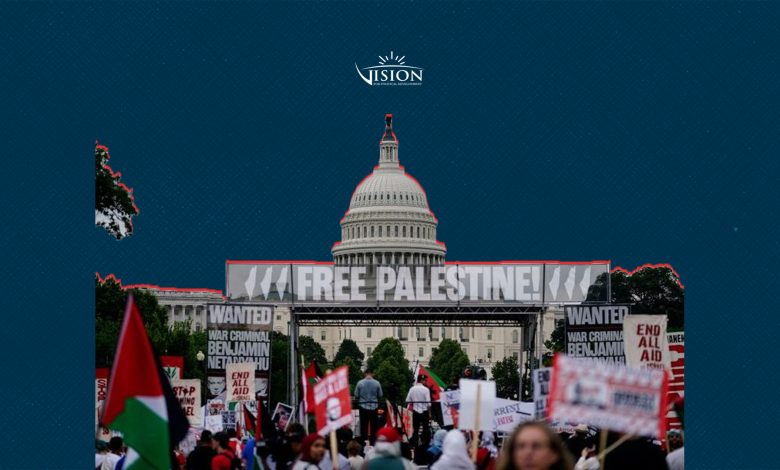
Israel in the U.S. Congress: Declining Support and Partisan Division
Since the establishment of the Israeli entity, the U.S.–Israeli relationship has represented an exceptional case in U.S. foreign policy across successive Republican and Democratic administrations, despite differences in their foreign-policy priorities and approaches to Middle East issues. This does not mean that the relationship has been free from disputes or differences between U.S. and Israeli governments. Historically, however, it remained within a broader consensus over the importance of the alliance and Israel’s place in U.S. strategy. The relationship evolved from political recognition and diplomatic support into a security and military partnership underpinned by an accumulation of institutional and legal frameworks.
Understanding the shifts that have emerged since October 2023 therefore requires looking beyond the positions of U.S. administrations or the nature of relations between the two political leaderships. It also requires examining the foundations of the political consensus and bipartisan support on which the relationship has rested, and assessing whether these foundations have retained the same degree of cohesion or have begun to undergo transformations that could affect the nature and future of the relationship.
This paper, the second in a series examining the U.S.–Israeli relationship in light of ongoing changes, focuses on the nature of the transformations taking place within the U.S. Congress, one of the most important strongholds of Israeli influence and centers of influence on U.S. policy.
Partisan and Institutional Consensus: The Historical Foundation of the U.S.–Israeli Relationship
Historically, the U.S.–Israeli relationship rested on broad consensus between Republicans and Democrats over the importance of the alliance, ensuring the continuation of security cooperation, preserving Israel’s qualitative military edge, and affirming its place in U.S. foreign policy regardless of which party controlled the White House. Military aid and defense cooperation became among the most prominent tools ensuring the continuity of this relationship, while Congress played a central role in translating political commitments into funding programs, legislation, and long-term security arrangements.
The roots of this framework date back to the early stages of the relationship. President Harry Truman’s administration recognized Israel in May 1948, minutes after its declaration of establishment. Relations then developed gradually following the June 1967 war, before Israel’s position within U.S. strategic calculations was strengthened after the October 1973 war in the context of the Cold War. Research findings by the Congressional Research Service (CRS) indicate that the relationship developed from that point through increasing levels of political, military, and security cooperation, culminating in the creation of a long-term institutional framework during the 1980s.
In 1981, the two sides signed their first memorandum of understanding on strategic cooperation. In 1983, the Joint Political-Military Group (JPMG) was established to coordinate security cooperation. Joint military exercises began in 1984, and Israel participated in the Strategic Defense Initiative (SDI) in 1986. In 1987, the Reagan administration designated Israel a “Major Non-NATO Ally,” and Congress later strengthened this status in law in 1996 through an amendment to the Foreign Assistance Act, granting Israel additional privileges in defense cooperation and access to U.S. weapons systems.
Congress is one of the clearest indicators of the institutional nature of the relationship, having helped transform some arrangements from accumulated political practices into more firmly established legal rules. For example, military aid and defense cooperation programs with Israel maintained broad bipartisan support for decades, while successive administrations continued to grant Israel priority access to certain U.S. defense technologies. It became the first“country” outside the United States to receive F-15 fighter jets in 1976 and F-16 fighter jets in 1980, giving it a temporal advantage over other countries in the region in acquiring the most advanced U.S. fighter aircraft.
In the same context, Congress embedded the concept of preserving Israel’s qualitative military edge (QME) in U.S. law, making it part of the legal framework governing defense cooperation between the two countries since legislation adopted in 2008. The law requires the administration to conduct periodic assessments of that edge and, when considering any U.S. arms sale to another Middle Eastern country, to determine its potential impact on Israel’s qualitative military edge to ensure that it is not undermined. Preserving Israel’s military superiority thus became an institutional element of the U.S. decision-making process on arms sales to the region, rather than merely a political position or preference that could change from one administration to another.
The continuity of this institutional commitment is also evident in the scale of U.S. assistance. According to data from the Congressional Research Service (CRS), the value of U.S. assistance provided to Israel from 1946 through fiscal year 2025 amounted to approximately $175 billion, including economic and military assistance and funding for missile-defense programs. According to the CRS, Israel is the largest cumulative recipient of U.S. foreign assistance since World War II. Military assistance has also evolved into a long-term commitment through successive memoranda of understanding, most notably the security memorandum of understanding signed by President Barack Obama’s administration and the Israeli government in 2016. Under that agreement, the United States committed to providing $38 billion over the 2019–2028 period, including $33 billion through the Foreign Military Financing program and $5 billion for missile-defense programs. The U.S. administration described it as the largest U.S. commitment to military assistance in the country’s history. The memorandum was concluded despite political disagreements between the Obama administration and Benjamin Netanyahu’s government over the Iranian nuclear agreement, reflecting the institutional structure’s ability to absorb political disputes between the two governments.
A Crisis of Consensus: The Genocide and the Emergence of Polarization
Congress as an Arena of Transformation
The genocidal war on Gaza since October 2023 has exposed growing pressure on this consensus within the U.S. political establishment, with Congress emerging as the clearest arena for measuring this transformation. Here, Congress refers to both the House of Representatives and the Senate, although the distinction between them is essential when interpreting the significance of votes. The House of Representatives consists of 435 members elected for two-year terms, each representing a congressional district. The Senate consists of 100 members—two from each state—who serve six-year terms, with approximately one-third of the chamber elected every two years. The two chambers also differ in their legislative procedures. Any federal law requires both chambers to approve the same text, while the Senate possesses special constitutional powers to confirm presidential appointments and approve treaties. Its procedural rules also provide greater scope for debate and delay than those of the House. By contrast, House rules give the majority greater ability to move legislation quickly.
These differences are important for this paper. Voting in the House can more clearly reveal the extent of division within a party bloc at a specific legislative moment because House members are more directly exposed to electoral changes within their districts and shifts in the attitudes of their party base, given that the entire chamber faces election every two years. A House vote alone, however, is insufficient to change U.S. policy, since legislation must also pass the Senate.
In the Senate, reaching a final vote or overcoming procedural obstacles represents a different test because of the nature of the chamber’s rules and the role of its committees in the stages preceding a final vote. Opposition votes in the two chambers therefore do not necessarily carry the same political significance, although both are important indicators of the shift in the U.S.–Israeli relationship from an issue that once largely transcended partisan polarization to one that has increasingly become the subject of legislative debate and political disagreement.
Congressional votes are especially significant because the U.S.–Israeli relationship is tied to legislative, financial, and security instruments in which Congress plays a determining role, most notably appropriations, military assistance, and oversight of arms sales. The shift from political statements and criticism to voting on aid or arms sales therefore represents a change in the nature of the debate itself. Nevertheless, the outcome of a vote in either chamber does not, by itself, constitute an effective change in U.S. policy toward Israel. Legislation becomes law only after both the House and Senate approve the same text and send it to the president. This paper therefore focuses on the significance of these votes as indicators of transformations within the political establishment and the parties.
Pressure on the consensus emerged at a very early stage of the war. In December 2023, Senator Bernie Sanders introduced a resolution calling on the State Department to provide Congress with information about Israel’s human-rights practices and its compliance with international humanitarian law when using U.S. assistance. Although the Senate voted in January 2024, by 72 votes to 11, to end the effort to advance the resolution by discharging it from the Foreign Relations Committee, the attempt represented one of the earliest indications that the conditions governing the use of U.S. aid to Israel had entered Congress’s legislative mechanisms after October 2023.
This shift became more visible in legislative discourse as demands to change policy toward Israel moved from political protest to the use of congressional tools. In April 2024, the House passed the “Israel Security Supplemental Appropriations Act” by 366 votes to 58. Although the majority of both Republicans and Democrats supported the package, 37 Democrats and 21 Republicans voted against it. This result deserves careful interpretation because the bill combined military funding for Israel with humanitarian assistance for Gaza, meaning that the motivations for opposition were varied. Its significance, however, lies in revealing the existence of an opposition bloc in the House willing to vote against a major package associated with U.S. support for Israel, after such appropriations had historically enjoyed a high degree of bipartisan consensus. The opposition was also significant because it emerged in a pivotal vote on aid to Israel only months into the war, providing an early benchmark for measuring opposition within the Democratic Party as debate shifted from supporting assistance to opposing some of its forms or conditions.
Then, in November 2024, the dispute moved from debate over an aid package to a direct attempt to block specific arms sales. In September 2024, independent Senator Bernie Sanders, who caucuses with Senate Democrats, introduced six joint resolutions of disapproval (JRDs) challenging U.S. arms sales to Israel. He then brought three of them to a final vote in November, but the effort failed after a majority in the Senate maintained the traditional position and voted against discharging them from the Foreign Relations Committee. Although support for the resolutions remained far short of the level needed for passage, the votes set a precedent by bringing the issue of conditions on arms transfers into the heart of Senate legislative activity. These efforts also helped create new political space to distinguish between a commitment to Israel’s security and acceptance of every form of military support and every decision of the Israeli government.
From Progressive Opposition to Division Within the Democratic Party
These transformations take on additional significance in light of the issue’s growing prominence within the progressive wing of the Democratic Party in Congress and, after October 2023, its clearer transition into the legislative activity of that wing through initiatives, bills, and resolutions directly related to arms transfers and military assistance. The Congressional Progressive Caucus offers an important institutional indicator of this shift. In September 2025, for the first time—in its own words—the caucus endorsed legislation directly concerning the “Israeli-Palestinian conflict” when it announced its support for the Block the Bombs Act (H.R. 3565), which seeks to restrict the transfer of several of the most destructive weapons systems to Israel while exempting defensive systems such as the Iron Dome. The significance of this step lies in moving the debate from the positions of individual members, such as Sanders, to a collective stance within an institutional bloc of Democratic members of the House.
The rise of this trend therefore cannot be measured solely by the growing number of votes supporting Sanders’s initiatives. It can also be seen in the transition of some demands previously associated mainly with the progressive wing into collective action within Congress. From this perspective, subsequent votes in the Senate and House become important indicators of the transformation taking place within the Democratic Party as this trend broadened throughout 2025.
In July 2025, Sanders forced a new Senate vote on discharging two resolutions from the Foreign Relations Committee for consideration, seeking to block the sale of offensive weapons to Israel. One concerned a bomb and munitions package worth more than $675 million, while the other involved the sale of tens of thousands of automatic assault rifles. The bomb resolution received the support of 24 members of the Democratic caucus, while 27 supported blocking the rifle sale, compared with 17 who opposed it. Although neither resolution secured a Senate majority, the significance of these figures lies in the fact that they indicate that more than half of the Democratic caucus had become willing to support legislative measures aimed at halting some arms sales to Israel.
This trend then took a step regarded as a historic shift in April 2026. Of the 47 members of the Senate Democratic caucus, 40 voted to block the sale of military bulldozers worth $295 million, while 36 Democrats voted to block a bomb sale worth $151.8 million. Both efforts failed because of Republican opposition, but the scale of support, which encompassed a majority of the Democratic caucus, turned debate over arms transfers to Israel into an issue with a broad institutional presence rather than a position confined to a small number of members, as it had initially been. This does not mean that a single Democratic position toward Israel has emerged, but it is a strong indication that disagreement within the party over the conditions and instruments of military support has widened.
In parallel, the House has seen limited instances of Republican opposition to the continuation of certain forms of military assistance to Israel, although they do not compare in scale or consistency with the transformation within the Democratic bloc. Republican Representative Thomas Massie stands out as one of the clearest examples showing that opposition to funding Israel is no longer confined absolutely to Democrats. He moved from voting—alongside 20 other Republicans—against the Israel Security Supplemental Appropriations Act in 2024 to introducing an amendment in July 2026 aimed at eliminating approximately $3.3 billion in annual military assistance to Israel under the Foreign Military Financing program. Although the amendment was rejected, it received the support of 103 Democratic representatives in addition to Massie. This means that Republican opposition remained almost individual in this case, while opposition to military funding for Israel had come to command the support of a large bloc within the Democratic Party.
The 2026 result becomes even more significant when compared with the previously mentioned 2024 legislative vote against the Israeli aid package. At that time, 37 Democrats voted against the legislation; by 2026, the number had risen to 103, making it the most recent vote to reveal the widening division within the Democratic Party over the conditions of U.S. military support for Israel. The comparison shows opposition shifting from a limited bloc within the party to an almost evenly divided party caucus. This transformation also requires a political reading that goes beyond the raw number of votes, since the 2026 amendment directly targeted military funding for Israel, whereas the 2024 package included several components, among them humanitarian assistance to Gaza.
This change is therefore evident in the progression from 37 Democratic representatives voting against the aid package in April 2024, to 27 members of the Senate Democratic caucus supporting a move to block an arms sale in July 2025, then 40 members in April 2026, and finally 103 Democratic representatives supporting the elimination of security-assistance funding in the House in July 2026. This progression shows the debate over military aid shifting from the level of political criticism to direct institutional legislative disagreement over the nature and limits of support, after it had for decades been among the issues enjoying broader bipartisan consensus. This becomes particularly significant given the continued existence of the legal and financial framework built over previous decades, meaning that the current dispute concerns changing part of an already established structure.
Conclusion
Based on the preceding discussion, it is evident that disagreement within U.S. politics has begun to move toward questioning the conditions, instruments, and limits of the relationship with Israel. These developments reveal a pivotal transformation: the relationship has moved from a sphere that often transcended partisan polarization to becoming itself a subject of partisan dispute, particularly within the Democratic Party. The disagreement then moved into Congress through debates over aid and the conditions governing the transfer and use of weapons. Although core assistance and defense cooperation continue, the ability of the U.S.–Israeli alliance to transcend U.S. partisan divisions has become less stable than it once was as a historical pillar of the relationship, while defending that relationship within U.S. politics has become increasingly subject to competition, challenge, and accountability.