Book: “The Convergence of the Palestinian Economy Towards a Genocide Economy”

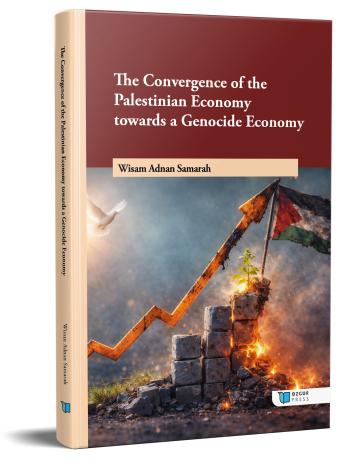
Author: Wisam Adnan Samarah
Publisher: Özgür Yayınları
Publication date: April 21, 2026
Language: English
Number of pages: 154
The Book’s Place in the Existing Literature
The book belongs to a body of literature that has examined the Palestinian economy under Israeli occupation. The study “The Gaza Strip: A Case of Economic De-development” (1987)[1] developed the concept of “de-development” to explain the policies that prevented Gaza’s economy from building an independent productive base and turned development into a continuous process of dismantling local capacities. The book “The Gaza Strip: The Political Economy of De-development” (1995)[2] later expanded on this concept, explaining that Gaza’s stalled development resulted from sustained and deliberate policies that dismantled the productive base and prevented the economy from building and strengthening its capacity for growth.
The book “The Palestinian Economy: Between Imposed Integration and Voluntary Separation” (1997)[3] examined the Palestinian economy’s subjection to an unequal integration with the Israeli economy, which weakened local labor and capital markets and created dependence on the occupation for employment, trade, and financial resources. The book offered a comprehensive analysis of the structure of economic dependency that took shape over the years of occupation, but treated it as an imbalance in the economic and institutional relationship between the two sides and did not address the shift of this relationship toward the systematic destruction of the conditions necessary for economic life.
Extending this approach, “Palestinian Labour Migration to Israel: Labour, Land and Occupation” (2005)[4] examined the relationship between labor, land, and occupation. It showed that the employment of Palestinian workers in Israel raised household incomes during certain periods, while at the same time contributing to the weakening of the Palestinian productive base and increasing dependence on the Israeli labor market. It thus demonstrated that labor dependency was the product of political arrangements linked to control over land and resources, rather than merely the result of wage differentials between two neighboring economies.
The analysis then shifted from the Palestinian economy’s dependency to the political economy of the occupation itself. “The Political Economy of Israel’s Occupation: Repression Beyond Exploitation” (2010)[5] argued that the continuation of the occupation could no longer be explained solely through the logic of direct economic exploitation, as the costs of control had become high and the occupation system had become entrenched as a repressive regime that controls the distribution of resources and interests. The book broadened the analysis beyond the economic benefits Israel derives from employing Palestinian workers and controlling Palestinian markets, focusing instead on the role the system of control plays in subordinating the Palestinian economy and maintaining political domination.
“The Political Economy of State Formation in Palestine” (2021)[6] also examined the political economy of establishing the Palestinian Authority after Oslo. The study showed how the state-building model produced institutions dependent on external financing and operating within an economic framework whose borders and resources are controlled by the Israeli occupation. It explained that the fragility of the Palestinian economy is tied to the nature of the political and institutional arrangements formed after Oslo, including dependence on aid and debt.
More recent literature has linked the destruction of Gaza to concepts of genocide and the erasure of the conditions that allow society to endure. The study “Genocide and the Destruction of the Means of Social Reproduction in Gaza” (2025)[7] introduced the concept of destroying the “means of social reproduction,” explaining that targeting homes, hospitals, food, water, care, and education strikes at the institutions and practices through which society is able to reproduce its life across generations. This study comes close to the genocide-economy thesis, but focuses on social reproduction from a political perspective more than on the structure of the Palestinian economy and its sectoral and macroeconomic transformations.
In “Resisting Erasure: Capital, Imperialism and Race in Palestine” (2025)[8], the concept of “erasure” is situated within a framework linking Israeli settler colonialism to the development of global capitalism, imperialism, racism, and geopolitical transformations in the Middle East. The book critiques approaches that reduce Palestine to a humanitarian crisis or an aid issue detached from the political and economic structures that produced its contemporary reality, arguing that erasure encompasses a set of political, economic, spatial, and cultural processes that sever Palestine from its historical and regional continuum.
In light of this literature, it becomes clear that previous works have addressed multiple aspects of the Palestinian economy, while the transformation affecting the targeted Palestinian economy still requires a more dynamic explanation that connects these interpretive frameworks. The book starts from this gap to analyze the point at which destruction moves beyond weakening growth and increasing losses and becomes a systematic dismantling of the conditions of life and production and a disruption of the prospects for recovery. It also brings together military destruction in Gaza, settlement expansion, and the seizure of land and resources in the West Bank within a single political and economic trajectory, presenting the “genocide economy” as a cumulative stage that begins with dependency and de-development, passes through a war economy, and ends with the undermining of the capacity to survive and rebuild.
The book’s contribution lies in moving from measuring losses to explaining the function of destruction, and in linking the targeting of productive sectors, infrastructure, and services to a system aimed at undermining the continuity of Palestinian society. The book’s originality does not stem from coining the concept of a “genocide economy” itself, which appeared in roughly contemporaneous works, but from using it in an integrated way to explain the condition of the Palestinian economy. The author links comprehensive military destruction in Gaza with land seizure and settlement expansion in the West Bank as two parallel and functionally connected tracks. In Gaza, housing, infrastructure, productive sectors, and sources of food and water are destroyed, while in the West Bank land confiscation, settlement expansion, movement restrictions, and control over resources are used to shrink the space available for Palestinian production and life. According to the book’s thesis, the two tracks dismantle the economy’s material base, entrench fragmentation between the Palestinian territories, and limit the possibility of establishing an independent economy capable of recovery and reconstruction—an essential element of the concept of a “genocide economy.”
The Book’s Research Problem and Central Thesis
The book examines the transformation of the Palestinian economy, with a particular focus on the Gaza Strip, from an economy constrained by occupation, blockade, and dependency into a war economy moving toward a “genocide economy.” It defines this as a model based on the systematic destruction of the material, institutional, and social foundations necessary for the population’s continued existence, including production, livelihoods, housing, health, education, infrastructure, and the capacity to rebuild. The book’s thesis is that economic collapse is the product of an accumulated process of blockade, fragmentation, destruction, and external dependency that has eroded the productive base and disrupted the conditions for recovery. The book seeks to document and measure the economic destruction in Gaza, analyze the mechanisms that produced this deterioration, frame the “genocide economy” as a concept linking economic collapse to strategies targeting the foundations of Palestinian existence, and propose pathways for reconstruction and the restoration of sovereignty based on international law, economic justice, and the right to self-determination (pp. vi–vii).
To do so, the book combines political economy with an analysis of macroeconomic and sectoral indicators for the period 1995–2025, drawing on Palestinian and international data as well as humanitarian and human-rights reports (pp. vii–viii). It also employs the concept of “convergence” to explain the Palestinian economy’s transformation over time toward a stable state of destruction in which productive capacities decline and recovery mechanisms are disabled, ultimately reaching what the author calls a “fixed point of destruction.” This analysis draws on the concepts of de-development, war economy, and genocide economy. The author summarizes the distinction as follows: “War economies distort development, while genocide economies eliminate its foundations” (p. 96).
Overview of the Book’s Chapters
The introductory chapter establishes the conceptual basis for the ideas of convergence and divergence on which the book relies to explain the trajectory of the Palestinian economy. Chapter One discusses the historical milestones that shaped Palestinian reality, from the establishment of “Israel” and the occupation of the West Bank, the Gaza Strip, and “East Jerusalem,” to the Oslo Accords and the establishment of the Palestinian Authority. Chapter Two provides a general picture of the structure of the Palestinian economy in terms of population, labor, sectors, output, trade, public finance, aid, and the banking sector, while highlighting its dependence on the Israeli economy. Chapter Three examines the Gaza Strip’s geography, resources, demographic shifts, urban expansion, and socioeconomic indicators.
Chapter Four analyzes agriculture, fishing, industry, services, trade, and tourism, showing the declining contribution of productive sectors under the impact of the blockade, destruction, and restrictions imposed on resources and markets. Chapter Five examines the labor market in terms of workforce distribution, unemployment trends, employing sectors, migration, remittances, and the relationship between the employment crisis, declining production, and restrictions on workers’ movement. Chapter Six reviews transport, energy, housing, education, and health, as well as the impact of deteriorating infrastructure on economic activity, services, and the capacity for recovery.
Chapter Seven examines the impact of the blockade, political restrictions, conflict, resource scarcity, and dependence on aid in weakening investment, production, and economic sustainability. Chapter Eight addresses the role of Palestinian political forces and institutions, budget management, economic reforms, and relations with international organizations amid internal division and limited decision-making capacity. Chapter Nine then discusses agreements and trade restrictions, relations with neighboring countries, and the impact of sanctions and aid on the Palestinian economy’s links to external markets. Chapter Ten presents examples of local projects, training programs, and humanitarian interventions, illustrating both the potential and the limitations of local initiatives in an environment governed by blockade and limited access to resources and markets.
Chapter Eleven presents the book’s central conceptual distinction between a “war economy,” which governs resources and activities under conditions of war, and a “genocide economy,” which employs economic and institutional systems to destroy a population and strip it of the means of survival. The author argues that “genocide economies exploit humanitarian systems themselves, so that aid functions as a mechanism of containment rather than recovery, preserving a minimum level of survival without enabling people” (p. 95).
Chapter Twelve applies this concept to the Palestinian case, linking the destruction of economic and life-support systems in Gaza with settlement expansion and the seizure of land and resources in the West Bank as part of a single trajectory leading toward a genocide economy. Chapter Thirteen concludes the book with a vision for recovery based on rebuilding the economy, supporting local enterprises, digital transformation, expanding access to finance, regional integration, and establishing a unified and transparent reconstruction authority within an integrated Palestinian economic framework.
Critical Reading of the Book
The book presents the concept of a “genocide economy” with considerable explanatory strength, combining theoretical grounding with quantitative and sectoral analysis to explain the Palestinian economy’s transition from de-development and a war economy to a stage in which the continuity of society and its capacity for recovery are themselves targeted. The author succeeds in linking political intent to the comprehensive targeting of life-support systems, the continuity of destruction, and the obstruction of reconstruction, drawing on indicators related to production, labor, investment, infrastructure, and basic services.
Despite the strength of this framework, the concept could be developed more precisely by formulating specific analytical criteria that would help distinguish a genocide economy from closely related concepts. This distinction remains largely theoretical, as the book does not identify operational indicators or clear thresholds showing when a given economy moves from war or de-development into a genocide economy, or how such a transition could be tested in other cases. The term “genocide economy” is also used broadly, at times referring to the economic and institutional system that deploys and benefits from destruction, and at other times to the condition of the Palestinian economy resulting from that destruction. A terminological distinction between the genocide economy as an instrument of the actor and an economy subjected to genocide as the condition of the targeted society would have made the boundaries of the concept clearer.
The book’s recommendations also raise the question of the relationship between recovery and the continuation of the colonial system that produced the destruction. A digital economy requires energy, telecommunications, and access to markets; cross-border economic zones presuppose sovereignty over crossings and the movement of inputs; and international financing may reproduce the dependency criticized by the book. These proposals therefore needed to be tied to political and legal conditions that protect investment and guarantee freedom of movement and Palestinian control over resources, while also clarifying the limits of the role and responsibilities of Palestinian institutions in governance and the management of financing.
References
[1] Roy, S. (1987). The Gaza Strip: A case of economic de-development. Journal of Palestine Studies, 17(1), 56–88. https://doi.org/10.2307/2536651 [2] Roy, S. (1995). The Gaza Strip: The political economy of de-development. Institute for Palestine Studies. [3] Arnon, A., Luski, I., Spivak, A., & Weinblatt, J. (1997). The Palestinian economy: Between imposed integration and voluntary separation. Brill. https://doi.org/10.1163/9789004491557 [4] Farsakh, L. (2005). Palestinian labour migration to Israel: Labour, land and occupation. Routledge. https://doi.org/10.4324/9780203431658 [5] Hever, S. (2010). The political economy of Israel’s occupation: Repression beyond exploitation. Pluto Press. [6] Hanieh, A. (2021). The political economy of state formation in Palestine. In L. H. Farsakh (Ed.), Rethinking statehood in Palestine: Self-determination and decolonization beyond partition (pp. 29–53). University of California Press. https://doi.org/10.1515/9780520385634-005 [7] Repo, J. (2025). Genocide and the destruction of the means of social reproduction in Gaza. European Journal of Politics and Gender, 8(2), 492–499. https://doi.org/10.1332/25151088Y2024D000000061 [8] Hanieh, A., Knox, R., & Ziadah, R. (2025). Resisting erasure: Capital, imperialism and race in Palestine. Verso. https://www.versobooks.com/en-gb/products/3410-resisting-erasure?srsltid=AfmBOorG7Vi_93yAOSvpxjk4A-ISvAZY050wdw3FNkUjrbu94QsRMIXtNOTE: This text is adapted from original Arabic article.