Refuge Becomes Borders: Genocide Reshapes Gazans’ Relationship with the Sea
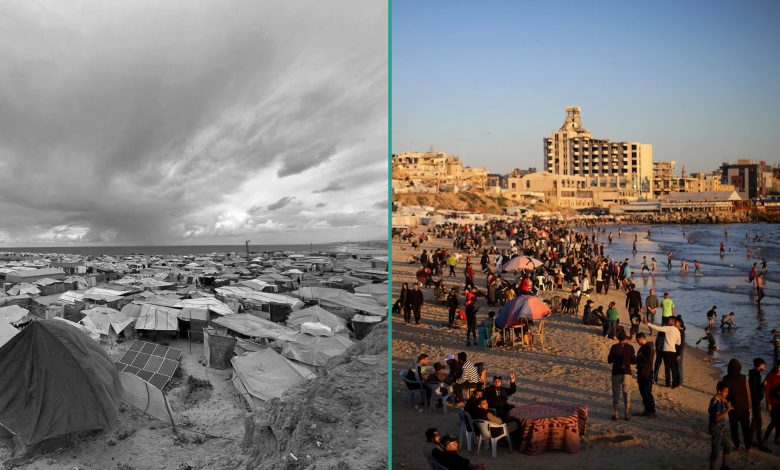
For roughly 40 kilometers along the coast, the sea has long been an essential part of daily life in the Gaza Strip. More than simply a geographical boundary overlooking the Mediterranean, it has served as a social, economic and cultural space that brings together Gazans from all walks of life. In a territory that has endured years of blockade, closures and a shortage of public spaces, the beach retained its place as the largest and most affordable refuge for residents with little access to parks, gardens or recreational facilities.
As the Israeli blockade tightened after 2007, the sea became even more central to everyday life. Families visited the coast during summer holidays and evenings to escape overcrowding, power outages and high temperatures. Children found space to play on the beach, while young people used it for sports and entertainment. Watching the sunset over Gaza’s shoreline became part of the collective memory of its residents.
The sea’s importance, however, was not limited to its social role. It was also one of Gaza’s most important economic resources. The fishing sector provided a direct source of income for thousands of fishermen and workers in related trades, including boat repair, net-making, fish marketing, transport and commerce.
According to Food and Agriculture Organization of the United Nations (FAO), more than 6,000 people in Gaza — including 4,200 registered fishermen and boat owners — relied primarily on fishing for their primary sources of income before the genocide, supporting around 110,000 people. Fishing also provided an important source of animal protein amid scarce resources and high levels of poverty and unemployment resulting from the blockade imposed since 2007. Fish were relatively affordable in Gaza compared with other protein sources such as meat and poultry. According to the Palestinian NGO Network (PNGO), Gaza produced between 3,000 and 4,000 tonnes of fish annually, in addition to 300 to 500 tonnes from fish farms in recent years.
Yet even before the genocide, this space was far from free of restrictions. For years, the Israeli occupation imposed repeated limits on the fishing zone, which had been set at 20 nautical miles under the Oslo Accords. The permitted distance was repeatedly expanded or reduced depending on security developments.
Two years after the agreement was signed, it was cut to 12 nautical miles, and the restrictions continued to tighten gradually until fishermen were limited to between three and nine nautical miles — an 85% reduction from the distance originally agreed upon. This made fishing dangerous and less profitable. Many fishermen were shot at, arrested or had their boats confiscated while working, turning the sea into a place where hope for a livelihood was inseparable from fear of losing it.
Despite those restrictions, Gaza’s seafront remained vibrant and busy around the clock. In the years preceding the genocide, the coast witnessed a surge in tourism investment, drawing tens of thousands of visitors each day to facilities stretching along Al-Rashid Street. While Gaza’s land crossings were closed much of the time, the maritime horizon continued to offer residents a symbolic sense of connection to the outside world, even if actual access remained restricted.
Today, however, that scene has been turned upside down. The waters have become stained red with blood amid repeated attacks on fishermen by Israeli naval vessels, while the shoreline has been transformed into an open-air displacement camp sheltering thousands of Gazans fleeing the ongoing genocide. Israel has carved out vast areas of the Strip, confining more than two million Palestinians to less than 9% of its territory under harsh conditions lacking even the most basic necessities of life.
This report examines the profound transformation in Gazans’ relationship with their sea and how the Israeli Occupation has turned it from a window of hope and a gateway to the world into a vast prison surrounded by warships — trapping fishermen at sea and displaced people along the shore, and tightening the maritime, economic and humanitarian blockade.
The Sea: Gaza’s Last Refuge
In a city exhausted by the sound of bombardment and weighed down by scenes of destruction and loss, the sea remains one of the few places Gazans can still turn to in search of fleeting moments of calm. Going to the beach is no longer associated with leisure or summer traditions as it was before the war. Instead, it has become an attempt to recover some sense of being alive in a reality dominated by fear, anxiety and psychological exhaustion.
As the sun begins to set, hundreds of families spread out across the sands of Gaza City’s beach, sitting on the ground in search of a breeze and a space slightly less harsh than the reality that follows them everywhere. Each person carries a story: a mother who has lost her home and children, another who has lost her husband and some of her young children, a child carrying memories of explosions, and a father trying to give his family a single hour away from scenes of devastation. They sit together staring at the horizon, before their children suddenly spring up and run after the waves, trying to steal a few brief moments of joy.
Ibtihal Samour[1], a Gaza City resident who is still suffering from injuries sustained two years ago and who lost her two children in an attack on a shelter to which she had been displaced, says: “We come to the sea not because we are looking for enjoyment as we used to, but because we need somewhere that allows us to feel, even for a little while, that we are still alive after everything we have endured and continue to endure.”
Therefore, the sea has shifted from a space for collective recreation into a means of psychological coping with the conditions of war.
Um Bakr[2], whose husband was martyred, brings her children to the sea because it gives them a few moments of temporary happiness. She says: “Since the Israeli Occupation destroyed most recreational spaces, the beach has become one of the few places where my children can run, play and spend a few hours away from the atmosphere of fear surrounding us. But even these moments remain overshadowed by the reality of war. The sea cannot completely isolate us from the trauma we live through every day, with warships offshore and random attacks taking place everywhere.”
The Sea: A Camp for the Displaced
The transformation of Gaza’s coastline during the genocide has gone far beyond its changing role as a refuge for residents. It has reshaped the entire urban and social landscape of the coast. With widespread destruction of residential neighborhoods, repeated evacuation orders and the shrinking of areas where civilians can seek refuge to just 9% of the Strip, the coastal areas have become one of Gaza’s largest displacement zones, with thousands of tents stretching along the shoreline in a scene the territory had never witnessed before.
Palestinian journalist Alaa Dardouna[3], who is displaced and living in the Al-Shalihat area west of Gaza City, says: “We did not choose to live beside the sea. We were forced to flee there by the terror of bombardment and the rivers of blood, after we were ordered to evacuate Jabalia under threat from Israeli drones. At that moment, survival was all we could think about, and there was nowhere else for us to go.”
The sands that once welcomed families on summer outings have become ground for tents made of cloth and plastic sheeting, sheltering families who have lost their homes and possessions. The beach is no longer somewhere people spend a few hours; it has become an address of forced residence, where displaced families live for months in conditions lacking the most basic necessities.
Dardouna describes daily life there as a “slow death”, as families endure the brutality of the seasons with no protection. In winter, rain floods the tents and winds tear them apart. Summer brings another form of suffering, with extreme heat, insects and rodents, compounded by difficulties obtaining water, bread and basic food supplies.
Although the sea had long been one of the few refuges available to Gazans, displacement to the shoreline has turned it into an open front exposed to death. The beach is no longer merely an emergency refuge; displacement there has become even harsher than in inland camps. Tents pitched on the sand are directly exposed to attacks and continuous fire from Israeli naval vessels. In one case, a displaced woman was killed by Israeli naval gunfire while inside her tent on the beach.[4]
The fabric of the tents is also worn down by the sea’s high humidity and salinity, while sand infiltrates every aspect of daily life. Direct military danger and relentless exposure to the elements have become intertwined, redefining Gazans’ relationship with a sea that has itself become an extension of an open-air prison offering no safety.
The Sea: A Graveyard for Fishermen
Amid the continuing maritime blockade enforced by Israeli naval vessels, the sea has been transformed from a source of livelihood into a place fraught with the risk of death, where the need to earn a living is inseparable from the fear of being targeted.
Fisherman Raed al-Najjar[5] says: “Every time I push my boat out to sea, I say goodbye to my family as though I am heading into battle, not going fishing. The question is no longer: Will I catch anything? It is: Will I return alive?”
Fishermen now work in extremely dangerous conditions, relying on small, basic boats that offer them no protection. Al-Najjar experienced this firsthand on August 16, 2025, when an ordinary fishing trip nearly cost him his life. He was around 400 metres from shore when an Israeli warship appeared, accompanied by a quadcopter drone, and gunfire was directed towards him.
Al-Najjar[6] recounts: “The shooting was extremely intense. I fell into the sea, and explosive munitions followed us. I was hit by shrapnel in my chest, head and foot. At that moment, the sea turned red, and I began reciting the shahada and saying, ‘God, save me.’”
The incident permanently altered his relationship with the sea. “After that incident, I began to see the sea as a monster. I see it killing fishermen,” he says.
The consequences of the war have extended far beyond the dangers fishermen face while working. According to Zakaria Bakr[7], an official with Gaza’s fishermen committees, the fishing sector has been subjected to “complete annihilation”, with around 95% of its facilities and infrastructure destroyed. These include boats, storage facilities, fishermen’s rooms, ice factories, solar-energy systems and ports. The war has also killed 233 fishermen, while around 120 have been detained and 130 wounded, some of them left with permanent disabilities, alongside the destruction of fishing harbors, boats and essential equipment.
This devastation has brought fish production to a near standstill. Before the war, the sector supplied between 15 and 20 tonnes of fish a day. Production has since fallen to only limited quantities each month because of destroyed infrastructure and restrictions on access to the sea.
Economist Ahmad Abu Qamar[8] says the collapse constitutes both an economic and a food-security loss. Thousands of fishermen have lost their livelihoods, while the small number who continue to fish are confined to waters close to shore and can catch only limited quantities. This has driven up fish prices and deprived thousands of families of one of their most important sources of protein amid the blockade and an escalating food-security crisis.
The Sea and Control Over Humanitarian Corridors
During the genocide, the significance of Gaza’s sea has not been limited to its role as a refuge for residents or a source of danger for fishermen. It has also become an arena for colonial control over humanitarian access to the Strip. Although the sea is Gaza’s only natural gateway that is not connected to its land borders, it remains subject to the Israeli naval blockade, preventing civilian initiatives aimed at breaking Gaza’s isolation and delivering humanitarian aid from reaching the territory.
Throughout 2025 and 2026, international solidarity vessels repeatedly attempted to reach Gaza, but every effort ended in interception or detention before the ships could reach the Strip’s shores.
On June 9, 2025, the Israeli military intercepted the Madleen, which had sailed from Italy carrying 12 activists of different nationalities. Its passengers were detained and its cargo confiscated. The Handala, which set sail on July 13, 2025, was also boarded by Israeli commandos. Its activists were detained for more than 48 hours before being deported, and the aid onboard was confiscated.
The Global Sumud Flotilla was launched in August and September 2025 with the participation of 44 vessels and representatives from more than 40 countries, with the aim of opening a humanitarian corridor to Gaza. Israeli forces intercepted the flotilla in October, detained 201 activists and transferred them to the port of Ashdod.
Another attempt followed with the Spring 2026 mission, launched on April 12, 2026, involving around 1,000 activists from 70 countries aboard more than 70 vessels. Israeli naval forces intercepted it in international waters near the island of Crete, seized 22 vessels and detained hundreds of activists. Amnesty International documented abuses against a number of detainees, including deprivation of sleep, water and medical care, while prosecutors in Rome opened a formal investigation into allegations that 36 Italian activists had been subjected to torture and ill-treatment.
On May 1, 2026, Israeli authorities also detained Palestinian-Spanish activist Saif Abu Keshek and Brazilian activist Thiago Ávila and accused them of belonging to a terrorist organization, before the United Nations intervened in the case.
Despite these measures, attempts to break the blockade continued. The Global Sumud Flotilla set sail again on May 14, 2026, with 54 vessels — including five affiliated with the Freedom Flotilla Coalition — and more than 500 activists of various nationalities. It too was subjected to a large-scale interception operation by the Israeli navy, after which contact was lost with several of its vessels.
These incidents show that the sea no longer functions merely as a barrier preventing Gaza’s residents from leaving. It has also become an obstacle preventing supporters and humanitarian aid from reaching them. The coastline has thus become an instrument of continued isolation: Gaza’s residents are confined from within, while attempts to reach them from outside are simultaneously restricted.
Conclusion
This is the full extent of the transformation that has overtaken Gaza’s sea: from a refuge for residents to a camp for the displaced; from a source of livelihood for fishermen to a space fraught with danger; and from a route that might once have connected Gaza to the world to a corridor closed to those seeking to express solidarity with its people.
The sea is no longer merely a geographical space. It has become one of the most visible manifestations of the blockade and genocide in Gaza, reflecting at once the isolation of its residents and the difficulty of reaching them.
⸻
[1] Ibtihal Samour, Gaza resident, interview conducted by the researcher, July 17, 2026. [2] Um Bakr, Gaza resident, interview conducted by the researcher, July 17, 2026. [3] Alaa Dardouna, Palestinian journalist, interview conducted by the researcher, July 17, 2026. [4] Zakaria Bakr, official with the fishermen committees, interview conducted by the researcher, July 17, 2026. [5] Raed al-Najjar, fisherman, interview conducted by the researcher, July 18, 2026. [6] Raed al-Najjar, fisherman, previously cited source. [7] Zakaria Bakr, official with the fishermen committees, previously cited source. [8] Ahmad Abu Qamar, economist, interview conducted by the researcher, July 16, 2026.