
We Have No Other Homeland: The Biography of the Freedom Fighter Abd al-Jawad Saleh

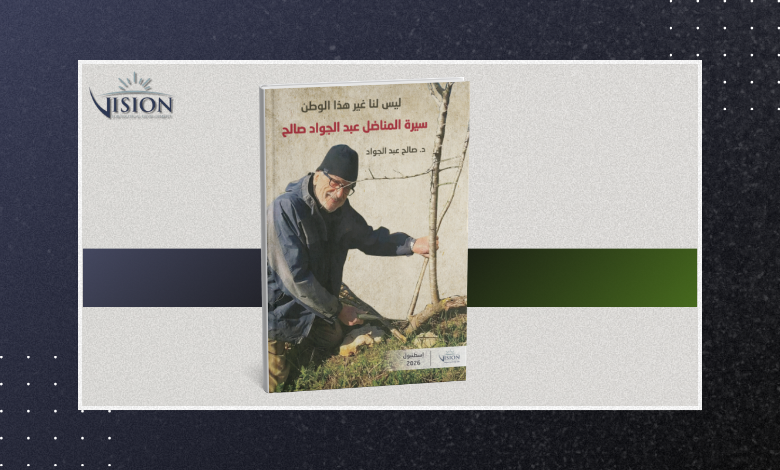
The Vision Center for Political Development’s latest publication; We Have No Other Homeland: The Biography of the Freedom Fighter Abd al-Jawad Saleh
This biography, published by the Vision Centre for Political Development, reflects four years of dedicated research and effort, offering readers a work that is innovative both in its methodology and in its content. Beyond merely recounting the life of the freedom fighter; it chronicles the stages of struggle and historical epochs of the utmost importance in the contemporary history of the Palestinian people, as embodied in the life of Abd al-Jawad Saleh. It adopts a rigorous and methodical approach that goes beyond reliance on the narrator’s memory alone, drawing instead on historical sources and references in order to construct a comprehensive and accurate biographical account. The book’s introduction itself constitutes a scholarly reference in understanding the art of biography. The significance of the biography is further enhanced by its focus on “the independents”—Palestinian leaders unaffiliated with any political party or faction, who shaped their trajectories of struggle through direct engagement in West Bank municipalities, the National Front, and civil institutions in confrontation with the Israeli occupation. This mode of political participation often resulted in deportation, imprisonment, or exposure to assassination attempts.
This book traces the biography of Abd al-Jawad Saleh — popularized as “Abu Saleh” — the Palestinian resistance leader who rose through the ranks of the Palestinian national movement from an early age and held multiple political and official positions throughout his eventful career. Yet his significance as a freedom fighter is not derived from the nature of the positions he held alone; it rests in the enduring national imprint he left and the impact he created in every role he assumed.
Abu Saleh began his political journey as a member of the Arab Socialist Ba’ath Party during his university studies in Cairo in the 1950s. After returning to his homeland (Palestine), he continued his party activities until he withdrew from its ranks in protest against policies that conflicted with his uncompromising critical orientation. Following a period of work in Libya, Abu Saleh returned once more to Palestine to begin the most prominent chapter of his political life: his tenure as Mayor of al-Bireh at the beginning of 1967. This period marked a decisive turning point in his trajectory of struggle, not least because he was, at the time, the youngest mayor—at thirty-one years of age—across the entire Hashemite Kingdom, which then encompassed the West Bank.
With the onset of the Israeli occupation in 1967, Abu Saleh found himself confronted with a new set of responsibilities. His role as mayor went beyond the usual administrative and service functions, extending into the national and activist sphere, as he was called upon to lead the popular resistance front and to confront the measures of the occupation from within his position of authority. This occurred within an exceptional historical context that transformed municipal work into an instrument of confrontation and resilience.
In his understanding of the profound responsibility, Abu Saleh combined formal institutional work through the municipality with popular initiatives that transcended geographical boundaries and the conventional frameworks of official authority. He set about establishing numerous institutions and projects aimed at strengthening popular resistance and enabling people to remain on their land, guided by his deep conviction that no popular resistance movement can rise except on the solid foundations of social and organisational structures — those that transform popular mobilisation from random individual acts into systematic collective action. On another level, the scope of his work expanded to encompass other regions, villages, and towns connected to al-Bireh, primarily through a shared destiny and common cause. In this way, Abu Saleh was transformed from a mayor into a unifying national figure, belonging not to any party but to the Palestinian cause, and to those who embodied it with sincerity.
His tireless activity led the occupation authorities to deport him at the end of 1973, after which he spent twenty years in exile. During this period, he served as a member of the Executive Committee of the Palestine Liberation Organisation in Lebanon. He played an active and influential role in a diverse range of critical matters, most notably issues relating to the occupied territories and the oversight of fortifications in Palestinian military positions and camps in Lebanon.
Abu Saleh continued his work within the organisation until his removal in 1981, after which he moved to Jordan and founded the Jerusalem Centre for Development Studies, which produced a substantial body of research and scholarship, including works authored by Abd al-Jawad Saleh himself. In 1993, Abu Saleh returned to Palestine in parallel with the announcement of the Oslo Accords, resuming his political trajectory through his victory in the elections to the first Legislative Council, before assuming the post of Minister of Agriculture, from which he was later dismissed during the first cabinet reshuffle. Throughout his career, Abu Saleh remained a committed dissident who viewed public office as a means of advancing the struggle; when he was unable to fulfil this role from within formal institutions, he returned to the ranks of the people and engaged directly in their struggle against the occupation.
From these milestones through to his return and steadfast attachment to the land, the full details of this eventful journey are documented in this book, which comprises 561 pages and includes rare historical photographs and a range of documentary appendices, in addition to a selection of tributes and eulogies dedicated to Abd al-Jawad Saleh by a wide spectrum of Palestinian factions, figures, and national institutions.
Availability — First Edition
Vision Centre for Political Development — Istanbul
Al-Maktaba al-Raqamiyya (Digital Library) — Ramallah
Dar al-Shoroq — Ramallah
Dar al-Shamil — Nablus
Downloads
View the book’s table of contents: (Arabic) Click here
View the book’s introduction: (Arabic) Click here
Source
This is an English translation of the original Arabic article published by the Vision Centre for Political Development on 4 May 2026. Original article available at: vision-pd.org