

Majed Al-Zeer

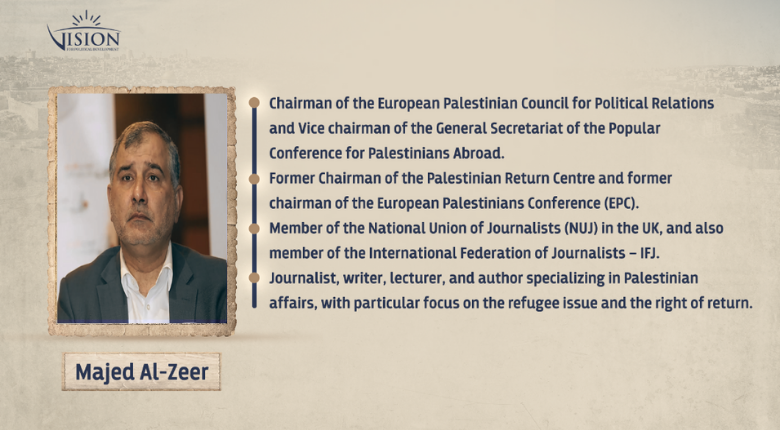
Mr. Majed Al-Zeer was born in the city of Bethlehem on December 8, 1962. He belongs to the Arab Al-Ta‘amreh community from the village of Harmala in the Bethlehem District. He is married and the father of five children—four sons and one daughter.
Al-Zeer completed his basic education at schools of Khalid ibn Al-Walid, Saad ibn Abi Waqqas, and Al-Hariri schools, before pursuing his secondary education at Hawli Secondary School in the State of Kuwait. In 1988, he obtained a Bachelor’s degree in Civil Engineering from Kuwait University. He later earned a Master’s degree in Refugee Studies from the University of East London in the United Kingdom in 2002.
Al-Zeer became active in student affairs at an early stage, serving as President of the Association of Palestinian Students in Kuwait from 1984 to 1986. During this period, he was deeply engaged in advocacy for Palestine, with a particular focus on the plight of Palestinian refugees and the right of return.
He began his professional career as a Journalist in 1994 and has been a member of the British National Union of Journalists and the International Federation of Journalists for the past three decades.
Al-Zeer served as President of the Palestinian Return Centre (PRC), based in London, from 1996 to 2020. He also held the position of President of the Palestinians in Europe Conference from 2003 to 2021.
In addition, he served as President of the European Palestinian Council for Political Relations and as Vice President of the General Assembly of the Popular Conference for Palestinians Abroad.
In 2014, Al-Zeer relocated to Berlin, where he continued his Palestinian national work at the European level, operating within the framework of European laws and within the limits permitted therein.
Al-Zeer worked through the Palestinian Return Centre to keep the right of return at the forefront of attention as a central pillar of the Palestinian cause. He contributed to organising mass public activities demanding the right of return, which contributed to the establishment of the Palestinians in Europe Conference in 2003. This initiative helped create a transnational national action and offered a practical, grassroots model that embodies the Palestinian people’s steadfast commitment to their right of return despite geographical distance and the passage of time.
During his running of the Palestinian Return Centre, the Centre obtained consultative status with United Nations–affiliated non-governmental organisations in 2015.
Al-Zeer has authored numerous studies, research, and working papers addressing various aspects of the Palestinian cause, with particular emphasis on the issue of refugees and the right of return.
He has also published three books, the first of which is entitled, “Closer to Return” in 2020, and it is a collection of 85 articles written over a period of 20 years documenting work related to the right of return and Palestinian national action.
The second book, “Palestinian Public Activism in Europe”, co-authored with Maher Hijazi and issued in 2024, examines Palestinian grassroots activism in Europe, its achievements, challenges, and prospects, drawing on the Palestinian Return Centre and the Palestinians in Europe Conference as a model.
The third book is entitled “The Continuity”, issued in 2025 and co-authored with Ibrahim Al-Ali, and explores the factors that have kept the Palestinian cause alive.
Al-Zeer believes that the national dimension is the most essential pillar of Palestinian work in the diaspora. He affirms that his relationship with the national cause is founded on the principle of serving the Palestinian cause without compromising rights. He maintains that the platforms through which he works are open to all who believe in the principle of upholding Palestinian rights.
He also believes that all of Palestine is the land of the Palestinian people and remains under occupation, and that the Palestinian people have the right to resist the occupation by all means permitted under international law to fully restore their rights. Al-Zeer further emphasises the inclusive national character of Palestine as a homeland for all its people, regardless of their religious affiliations or intellectual orientations.
He believes that the Oslo Accords are a catastrophe that befell the Palestinian people which created negative consequences of which continue to this day.
He calls for a complete and effective annulment of these accords. He also views the Palestinian division as having two dimensions: a divergence in political visions and a practical, on-the-ground split. He argues that there is no overlap between these opposing visions and that the disagreement will persist as long as it revolves around adherence to rights, refusal to relinquish them, and commitment to restoring them.
Al-Zeer affirms that no solution can be imposed on the Palestinian people against their will, and that the optimal approach lies in managing disagreements in a manner practised in other countries, where partisan differences may reach the level of outright contradiction.
In such cases, the final authority should rest with democratic institutions that enable the people to choose their representatives in a way that reflects their will and defends their rights.
Moreover, Al-Zeer calls for the establishment of an inclusive political framework that is nationally agreed upon by Palestinians, stressing that the Palestine Liberation Organisation (PLO), as a national legacy built through the contributions of all segments of the Palestinian people, must be preserved and rebuilt on democratic foundations.
This includes holding elections wherever possible and reaching consensus where elections are not feasible, in accordance with an agreed factional reference framework.
Such a process, he argues, would safeguard unity and produce a Palestinian leadership through an elected Palestinian National Council, followed by an elected Central Council, ultimately leading to an elected leadership that genuinely reflects the will and convictions of the Palestinian people.
Al-Zeer also urges the Palestinian people to mobilise all available elements of strength, both domestically and internationally, in support of a comprehensive liberation project that employs all lawful and internationally available means to fully restore rights and achieve return to all of Palestine.
He affirms his conviction that existing political solutions have failed to secure even the minimum rights of the Palestinian people, due to the nature of the occupation which is founded on dominance and exclusion.
He further emphasises that the Arab world, in general, must serve as a supportive incubator for the liberation of Palestine, asserting that the Palestinian people’s liberation and attainment of their legitimate national and international rights cannot be realised amid the prevailing injustice in the Arab region.
He considers the international dimension of the Palestinian cause, and its integration into the broader liberation project, to be of critical strategic importance.
Al-Zeer also believes that mobilising Islamic and international support, and galvanising free people around the world, are among the most important factors in keeping the Palestinian cause alive and advancing efforts to restore Palestinian rights.
He regards the current Palestinian political system as ineffective and unsuccessful, as it marginalises the people and suppresses their will and voice.
Al-Zeer maintains that the overwhelming majority of Palestinians cannot be compelled to relinquish their right to participate in elections and to choose a leadership that represents them.