Genocide and Settlement Expansion: A Summary of Israeli Violations in August 2026

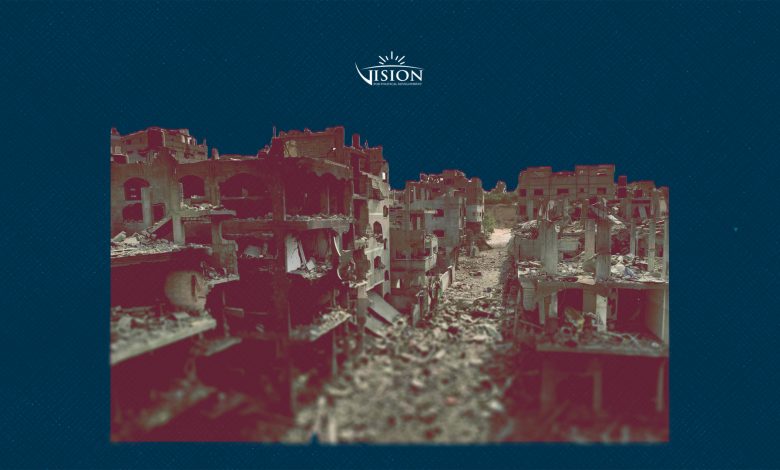
This report documents the most significant violations committed by the Israeli occupation against Palestinians during August 2026, amid continued killings and displacement, worsening health and living conditions in the Gaza Strip, and expanding military and settler attacks across the West Bank, including occupied Jerusalem. It covers arrests, demolitions of homes and structures, land seizures, attacks on crops, as well as settlement plans and measures affecting Palestinian powers and entrenching de facto annexation. The documented developments reveal how these practices are interconnected in undermining the foundations of Palestinian life, depriving residents of their rights to safety, housing, health, education and work, and deepening coercive conditions that drive them from their land and homes.
The report draws on information from the United Nations Office for the Coordination of Humanitarian Affairs (OCHA), the Colonization and Wall Resistance Commission, Peace Now, and the Negotiations Affairs Department of the Palestine Liberation Organization.
Genocidal War on the Gaza Strip
Military activities in the Gaza Strip continue to inflict further civilian casualties and trigger new waves of displacement, while causing extensive damage to civilian and humanitarian infrastructure. Recent incidents have also affected humanitarian facilities and warehouses, exacerbating the challenges obstructing aid delivery and efforts to meet residents’ basic needs.
Since the ceasefire of October 11, 1,334 Palestinians have been killed and another 4,429 injured. This brings the cumulative toll since the beginning of the Israeli offensive on October 7, 2023, to 73,470 Palestinians killed and 174,540 injured.
The health sector is approaching a highly critical stage as stocks of medicines, medical supplies and reagents used in laboratory testing continue to decline, alongside shortages of supplies for dialysis patients and oxygen equipment. Restrictions on the entry of medical shipments and delays in their arrival are limiting the ability of hospitals and health centers to continue operating, placing thousands of patients and wounded people at life-threatening risk.
Concerns have intensified following the Ministry of Health’s announcement that its central warehouses have run out of intravenous fluids, which are essential for emergency departments, surgical procedures, and the treatment of patients and wounded people. This threatens to disrupt further essential medical interventions.
Alongside the collapse of the health sector, the shelter crisis is deepening across the Gaza Strip. Approximately 1.98 million people, representing 94% of the population, lack adequate shelter and basic household necessities. Moreover, 58% of the population are living in conditions classified as critical or catastrophic due to inadequate accommodation and the absence of essential services and supplies.
Nearly 84% of households face extremely harsh living conditions, particularly due to the lack of shelter capable of protecting them from changing weather conditions. This exposes displaced people—especially children, patients and the elderly—to additional health and humanitarian risks.
Key Statistics on Israeli Violations in the West Bank and Jerusalem
Violations against Palestinians in the West Bank, including East Jerusalem, are escalating amid expanding attacks by Israeli forces and settlers, land seizures and movement restrictions, as well as forced evictions and attacks on educational facilities and private property.
Since the beginning of 2026, 79 Palestinians, including 19 children, have been killed, while approximately 1,870 others have been injured by Israeli forces or settlers. Twenty-three deaths and more than 1,040 injuries occurred in the context of settler attacks. The figures reveal an unprecedented acceleration in the rate of injuries directly caused by such attacks: while the average stood at one Palestinian injured every three days in 2020, it rose to two injuries per day in 2025 and has exceeded three injuries per day since the beginning of 2026.
During the second half of August, 80 settler attacks resulting in Palestinian casualties or property damage were recorded. These attacks displaced three families from their homes. A six-member family, including four children, was forced to leave its home near Yatta in the Hebron governorate after settlers set it on fire on August 20. Two other families comprising nine people, including two children, were also displaced after their homes and livelihood structures were burned in the town of Burqa in the Ramallah governorate.
In and around the village of Al-Mughayyir in the Ramallah governorate, repeated attacks targeted residents and their vehicles and extended to the only road leading to the village, repeatedly obstructing residents’ movement and isolating the community. On August 20 alone, 11 Palestinians were injured during a large-scale attack on the village.
In Qusra, three families remained nearly isolated from their surroundings following the establishment of a settlement outpost inside Area B around August 9. As of August 26, the families faced severe restrictions on their movement, with two of the four roads connecting the area to the rest of the town subject to Israeli measures: one through a permanent military checkpoint and the other through a gate installed by Israeli forces.
Israeli forces used one of the affected families’ homes as a base for approximately 10 days before withdrawing on August 23, allowing the family to return. During the period in which the house was occupied, most of its contents were removed and many were damaged.
This comes amid accelerating settlement expansion within Palestinian areas. Settlers have established at least 26 outposts in Area B over the past two and a half years, including 19 established since late 2024, most of which appeared during recent months. Estimates indicate that settlers have taken control of more than 100,000 dunams in Areas A and B, including approximately 55,000 dunams in Area B. This takeover has been accompanied by attacks and intimidation aimed at preventing landowners from accessing their property and forcing some families to leave their homes.
East of Jenin, the return of settlers to the Ganim settlement, which was evacuated in 2005, was accompanied by extensive military measures. On August 13, Israeli forces erected checkpoints and closed sections of Route 60, cutting off direct access to Jenin city for residents of approximately 10 villages with a combined population of more than 20,000 Palestinians.
In Tulkarm, Israeli forces temporarily evacuated approximately 10 families from the Jabal al-Nasr neighborhood on August 17, forcing them to remain away from their homes for seven hours while military activities were carried out near the adjacent Nur Shams refugee camp.
In an escalation targeting facilities belonging to the United Nations Relief and Works Agency for Palestine Refugees (UNRWA) in East Jerusalem, Israeli forces raided and seized the Qalandia Vocational Training Center on August 25. The move deprived 340 young Palestinian refugees of the ability to continue their education and threatened the right of thousands more to benefit from its services in the coming years. Established in 1952, the center is UNRWA’s oldest vocational training facility.
In Jerusalem, Palestinians continue to be uprooted from their homes through Israeli court rulings. Since the beginning of 2026, 24 families comprising 93 people, including 30 children, have been forced to vacate their homes, most of them in the town of Silwan. Around 200 additional families comprising approximately 900 people remain at risk of the same fate due to pending eviction cases before Israeli courts, most of which were filed by settler organizations.
Palestinians Killed and Injured
Attacks and raids carried out by Israeli forces across various parts of the West Bank during August killed six Palestinians, including two children. The Jenin governorate recorded the highest death toll, with four Palestinians killed.
Another 105 Palestinians, including 14 children and six women, were injured by gunfire and assaults accompanying Israeli military raids across the West Bank.
Arrests
Israeli forces intensified arrest campaigns across the West Bank during the period covered by the report. Relevant bodies documented the arrest of 705 Palestinians, including 18 children and five women.
Nablus governorate recorded the highest number of arrests, with 123 cases, followed by Hebron with 107. The remaining arrests were distributed across the governorates of Jerusalem, Bethlehem, Jericho, Salfit, Qalqilya, Tulkarm, Tubas and Jenin.
Demolition of Homes and Structures
During August, Israeli authorities intensified demolitions of Palestinian structures, carrying out 71 demolition operations affecting 155 structures. These included 47 inhabited homes, eight uninhabited homes, 33 economic structures that served as sources of livelihood, 61 agricultural structures and six structures of other types.
Geographically, Jenin was the most affected governorate, with 29 structures demolished, followed by Jericho and Hebron with 24 each, Nablus with 21, Ramallah and Al-Bireh with 16, Jerusalem with 15, Bethlehem with 13, Tubas with nine and Tulkarm with three. One structure was demolished in Qalqilya.
The demolition policy was not limited to structures that were actually destroyed but extended to threats against additional properties. During the month, Israeli authorities issued 44 demolition notices, concentrated primarily in Hebron governorate, where 11 notices were issued. Jerusalem and Bethlehem each recorded eight notices, while Jenin and Tulkarm each recorded five.
This policy had a direct impact on Palestinians’ lives, with demolitions affecting at least 200 documented individuals, including 75 children and 56 women. These figures demonstrate that demolitions do not merely target physical structures but undermine family stability and livelihoods, imposing coercive living conditions on Palestinian families that restrict their ability to remain and push them toward displacement.
Land Confiscation and Bulldozing
Israeli authorities expanded their control over Palestinian land during August, targeting approximately 1,629 dunams through a series of military orders. “State land” declarations were the primary mechanism used, covering 1,152 dunams of land belonging to Sinjil, Al-Lubban ash-Sharqiya and Qaryut, as well as 370.28 dunams belonging to Abu Dis and Arab al-Sawahra. Including other orders, the area subjected to direct confiscation during the month reached approximately 1,628.5 dunams, while the declaration concerning Abu Dis and Arab al-Sawahra threatens the geographical area on which the Al-Muntar Bedouin community is located.
Israeli authorities also used “seizure orders” as an additional means of taking control of land, issuing nine such orders during August affecting more than 106 dunams. The largest targeted areas were in Beitunia, at approximately 37.481 dunams; Tubas, 19.30 dunams; Al-Jib, 15.580 dunams; Al-Bireh, 15.342 dunams; and Jaba’, 11.970 dunams. Other orders affected land in Marka, Marda, Jinsafut and Jericho.
At the same time, Israeli authorities issued eight orders under the pretext of “taking security measures,” imposing restrictions on 317.086 dunams and permitting the removal of wild vegetation and the uprooting of olive trees. The overwhelming majority of the affected land was in the Jenin governorate, which alone accounted for 310.868 dunams of the total area covered by these orders.
Land targeted under “security measures” orders is not classified as directly confiscated, but the practical consequences are no less serious. Such orders restrict landowners’ access, prevent them from using their land, and allow changes to its physical features and vegetation. The variety of legal and military designations reveals different mechanisms leading to the same outcome: tightening control over the land and reducing Palestinians’ ability to use it. When “state land” declarations, “seizure orders” and “security measures” orders are combined, the total area targeted during August reached 1,945.597 dunams.
Settler attacks during August targeted 21,508 trees, including 19,375 olive trees, accounting for more than 90% of all affected trees. Salfit governorate recorded the highest number, with 4,892 trees, followed by Jenin with 4,241, Nablus with 3,718, Qalqilya with 3,530, Hebron with 2,311, Ramallah and Al-Bireh with 1,652, Tubas with 802 and Bethlehem with 362 trees.
The heavy concentration of attacks on olive trees shows that the damage extends beyond the destruction of crops, striking at one of the most important pillars of the Palestinian rural economy and a major source of family income. It also affects Palestinians’ deeply rooted relationship with their land and threatens the continuity of agricultural activity, particularly because replacing mature trees and restoring their productive capacity requires many years.
Settlement Activity
August witnessed an expansion of settlement activity in the West Bank and occupied Jerusalem, including attempts to establish new outposts, advance construction, road and infrastructure plans, and seize land to retroactively legalize existing outposts under Israeli law. Together with the removal of Palestinian powers and the displacement of residents, these measures reveal a trajectory linking the physical expansion of settlements to the restructuring of control over the land and the fragmentation of geographical continuity between Palestinian communities.
On the ground, settlers attempted to establish 32 new settlement outposts during the month. Nine of these attempts took place in the Ramallah and Al-Bireh governorate, followed by Hebron and Nablus with six attempts each, Jenin with three, Jerusalem, Bethlehem and Tubas with two each, and Tulkarm and Qalqilya with one attempt each.
Alongside attempts to establish new outposts, Israeli authorities advanced 12 settlement plans and projects in the West Bank and occupied Jerusalem, comprising six plans deposited for approval, four approved plans and two construction tenders. These measures covered 3,819 housing units, while the deposited and approved plans encompassed 5,472.22 dunams, reflecting how residential expansion is coupled with the allocation of large areas for roads and infrastructure needed to serve it.
Nine of these plans and projects were located in the West Bank. They included four deposited plans covering 912 housing units across 476.618 dunams in the settlements of Avigail, Hananit, Psagot and Givat Ze’ev. Three additional plans were approved, covering 156 units across 4,871.402 dunams. The most significant was the expansion of Route 60 between the Tapuah Junction and the British Police Junction, extending for 18 kilometers across an area of 4,693 dunams. In addition, two tenders were issued for the construction of 1,861 housing units, including 627 units in Kochav Ya’akov and 1,234 units in the E1 area.
In occupied Jerusalem, the measures included three plans, two of which were deposited for the construction of 890 housing units across 30.176 dunams: 650 units in the new Nofei Rachel settlement at the western entrance to Sur Baher and 240 units in Gilo. An infrastructure plan south of Gilo covering 94.024 dunams was also approved. The simultaneous advancement of housing, road and infrastructure projects indicates expansion that goes beyond adding residential units, strengthening connections between settlement blocs and further isolating Palestinian communities.
The E1 tender stands out as one of the most dangerous components of this process because of its location and impact on Palestinian geographical continuity. According to Peace Now, the Israeli Ministry of Housing issued the tender on August 18, 2026, as part of a broader plan comprising 3,401 housing units. October 19 was set as the deadline for bids, approximately one week before the Israeli elections. Peace Now believes the timing is intended to ensure construction contracts are signed before the elections, making it more difficult for the next government to cancel the project.
The tender was opened despite an ongoing court petition against the plan and without prior notification to the petitioners, contrary to a government commitment made before the court. The move entrenches settlement realities that separate the northern West Bank from the south and isolate East Jerusalem from its Palestinian surroundings, undermining prospects for the establishment of a geographically contiguous Palestinian state.
To make additional land available for settlement expansion, Israeli authorities also declared Palestinian areas as “state land.” These declarations covered approximately 1,522 dunams during the second half of August, including 1,152 dunams belonging to Sinjil, Al-Lubban ash-Sharqiya and Qaryut to legalize the Givat Harel outpost, and 370.28 dunams belonging to Abu Dis and Al-Sawahra ash-Sharqiya to legalize the Keidar South outpost and connect it with the planned Mishmar Yehuda settlement, expanding settlement control around the E1 area.
The boundaries of the land included in these declarations show that the targeted areas extend far beyond existing construction. The area declared around Givat Harel is more than four times the size of the outpost itself. In Abu Dis and Al-Sawahra ash-Sharqiya, the declaration encompasses almost all the land surrounding Bedouin residents’ homes, leaving them only small areas immediately adjacent to their dwellings. The total amount of land declared “state land” since the current government was formed in December 2022 has risen to approximately 28,641 dunams, exceeding the total area declared under this designation from the Oslo Accords until the formation of the current government.
This expansion is inseparable from the extension of Israeli control measures into areas under Palestinian jurisdiction. In a report published on August 13, 2026, Peace Now documented the establishment of 26 settlement outposts in Area B over the past two and a half years, settlers’ takeover of approximately 100,000 dunams in Areas A and B, the displacement of at least 19 Palestinian communities and population groups in Area B, and the seizure of dozens of homes.
At the military level, the report noted the displacement of approximately 33,000 Palestinians from the Jenin, Tulkarm and Nur Shams refugee camps since January 2025, their continued prevention from returning, and the establishment of a permanent military base near Jenin refugee camp inside Area A. It also documented the issuance of 15 land seizure orders in July 2026 affecting approximately 200 dunams within Area A for the construction of a road connecting two new settlements.
Measures on the ground have been accompanied by a reduction in Palestinian powers. The report documented the expansion of the Israeli Civil Administration’s authority in Areas A and B in matters related to the environment, water and antiquities, as well as the allocation of 113 million shekels to archaeological projects involving sites in both areas. It also documented the removal of Palestinian planning and construction powers concerning settlement outposts and holy sites in the heart of Hebron. The report further noted the complete suspension of the transfer of Palestinian clearance revenues since June 2025, even though they account for more than 60% of the Palestinian Authority’s budget, exacerbating its financial crisis and weakening its ability to carry out its functions.
These steps form part of a government policy aimed at weakening the Palestinian Authority economically, politically and in security terms, undermining its control over the land with the ultimate aim of bringing about its collapse and blocking a political settlement based on the two-state solution. Developments in Areas A and B constitute an extension of the de facto annexation process that began in Area C, through the imposition of settlement realities, the removal of Palestinian powers and the hollowing out of the Oslo Accords without formally declaring their cancellation or the annexation of the territory.
In occupied Jerusalem, the seizure of property also takes a judicial route that results in the eviction of Palestinian residents and their replacement by settlers. Settlers affiliated with the Ateret Cohanim organization seized the Al-Basha family home in the Old City on July 22, 2026, after the last elderly couple residing there was forced to leave under a court order. The eviction followed lawsuits filed by a body affiliated with the Israeli Ministry of Justice against six elderly couples from the family, based on claims that the property belonged to a Jewish endowment, despite the family having lived there since the 1930s and having purchased parts of the property and rented others under agreements dating to before 1948.
NOTE: This text is adapted from original Arabic article.