
Leadership Crisis in Israeli Opposition: Will Gadi Eisenkot Be Netanyahu’s Alternative?

Saher Ghazawey & Karim Kurt
Israeli politics has been marked by volatility and instability since 2019, reflected in the rapid rise of figures who were successively presented as the alternative capable of challenging Benjamin Netanyahu, only to decline just as quickly. This phenomenon has deepened amid the continuing political crisis and, later, the war and its domestic and external repercussions, reinforcing a recurring search for an “alternative” rather than for a new political project. In this context, Gadi Eisenkot has emerged as one of the leading candidates for prime minister, while the National Unity party now faces the prospect of failing to cross the electoral threshold.
This article seeks to analyze the rise of the “alternative” in Israeli politics by examining the political, security and media factors that contribute to its emergence. It uses a comparative tracking and analysis approach to examine the paths of the figures who have led the opposition to Netanyahu from the April 2019 elections through the October 2026 elections, taking Gadi Eisenkot as a case study.
The Leadership Crisis in the Israeli Opposition
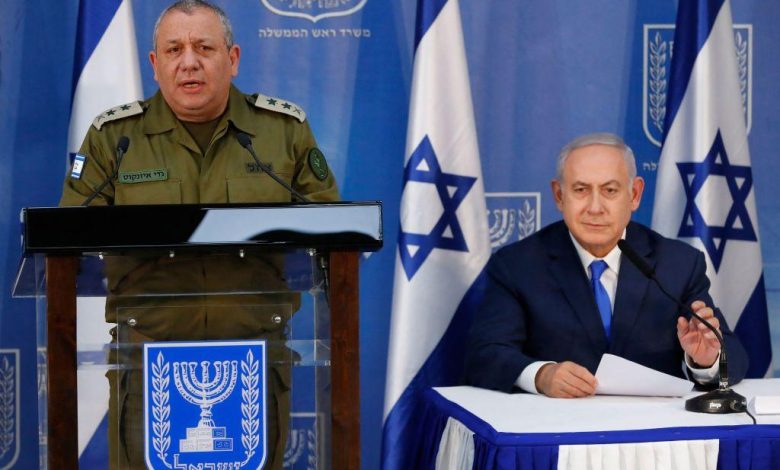
Since the April 2019 elections, Israeli politics has seen no stability in the leadership of the political forces at the forefront of opposition to Benjamin Netanyahu. Instead, more than one leader has successively assumed the role of the “alternative.” According to a poll conducted by the Israeli Public Broadcasting Corporation following the dissolution of the Knesset on July 17, Gadi Eisenkot and his Yashar party came first with 24 seats, ahead of Likud with 23 seats and well ahead of the Bennett-Lapid alliance, “Beyachad,” which secured only 15 seats. This makes Eisenkot the leading candidate to challenge Netanyahu and lead the opposition bloc.
Eisenkot’s rapid rise has come amid a sharp decline in the standing of other leaders and parties in the opposition camp that had served as Likud’s main challengers in recent years. Since October 7, 2023, Israeli politics has witnessed the rapid rise and fall of two central figures: Benny Gantz and Naftali Bennett.
In the first months of the war, Gantz and his National Unity party were polling at around 42 seats, an unusually high figure in Israeli politics over the past two decades, particularly given that the party held only 12 seats in the Knesset. Gantz’s support, however, continued to decline amid several changes within his party, including Gideon Sa’ar’s departure, followed by Gantz’s withdrawal from Netanyahu’s emergency government and his later declaration that he was prepared to return to it, a move described as an attempt to rescue Netanyahu once again. His decline continued with Eisenkot’s departure from the party in June 2025, culminating in the party falling below the electoral threshold for the first time in polls in August 2025.
As Gantz declined, Naftali Bennett’s prospects began to rise in his place, also benefiting from the weakening of Likud and other parties. In the first poll to include him hypothetically, since he was outside the political arena at the time, Bennett won 23 seats in August 2024. By late 2024, however, Bennett had begun to overtake Likud, which received 24 seats compared with 25 for Bennett if he were to form a party. His support continued to rise rapidly, reaching 27 seats just one week after the previous poll.
When Bennett and Yair Lapid announced an alliance between their parties under the name Beyachad (“Together”) in April 2026, expectations were that the new party would secure more than 30 seats, given the number of seats each party had been polling separately. The polls, however, showed the opposite, with the alliance securing only 26 seats. It continued to decline afterward until it was polling at just 15 seats, a rapid loss of roughly 15 seats in about three months.
Meanwhile, Eisenkot, who founded his party “Yashar” in September 2025, was gaining ground in the polls. He began with nine seats, rising to 15 seats when the Bennett-Lapid alliance was formed. As Beyachad continued to decline, alongside the decline of Likud and its coalition, Eisenkot reached 24 seats, as noted above.
The preceding overview points to a state of chronic political instability in Israel, with figures and parties emerging within months or even weeks, topping the polls and then declining to the point of near-collapse. Now, with the electoral race underway following the dissolution of the Knesset, such swings are likely to become even faster and measured in days. This sequence also shows that the change has been less about political programs than about the individual figure on whom voters pin their hopes at each stage.
On the other hand, these rapid rises and falls do not necessarily follow logical or objective factors. Netanyahu is an exception: his standing declines during crises and periods in which his policies fail, then recovers when he manages to achieve military and political successes, before falling again as those achievements fade. The other leading opposition figures, however, do not follow the same pattern.
It would be logical for swings in Gantz’s polling numbers to correspond with Netanyahu’s rise and fall. Instead, Gantz virtually disappears from the polls and Bennett takes his place. Bennett, for his part, has no substantial political record that would qualify him for such a position. During his single year as prime minister, a position he attained through an opportunistic turn of events, his policies were far from those of a strong statesman. He betrayed his partners on the right in exchange for becoming prime minister, and once he assumed the post, the unraveling of the “change government” began within his own party and office. This ultimately pushed him out of the political arena altogether, leaving behind his party and his partner Ayelet Shaked to struggle and ultimately fail to cross the electoral threshold in the 2022 elections.
Gadi Eisenkot: The Black Horse
Likewise, Eisenkot’s current rise may appear unjustified in light of his recent political record. Unlike many generals who moved directly to establish new parties or sought to lead the political arena after retiring from the military, Eisenkot chose to enter party politics through collective political action. In 2022, he joined “National Unity”, led by Gantz. The two shared a military background and broadly similar views on most security and strategic issues. At that stage, Eisenkot was not seen as a rival to Gantz, but rather as a partner who strengthened the party’s standing and added further security credentials, drawing on the respect and credibility he enjoyed within the military establishment.
Following the events of October 7, 2023, both Gantz and Eisenkot joined the emergency government formed by Netanyahu. They served together in the war cabinet, voiced similar criticism of the conduct of the war, and withdrew from the government at the same time. Yet this shared political path produced different outcomes: Gantz’s popularity declined sharply, while Eisenkot’s began to rise, even though his political experience had not been independent of Gantz’s.
As Benny Gantz’s popularity gradually declined, Eisenkot did not need to offer a radically different political project in order to overtake him in the polls, since their positions remained similar on most major issues. The main difference was not their political programs, but the public image that developed around each man. Over time, Gantz came to be seen as a conventional politician worn down by his repeated participation in governments and compromises with Netanyahu. Eisenkot, by contrast, retained the image of a “mamlakhti” (ממלכתי) figure, a term commonly used in Israeli political discourse to describe someone with a statesmanlike, institutional character who places considerations of the state and the public interest above narrow partisan and personal calculations. This image strengthened his standing among segments of the electorate seeking new leadership for the political center, making him appear, in the eyes of many, as the alternative most capable of challenging Netanyahu and restoring confidence in this camp.
His rise has been shaped by a combination of personal, political and security-related factors. Eisenkot entered politics after a long military career that culminated in his tenure as chief of staff of the Israeli military from 2015 to 2019, a period that cemented his image in the Israeli public consciousness as a professional commander known for calm and discipline, limited media exposure and distance from the populist rhetoric associated with a number of politicians.
Alongside these political factors, personal circumstances helped reinforce this image, foremost among them the loss of his son Gal in the fighting in the Gaza Strip, followed months later by the loss of a relative. This gave his political presence a human dimension in Israeli society and helped strengthen his image among segments of public opinion as a leader who had personally paid the price of the war rather than merely an official speaking about it from afar.
Yet the distinction between Eisenkot and Gantz may also appear less convincing when put to a practical test. As noted above, there has been no decisive point in Eisenkot’s political career at which he charted a fundamentally different course from Gantz. Even his military credentials are shared by Gantz, who also served as chief of staff from 2012 to 2015. Eisenkot has also faced criticism for being responsible for reducing and neglecting the military’s ground forces during his tenure as chief of staff, which critics argue contributed to the events of October 7.
The most direct factor behind Eisenkot’s rise, however, has been Bennett’s decline, particularly after his alliance with Lapid. Eisenkot had initially been expected to join the alliance, but ultimately did not, because he personally aspires to compete for the premiership and had a different vision for the nature of the coalition in which he wanted to participate with them. The main factor behind his current rise can therefore be described as an “empty throne”: there is no opposition figure who has maintained broad support or demonstrated the ability to attract votes from across different political currents, particularly the right and center, and thereby lead the opposition bloc. Eisenkot has thus found himself rising from the ruins of Gantz’s political standing while benefiting from the simultaneous decline of Bennett and Lapid. Meanwhile, Yair Golan, leader of The Democrats, and Avigdor Lieberman, leader of Yisrael Beiteinu, are unable to compete for the leadership of the opposition because they represent specific constituencies and political currents.
Why Does the Israeli Alternative Rise and Then Fall?
If Gadi Eisenkot’s rise has been linked to personal, political and security factors, as well as broader political instability, the more important question concerns not the man himself, but the political pattern that produced his rise.
This phenomenon cannot be explained simply by the personal differences between Gantz, Bennett, Eisenkot and Lapid, because what they have in common outweighs their differences. All belong to the right or center-right and hold similar positions on most security and strategic issues. None offers a political project that breaks with the prevailing Zionist shared position, particularly on the Palestinian issue. The shift in support from one figure to another therefore does not reflect an ideological transformation among Israeli voters so much as a continuing search for the figure who, at a particular moment, appears most capable of challenging Netanyahu.
This reality points to a structural crisis among the political forces generally classified as Israel’s “centrist camp.” Since the decline of the “Zionist Camp” experiment in 2015, these forces have failed to build a stable party framework or a unifying leadership capable of competing with Likud over the long term. Instead, they have come to rely more on personalities than on institutions and political programs. Nor does this “camp” represent a unified political current anymore. Rather, it is a broad electoral framework bringing together different forces united more by their opposition to Netanyahu than by a common political, economic or social project. Likud, by contrast, has maintained its organizational cohesion under Netanyahu, meaning that any decline in the image of an opposition leader is quickly reflected in the party he leads, as happened with Benny Gantz.
Yet the repeated search for an “alternative” cannot be explained by the opposition’s crisis alone. It is also tied to the political disorientation within Israeli society resulting from a succession of accumulating crises since 2019. Political instability and repeated elections, followed by the October 7 attack and the prolonged war that followed, along with the human and economic losses, the deterioration of Israel’s international image, mounting criticism of the government’s performance, and the growing debate over the role of Haredi parties and the burden of military conscription, have deepened the sense that a change in leadership is needed. At the same time, opposition forces have failed to present a coherent political project capable of addressing these challenges. Their main common denominator has remained opposition to Netanyahu rather than the presentation of an alternative vision. As a result, a growing segment of Israelis knows what it does not want, but has yet to decide what it does want or who can lead the next phase.
In this context, the rise and decline of Netanyahu’s challengers appears to be closely linked to the level of public confidence in his political and security performance. Whenever Netanyahu’s popularity declines or the crises facing his government intensify, the chances increase that a new figure will emerge and be presented as the “alternative” capable of challenging him. Conversely, when Netanyahu regains the initiative or improves his political standing, the momentum behind these challengers declines. This was evident, for example, following Israel’s first war on Iran in June 2025, after which Likud returned to first place in the polls. This prompted analyses suggesting that Netanyahu could launch another operation against Iran ahead of the elections in order to further improve his position.
The rise of the “alternative,” therefore, does not follow an independent path, but is heavily influenced by Netanyahu’s own strength or weakness. As Netanyahu improves his position, his rivals become increasingly worn down and their political capital weakened, particularly as they continue to direct accusations against him. Their popularity then begins to fade, especially as alliances, splits and other political maneuvers among his challengers erode their momentum.
Netanyahu himself may be the greatest beneficiary of the opposition’s transformation into an “Anyone but Netanyahu” camp. By directing their entire political discourse toward Netanyahu and his failed policies, opposition leaders leave him able to undermine their entire narrative whenever he achieves a major success, causing them to lose standing in the eyes of the public.
Opinion polls and the media also play an important role in perpetuating this phenomenon. They do not merely measure public sentiment, but also contribute to reshaping it by presenting a particular figure as the “alternative most capable of winning.” As this image is repeatedly reinforced in the media, votes within the same political camp shift toward that figure, not necessarily out of conviction in their political program, but on the basis of pragmatic calculations centered on identifying the candidate most capable of removing Netanyahu.
Conclusion
Based on the above, Eisenkot’s current rise is far from guaranteed, not only because of the rapidly shifting political dynamics within the opposition camp, but also for reasons related to his party and the policies he will seek to implement. On the party level, Eisenkot is still trying to recruit figures to fill the seats that opinion polls currently project for him, but he faces a genuine challenge in attracting prominent names capable of reinforcing his momentum. At the same time, if Eisenkot remains at the forefront of the political scene, he will face the same challenges that confronted Gantz and, before him, Bennett. The closer any candidate gets to power, the more they move from being a symbol to being a politician required to provide practical answers on the conduct of the war, coalition formation, relations with Haredi parties, the role of Arab parties, and the management of competing interests within and beyond their own political camp. These issues quickly force compromises that erode the image that initially drove their rise.
This dynamic becomes even more pronounced as a challenger approaches a position of responsibility, whether shortly before an election or immediately afterward. Once they enter coalition negotiations, are forced to make concessions, or join a government, the image of the “clean leader” or “savior” begins to fade, and the search begins for another figure who has not yet been politically worn down.