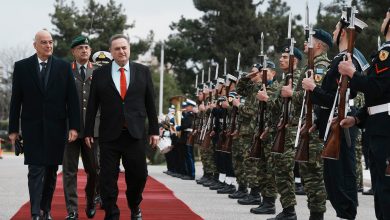
Serbia Localises Israeli Drone Manufacturing: Military Cooperation in the Shadow of Genocide and Diplomatic Isolation

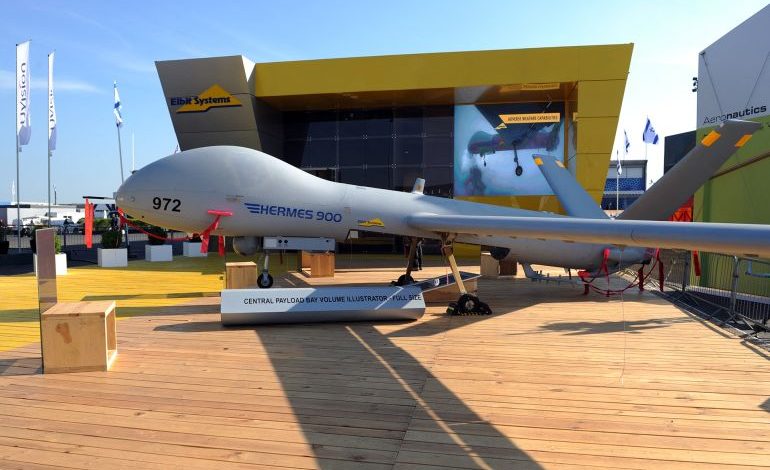
On 17 September 2026, Serbian President Aleksandar Vučić inaugurated a factory for assembling Israeli-designed drones, saying it would create around 100 jobs and produce “highly advanced” equipment for the Serbian armed forces and the armies of other countries. He also announced that Belgrade and its Israeli partners would open at least three additional factories across Serbia. Journalists were not invited to the inauguration owing to “the secrecy of the production process”; Vučić instead released limited footage showing his tour of the facility alongside Israeli Ambassador Avivit Bar Ilan. In that footage he described the drones as capable of “entering through windows and pursuing the enemy,” and noted that the warheads would be manufactured at Serbia’s Krušik military-industrial facility.
Although the Serbian president did not name the Israeli partner, a joint investigation by BIRN and Haaretz published in April 2026 revealed that Elbit Systems would hold a 51% stake in the venture, with the remaining 49% going to the Serbian state company Yugoimport SDPR. The Israeli Embassy in Belgrade subsequently celebrated the inauguration as a “new milestone” in cooperation between Serbia’s defence industries and Elbit. A further report indicated that the factory is located in the Makiš district of Belgrade and will produce two types of combat drone: one short-range with rotary wings and high payload capacity, the other faster and longer-range with a ceiling exceeding six kilometres. The project does not represent a conventional arms transaction; it marks a significant shift in bilateral cooperation, from purchasing Israeli weapons to assembling and producing them locally inside Serbia.
In this context, this article unpacks the dimensions of localising Israeli drone production in Serbia: surveying the accelerating context of defence cooperation between the two sides, analysing the Israeli motivations and Serbian gains behind the project, examining the political and security challenges it faces, and, finally, assessing the limits of this model as a practical substitute for Tel Aviv’s declining relations with the major European powers.
Israel’s Objectives in Serbia
The factory inauguration cannot be separated from an accelerating trajectory in bilateral defence relations, reflected in three principal indicators.
The first is large-scale procurement: Serbia purchased the PULS rocket-artillery systems and Hermes 900 drones for $335 million at the start of 2025, then signed a five-year contract worth $1.63 billion in August 2025 covering precision long-range missiles, electronic warfare systems, and intelligence, surveillance and reconnaissance capabilities; one of the highest-value contracts in Israeli defence-industry history.
The second is reverse exports: The value of Serbian arms exports to Israel rose roughly 42-fold since 2023 to reach €114 million in 2025, with Yugoimport executing the bulk of the shipments. Some 38 cargo flights from Belgrade to Nevatim Air Base were also tracked during 2025 alone.
The third is the legal framework: In April 2026, the two countries signed a security agreement for the exchange and protection of classified defence information. The agreement stipulates that no dispute between the parties may be disclosed publicly and that disputes may not be submitted to any national or international court; implementation on the Israeli side falls to the Defence Establishment Security Directorate, known as Malmab.
Against that backdrop and in light of the recent drone deal, it is reasonable to infer that Israel is pursuing several interests through deepening military cooperation with Serbia, including the following.
1 — Leveraging security superiority to manage deepening diplomatic isolation. A Pew Research Center survey conducted between February and May 2026 across 36 countries found that an average of 67% of respondents held negative views of Israel against only 25% who held positive ones, and that negative perceptions had widened in 13 of the 24 countries for which comparable 2025 data were available. This decline is no longer confined to public-opinion trends; it is increasingly reflected in the diplomatic arena. Delegations from dozens of countries walked out of the UN General Assembly hall as Prime Minister Benjamin Netanyahu began his address in September 2026. Netanyahu himself had acknowledged this reality in September 2025, speaking of Israel entering “a kind of isolation,” insisting it would have to become “both great Athens and great Sparta,” warning that its defence industries “could be blockaded,” and calling for developing the capacity to produce everything it needs militarily.
Tel Aviv accordingly proceeds from the conviction that the erosion of its diplomatic legitimacy compels it to compensate by imposing itself as an indispensable security provider, exploiting states’ need for battle-tested weaponry and technology as a lever for binding those capitals to it irrespective of the views of their own populations.
2 — Circumventing growing European restrictions on arms trade. The project arrives at a moment when Israeli defence industries have come under unprecedented European pressure over the genocide in Gaza and Lebanon. Spain cancelled a €700 million contract for Elbit missile systems in September 2025, and Italy suspended the automatic renewal of its 2003 military cooperation agreement with Israel on 14 April 2026. Serbia, as a non-EU state, therefore represents a production base relatively removed from European decision-making mechanisms. This allows Israel to maintain an industrial presence on the continent that is difficult to target through Brussels export bans, while giving Elbit products assembled there an avenue to reach third-party markets that are reluctant to purchase directly from Israel.
3 — Securing military supply chains beyond the range of direct threat. The multi-front war Israel has waged since October 2023 in Gaza and Lebanon and then against Iran exposed the pressure on its production lines and the vulnerability of its industrial facilities to missile strikes. Vuk Vuksanović, a lecturer in the Department of War Studies at King’s College London, argues that through this cooperation Israel is pursuing a strategy of building diplomatic and security partnerships in its wider periphery, away from its immediate Islamic neighbourhood, thereby expanding its room for manoeuvre and strengthening its supply chain while distancing itself from the “highly combustible” Middle East arena. The relationship with Belgrade, according to researcher Jonathan Spyer, represents an early model of Israel’s desire to diversify its supply sources and build relationships with peer-level states rather than depending exclusively on “a great-power patron whose domestic politics are undergoing rapid change” — a reference to the United States.
4 — Capitalising on crises and presenting Israel as the solution. It is a recurring pattern in Israeli policy that Tel Aviv positions itself as a ready provider whenever a state faces an acute security need. Following the Russian war on Ukraine, the Arrow 3 deal with Germany became the largest defence export contract in Israeli history; Berlin expanded it in December 2025 by an additional $3.1 billion, bringing the total close to $6.5 billion. During the India-Pakistan confrontation of May 2025, Israeli loitering munitions such as the Harop, Harpy and Sky Striker took centre stage in Indian media coverage and became free advertising for the Israeli defence industry as “combat-proven” equipment. By the same logic, Israel presents itself to Belgrade as the solution to the imbalance Serbia perceives in the regional balance of power.
5 — Repurposing the logic of the “Periphery Doctrine” within the European space. The rapprochement with Belgrade reflects an Israeli revival of a longstanding foreign-policy principle: building security and diplomatic partnerships in outer rings to compensate for isolation in inner ones. As Israel’s relations deteriorate with European capitals such as Madrid and Dublin, it is moving to construct a network of “pragmatic” partners in Central and Eastern Europe. This is confirmed by Slovenia lifting its arms-trade ban with Israel in June 2026 following the arrival of Janez Janša’s right-wing government, and by the continuation of Czech support. Serbia occupies a prominent position in this network; Prime Minister Netanyahu described his Serbian counterpart in February 2024 as “a true friend of Israel,” thanking him for his support “in words and deeds.”
6 — Shifting from export to “organic partnership” through a repeatable localisation model. Serbia is not the first case. In December 2018, Elbit inaugurated its first facility for manufacturing the Hermes 900 drone outside Israel, together with the Adani Group in Hyderabad, under India’s “Make in India” initiative. In November 2021, following the Abraham Accords, the company established its subsidiary Elbit Systems UAE to undertake “technology transfer to local partners.” This coincided with an agreement between Israel Aerospace Industries (IAI) and the UAE’s Edge Group to develop a counter-drone system. This pattern reveals that Tel Aviv is not content merely to sell weapons; it seeks to bind the interests of local elites and industries in partner states to Israeli technology, transforming the relationship into one of mutual dependency that is difficult to reverse.
7 — Establishing a foothold in Russia’s and China’s traditional sphere of influence. Serbia is among the most heavily non-Western-arms-dependent countries in Europe: Beijing accounted for 57% of Serbian arms imports during 2020–2024, against 20% for Moscow and 7.4% for Paris over the same period. Serbia was also the first European country to receive Chinese CH-92A and CH-95 drones. The project thus gives Israel a direct foothold in Serbia’s drone market to compete with China and introduces Israeli technology into the military architecture of a state that has spent decades within Russia’s sphere of influence. This yields a commercial gain for Tel Aviv while also presenting it to the US administration as a partner capable of curbing Chinese penetration of the Balkans.
8 — Strengthening Elbit Systems’ economic weight and expanding its markets. Elbit Systems is Israel’s largest defence company and its growth depends substantially on overseas markets: its order backlog reached a record $32 billion at the end of June 2026, approximately 73% of which came from outside Israel. Chief Executive Bezhalel Machlis stated that growth is driven primarily by international markets — notably the United States, Europe, and Asia-Pacific — amid rising defence spending across a number of those markets.
Within this framework, cooperation with Yugoimport SDPR may allow the company to draw on established Serbian expertise in producing and exporting defence equipment, alongside the participation of engineers and specialists from Utva Aircraft Industry, a Yugoimport subsidiary, in the project. The diversion of part of the output to armed forces outside Serbia — as announced by President Vučić — opens the possibility that the factory will serve external demand beyond the Serbian military’s own needs. The facility thus represents for Elbit not merely a product sales arrangement with Serbia but potentially a component of broadening its access to international markets through local-production arrangements while leveraging Serbia’s industrial base.
Why Is Serbia Deepening Its Military Cooperation with Israel?
Israeli motivations intersect with clear Serbian calculations. Belgrade, which signed a contract on 29 August 2024 to purchase 12 new French Rafale fighters (9 single-seat and 3 twin-seat) for €2.7 billion, is seeking to diversify its arms procurement and establish a qualitative edge in the Western Balkans.
This orientation gains added urgency as the Russian alternative is blocked by the war in Ukraine. Russia has historically been Serbia’s principal arms supplier, but the war and Western sanctions have made continued dependence on Moscow increasingly difficult. Serbia’s Chief of General Staff, General Milan Mojsilović, acknowledged in January 2025 that obtaining Russian arms shipments had become “nearly impossible at present,” noting that Belgrade had been forced to terminate some contracts and postpone others while focusing on securing spare parts for Soviet and Russian equipment already in service.
This impetus is further sharpened by what Belgrade regards as a threat from the trilateral defence cooperation declaration signed by Croatia, Albania and Kosovo in Tirana on 18 March 2025, which President Vučić described as “opening an arms race in the region, directed against Serbia,” as well as by Kosovo’s receipt on 8 October 2025 of thousands of Turkish-made Skydagger loitering munitions.
A political dimension is also at play, identified by Vuk Vuksanović: Belgrade’s ruling elite views Israel as a shortcut to the White House at a time of rising popular discontent with Vučić and the Serbian Progressive Party after 14 years in power, prioritising regime survival by not antagonising Washington. Vučić does not conceal this orientation; he said: “We don’t know how to make drones the way Israel does… and I’m proud of that. We will do it together, fifty-fifty, and we will have the best drones in this part of the world.”
It is worth noting that the Serbia–Israel rapprochement also carries a political dimension reflecting a growing convergence between certain right-wing and nationalist forces in Europe and Israel. In January 2026, Serbian President Vučić and Israeli Prime Minister Netanyahu appeared in video messages supporting Hungarian Prime Minister Viktor Orbán in a campaign that also included Italian Prime Minister Giorgia Meloni and the leaders of France’s Rassemblement National, Germany’s Alternative für Deutschland, Spain’s Vox, and Austria’s Freedom Party. In February 2025, the Likud party obtained observer status in the “Patriots for Europe” group in the European Parliament, becoming the first non-EU party to receive such status.
Ongoing Challenges
Despite the gains Israel anticipates from the project, the future of this partnership and its expansion to three additional factories faces a number of challenges.
1 — Political uncertainty in Serbia. The project is heavily tied to the person of Vučić and his Serbian Progressive Party at a moment when Serbia is undergoing a sharp political test. Vučić resigned from the presidency on 27 September 2026 to stand for the prime ministership in early parliamentary elections scheduled for 25 October 2026, with assessments pointing to a close contest between his party and the student movement coalition that led protests over nearly two years. Although the student movement focuses on corruption and rule of law, any change in power could open the door to a review of defence agreements concluded without parliamentary or media scrutiny — above all the classified-information protection agreement.
2 — EU pressure and its tension with the accession track. Serbia has been a candidate for EU membership since 2012, and its accession path is stalled over democratic backsliding and its refusal to join EU sanctions on Russia. Deepening the defence partnership with Israel may add a new burden to its relationship with Brussels, particularly if European states move to demand that EU candidate countries align their policies with European positions on arms exports to Israel. Adding to the sensitivity of this file is the fact that UN Special Rapporteur Francesca Albanese included Elbit (alongside IAI) in a June 2025 report listing companies benefiting from the war in Gaza, characterising it as part of an economy of genocide.
3 — Security risks and the targeting of Elbit-linked facilities. Europe has recently witnessed attacks targeting facilities associated with Elbit Systems or companies believed to be cooperating with it. The most prominent was the deliberate fire that broke out on 20 March 2026 at a facility of the Czech company LPP Holding in Pardubice. A group calling itself the “Earthquake Faction” claimed responsibility, alleging that the facility was linked to the production of Israeli weapons in partnership with Elbit.
4 — The sensitivity of Serbia’s balancing act with Russia and China. Serbian foreign policy rests on the principle of simultaneously balancing multiple poles. Expanding Israel’s presence in Serbia’s defence industries may therefore provoke sensitivity in Moscow — whose intelligence services already accuse Belgrade of indirectly supplying Kiev with ammunition via intermediary states — as well as in Beijing, which regards Serbia as its most important military gateway in Europe after becoming its principal arms supplier. Belgrade may find itself obliged to moderate the pace of cooperation with Israel to preserve these delicate balances, potentially curtailing Israeli ambitions to turn Serbia into a major production base.
Conclusion
The opening of the drone factory in Serbia reveals a shift that goes beyond the commercial dimension of an arms deal, embodying an advanced model of Israel’s approach to managing its external relations. With its diplomatic legitimacy eroding and its isolation deepening, Tel Aviv is moving to redefine its strategic value, transforming itself into something resembling a “technological Sparta” that asserts its presence by meeting security needs. By shifting the weight of the relationship from conventional export to industrial localisation and organic partnership, following earlier precedents in India and the UAE and, more recently, Greece; Israel is seeking to crystallise a network of defence interests that reinforce alliances and serve it in times of crisis.
In conclusion, the Serbian model demonstrates that weapons may provide Tel Aviv with a functional safety net for circumventing its reputational deterioration and the reversal of international public opinion against it, but cannot by themselves resolve the intractable crisis in its international standing. Its positioning on Europe’s periphery remains an attempt to manage isolation and cushion its reverberations; not a genuine resolution of its underlying causes.