Civil War Looms over Lebanon… Will the Israeli Objective Be Achieved?
“O my people in Lebanon – all of Lebanon, beware of fitna (internal strife)!” With these words, Lebanese Parliament Speaker Nabih Berri responded to the framework agreement between the Lebanese authorities and the Israeli occupation on 26 June. Berri’s warning was more than a passing remark. Amid the war Israel has been waging against Lebanon since 2024, it has become increasingly evident that Israeli objectives are no longer confined to dismantling Hezbollah’s military capabilities. Rather, they extend to what this article argues is a deeper and more dangerous project: exploiting the fragility of Lebanon’s social fabric and turning it into fuel for internal conflict. This is particularly significant in a country where sectarian affiliations and collective identities are deeply intertwined, regional and international interests intersect, and the legacy of the civil war continues to cast a long shadow through wounds that have not yet healed.
This article examines the Israeli policies aimed at deepening sectarian divisions in Lebanon through the systematic displacement of Shiite communities, psychological warfare designed to sow mistrust and suspicion among Lebanon’s diverse social groups, and media narratives intended to undermine the national legitimacy of the resistance by portraying it as a burden on the country’s other constituencies. Adopting a critical approach, I analyse this strategy across its military, media, and political dimensions.
The Return to the “Dahiya Doctrine”
During the July 2006 war, Gadi Eisenkot, then commander of Israel’s Northern Command and later Chief of Staff, formulated what became known as the “Dahiya Doctrine”, named after Beirut’s southern suburb of Dahiya. This doctrine rests structurally upon the use of “disproportionate force” by inflicting massive and deliberate destruction upon the infrastructure, proceeding from a vision that holds the Lebanese state fully responsible for the operations of the resistance, and deliberately transfers the cost of the war to the “popular base” in order to turn it into an internally pressuring element that weighs upon the resistance and deprives it of its incubating environment. Eisenkot stated clearly that Israel would not deal with Lebanese villages as “civilian villages”, but rather as “military bases”, and that the village from which a rocket is launched will be destroyed. This doctrine crystallised as a choice driven by the desire to settle confrontations swiftly, and to direct a deterrent blow not to the resistance alone, but to all the civilian components in Lebanon.
With the outbreak of the current war, Eisenkot reaffirmed this strategic orientation through a public statement, explicitly calling for the revival and full implementation of the Dahiya Doctrine in Lebanon. His position does not represent an isolated view but reflects a broader current of thinking within Israel’s national security establishment. This orientation is likewise evident in analyses published by the Misgav Institute for National Security, which advocate targeting Lebanon’s centres of power and critical civilian infrastructure. Such an approach extends beyond military objectives to encompass the systematic disruption of the country’s social and institutional foundations, with the potential to fracture the social fabric and weaken internal cohesion.
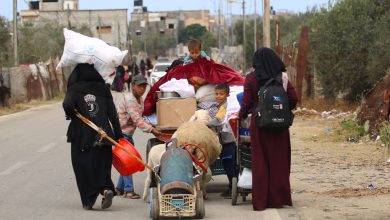
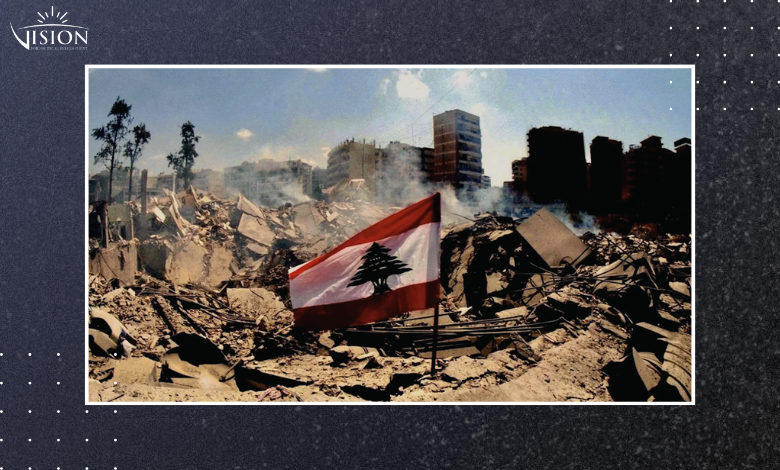
The practical implications of this doctrine have become evident during the current war, where Israeli military operations have not been limited to areas designated as military targets but have extended to the destruction of the material foundations of everyday life within the communities associated with the targeted social base. The occupation pursued a policy named “scorched earth” in the areas where its forces advanced in southern Lebanon, resulting in the complete or partial destruction of dozens of villages, as well as tens of thousands of homes, installations, and other facilities. The overall scale of devastation is estimated at approximately 25–30% of the total built-up area within the zones extending 5–10 kilometres south of the Litani River. This destruction was accompanied by the mass displacement of nearly 1.4 million human beings up to June 2026.
In addition to that, the occupation deliberately targeted civilian institutions such as hospitals and the “al-Qard al-Hassan” association, which is a financial and social quasi-banking association concerned with providing soft loans and assistance to wide segments of Lebanese society, and which constitutes the nerve of material security for the environment of the resistance. Many human rights organisations, among them Human Rights Watch, have emphasised that this targeting violates international humanitarian law, given that it is a financial institution serving civilians, and does not acquire the character of a “military objective” merely by its association with a political or military party.
In the same context, an investigation by Amnesty International documented the systematic targeting of healthcare facilities, ambulances, and civil defence services, characterising these actions as war crimes and violations of international humanitarian law. Yet Israel’s conduct has repeatedly demonstrated the limited constraining effect of international legal frameworks on its military operations. Despite the scale of destruction and the allegations of violations, Israeli officials have continued to issue statements threatening further military escalation and additional devastation. The occupation’s finance minister Bezalel Smotrich threatened to destroy the southern suburb along the lines of Khan Yunis. And the national security minister Itamar Ben Gvir declared that “for every tear of an Israeli mother, a thousand Lebanese mothers must weep… all of Lebanon must burn.”
This destructive conduct was accompanied by an intensive Israeli media campaign aimed at producing a rupture between the resistance and its social base by attributing exclusive moral and material responsibility for the widespread destruction of border villages and towns to the former, while portraying it as having dragged Lebanon into “the wars of others.” The occupation’s military spokespersons, particularly those addressing Arab audiences, have not ceased repeating those narratives, whether Avichay Adraee, the former spokesman for the occupation army, or Ella Waweya, the current spokeswoman who publishes dozens of clips on social media promoting narratives of “Hezbollah’s destruction of Lebanon”, of “confining the problem solely to the party and its foreign agenda”, of “the Lebanese people’s yearning for life against Hezbollah’s prevention of it”, and other such narratives.
This discourse does not stop at media spokespersons, but rather senior Israeli officials participate in it, for the Israeli prime minister Benjamin Netanyahu directed an explicit invitation to the Lebanese people to participate in the war against Hezbollah under the pretext of “liberating Lebanon”. For his part, War Minister Katz threatened the Lebanese government with the necessity of disarming Hezbollah before it faces far more dangerous consequences. Successive American administrations have likewise persisted in characterising Hezbollah as an “Iranian proxy”, stressing that Tehran funds and arms it in order to achieve its regional ambitions at the expense of Lebanese stability.
This shared discourse constitutes a pivotal pillar in the endeavour to strip the resistance of its national legitimacy, and to transform it in the Lebanese collective consciousness from a defensive force into an instrument in the hand of external regional powers, which is a matter that makes Hezbollah appear as the party primarily responsible for the crisis in the face of the remaining parties and components.
The Lebanese Internal Sectarian and Political Fragmentation
In the aftermath of Hezbollah’s involvement in the regional escalation following the Gaza war, the party sustained significant blows and emerged from the confrontation in a weakened position. This occurred amid a broader regional realignment marked by the fall of the former Syrian regime and the subsequent launch of the Israeli–American war on Iran in 2025. Against this backdrop of shifting regional dynamics and domestic political pressures, Hezbollah faced growing challenges within Lebanon’s evolving political landscape, alongside intensified efforts by regional actors, in coordination with Washington and Tel Aviv, to secure its disarmament. This reality placed Hezbollah in a confrontational position with the state, given its categorical rejection of disarmament. With the outbreak of the second war on Iran and Hezbollah’s renewed involvement alongside it—accompanied by its declaration of an end to the policy of silence in response to Israeli attacks—the indicators and warnings of Lebanon’s potential slide toward civil conflict intensified.
In this context, Israeli policy towards Lebanon seeks to exercise systematic international pressures upon the Lebanese government, with the aim of pushing the military institution toward a direct confrontation with Hezbollah, which is what places the army before the danger of a vertical split along sectarian foundations. However, the controversy over the party’s weapons reflects a deep tension, for while one camp sees in it a defensive necessity produced by decades of occupation and Israeli aggressions on the south, the Lebanese forces opposed to Hezbollah’s weapons (such as the Lebanese Forces party, the Kataeb party, and the blocs of the Change and independent deputies) demand an end to “illegitimate” armed manifestations, considering the existence of an armed force outside the military institution an explicit violation of the sovereignty of national decision-making. The Arab Barometer report revealed a sharp sectarian division in the Lebanese street’s view of Hezbollah, where only 30% of Lebanese trust it, against wide support within the Shia community alone that reached 85%.
This political pressure is complemented through an internal discourse that strips the national legitimacy from the resistance by portraying Hezbollah as a “non-state actor” that gambles with the stability of the rest of the Lebanese components in the service of external agendas. For segments of the Lebanese opposition have adopted that narrative and hastened to employ it in their internal polemic, taking the party’s intervention in 2023 in support of Gaza without governmental authorisation as evidence that it “moves according to operations orders coming from Tehran, not according to a Lebanese agenda”. This discourse has fed deep-rooted fears of “bringing on destruction”, and has permitted the direction of accusations against the party of exposing Lebanon to war in the service of Iran’s interests.
In 2026, the response of the official Lebanese authority to these pressures came to constitute a genuine reversal in the political doctrine of the state; for on 2 March the Lebanese government issued an official decision banning all of Hezbollah’s military and security activities, declaring its military wing an “organisation outside the law”, and holding it alone responsible for the consequences of the catastrophic war. This transformation extended from policy to official national discourse, so it included the deletion of the “trinity of the army, the people and the resistance” from official literature. In addition to the circular of the Lebanese Ministry of Information, which prohibited the use of the term “resistance” and substituted in its place the term “militias” or “illegitimate forces”, under penalty of legal prosecution.
Striking the “Incubating Environment” as a Tool of Sectarian Incitement
This discourse enters into a dialectical relationship — feeding and being fed by — the condition of sectarian incitement, which has reached the point of portraying the party’s incubating environment as a demographic and security burden upon the national fabric, and holding it responsible for the destruction of the country. The report of the ACAPS organisation monitored how the intense displacement from the south (of Shia majority) toward areas in the Mountain, the North and Beirut caused security and sectarian fears among the host communities, which is a matter that altered their popular positions from the initial welcome of the displaced with the beginning of the aggression in 2024, to a state of escalating suspicion and doubt. This transformation came in the wake of an Israeli policy that deliberately targets safe sheltering areas in order to commit massacres among civilians.
On 29 September 2024, the Israeli occupation targeted a residential area in the town of Ain al-Delb east of the city of Sidon, leaving 45 martyrs and 70 wounded, on the claim of the presence of Hezbollah elements there. And although international and media investigations, among them a BBC documentary, refuted the Israeli pretexts, the occupation did not cease practising those aggressions. On 16 October, for the first time, Israel targeted a residential building housing displaced people in the town of Aitou in the district of Zgharta in the north, an area far from the traditional lines of confrontation, which took the lives of 20 martyrs and 6 wounded from a single family, a matter that led to a mass displacement from the town.
In the same month, the bombardment reached the area of Basta al-Fawqa in the heart of Beirut, to convey a message to the effect that no place is fortified so long as it shelters displaced people. That was followed by the targeting of a house in the town of Almat in the district of Jbeil, which took the lives of 27 persons, in addition to scattered strikes that reached areas in Nabatieh, Tyre, the Bekaa and Mount Lebanon.
This aggressive policy reached its peak on 8 April 2026, when the Israeli occupation launched what is known as the “terror of the ten minutes”; for it carried out around 100 to 130 raids within ten minutes only, targeting the heart of Beirut, the southern suburb, the south and the Bekaa, leaving hundreds of victims and immense destruction in neighbourhoods that had been classified as safe havens. This unprecedented density of fire aimed to produce a comprehensive security and psychological shock, reinforced by Israeli communications with many heads of municipalities requesting them to expel the displaced, which led to the sowing of doubt between the residents and the displaced. And the ultimate purpose of all of that is to hold the victims responsible for their own destruction, and to produce a sectarian and regional rift that dismantles society from within, which drove many municipalities to refuse to receive the displaced under the pretext of self-security and the fear of the infiltration of Hezbollah elements among civilians. Such dynamics risk recasting the entire Shi’a community as a source of collective suspicion among other components of Lebanese society, thereby transforming a political conflict into a wider social division structured around identity and sectarian boundaries.
Conclusion
Following the signing of the framework agreement between the Lebanese government and the Israeli occupation, an analytical discussion took place on the dimensions of this agreement on Hebrew Channel 13, where the presenter Raviv Drucker commented: “It seems that we are leading Lebanon toward a civil war, and perhaps this is not bad for us; let the Lebanese government fight Hezbollah.” The military affairs analyst Alon Ben David replied to him: “This was the objective from the beginning.”
That analysis added nothing new to the scene, for all the Israeli and American policies toward Lebanon indicate that there is an orientation toward dragging Lebanon into a civil war. It is a constant Israeli policy that is not confined to the Lebanese arena alone, but extends to include the stoking of sectarian and political divisions and the incitement of peoples to internal fighting, as is the case in Syria, Iran and Gaza, where the occupation employs internal rifts to entangle states in self-directed conflicts, while promoting a narrative that holds local parties responsible for the catastrophic consequences of the Israeli aggressions, while Israel remains watching from afar.
However, the Lebanese context appears more vulnerable to becoming entangled in such efforts due to its highly sensitive political and sectarian structure, as well as the historical divisions between isolationist and national-patriotic currents. Nevertheless, these Israeli strategies face structural constraints that limit the possibility of their full realisation under current conditions. From a military perspective, Lebanese political actors—apart from Hezbollah—lack organised armed capabilities comparable to those required for sustained confrontation, thereby limiting their capacity for a prolonged conflict. The Lebanese army also faces significant institutional and operational constraints in managing major security crises or engaging in direct confrontation with Hezbollah, particularly given its own position within Lebanon’s delicate sectarian balance.
These structural constraints are reinforced by the positions of regional actors that retain considerable influence among Lebanon’s social and political constituencies, particularly Sunni and segments of the Christian communities. While these actors generally oppose the prospect of renewed civil conflict and favour the consolidation of state authority over armed actors, they have also avoided policies that could precipitate a direct confrontation, given the risk that such a conflict could extend beyond Lebanon’s borders and evolve into a wider regional sectarian confrontation.