“A Drowning Man Clutches at a Straw”: The American-Israeli Reliance on the Kurds to Topple the Iranian Regime

With the outbreak of the second American-Israeli war on Iran, certain statements and reports began to emerge regarding American-Israeli efforts and plans to stir a peripheral Kurdish rebellion inside Iran, one that would contribute to toppling the Iranian regime and encourage other minorities to follow the Kurdish minority’s example. Yet the clamour that was raised in the early days of the war quickly dissipated as the war grew more complex and transformed into a global crisis whose repercussions continue to escalate. The fading of that noise around the Kurds, however, stems not only from the complications of the war’s own trajectories, but from the very nature of the American-Israeli bet on the Kurdish minority and the miscalculation that accompanied the war from its very outset.
On this basis, and in light of the Israeli reliance on a Kurdish movement to topple the regime, the following article attempts to read the particularity of the Kurds and their positioning within Israeli strategy against Iran, framed around the question “why the Kurds above all others?” and its connection to the doctrine of “the Alliance of the Periphery/Minorities.” This article further analyzes the American-Israeli plans for supporting a Kurdish rebellion, within the parameters of success that led to the proposal of those plans, and the deep failure factors that condemned them before they ever got off the ground.
Israel’s Historical Exploitation of the Kurdish Cause
The Kurdish presence in Israeli regional strategy is neither recent nor incidental; it predates the act of founding on the ruins of the Palestinian Nakba, and is built on the duality of “minority status and the search for selfhood”, a framing that Israelis have long promoted as shared ground between themselves and the Kurds. This began with the intelligence figure Reuven Shiloah, who established early formal relations between the Zionist movement and the Kurdistan region of Iraq in 1931, and continued into the late 1940s when Kurdistan provided support and facilitated the passage of Jewish emigration from Iraq to Israel.
This presence placed the Kurds at the centre of Ben-Gurion’s strategy, which rested on four pillars: building alliances with the great powers, encouraging Jewish immigration on a wide scale, building a nuclear deterrent, and establishing the Periphery Doctrine — “Torat HaPeriferia / תורת הפריפריה.”
This was a doctrine created to reinforce Israeli national security by consolidating relations and building alliances with states on the periphery of the confrontation states, with religious minorities, and with ethnic minorities, in ways that would assist Israel in any Arab confrontation, counter diplomatic and economic boycotts, and entrench a balance of power within the Arab world.
In application of this doctrine, Israel allied at the first level with Türkiye, Iran, and Ethiopia, and at the second and third levels built strategic relations with religious and ethnic groups and minorities within and around the Arab world, such as Christian minorities in southern Sudan, Druze minorities in Syria and Lebanon, Kurdish minorities (particularly in Iraq), and Maronites in Lebanon, with the aim of creating spaces of influence or policy partners within Arab environments, to be activated at the right moment to strike those environments and their regimes.
Thus the Kurds came to be positioned, as the largest non-Arab ethnic group in the region with a population ranging between 30 and 40 million, at the heart of Israeli interest. Relations began with meetings between Mustafa Barzani and Israeli Foreign Minister Golda Meir in the 1950s, then extended to military support, coordinated with the Shah’s Iran, against the Iraqi regime between 1961 and 1970, humanitarian and economic support through the construction of hospitals and schools and the printing of educational curricula, diplomatic support through Israel’s championing of Kurdish demands for separation and independence, and even security support through a joint effort between the Israeli Mossad and the Iranian SAVAK to establish the Kurdish intelligence apparatus “Parastin,” aimed at gathering intelligence on the Iraqi government, as well as support for a special Kurdish mission at the United Nations.
That cooperation, however, reached its end with the Algiers Agreement between Iran and Iraq in 1975, which led Iran to halt its cooperation with Israel in supporting the Kurds. This was completed by the closure of the Israeli aid corridor to the Kurds following the Islamic Revolution in Iran in 1979, while the relationship between revolutionary Iran and Israel entered a phase of gradual drift toward enmity, though this did not mean an immediate or comprehensive break.
The occupation state continued to employ the politics of the periphery by other means, supporting the Kurds in Iraq during the Iran-Iraq war in hopes that the war might end in the fragmentation of Iraq into three entities (Sunni, Shia, and Kurdish), one of the manifestations of the Yinon Plan. Later, during the war against Iraq in 1991, it was able to gain entry to the region under the American-British presence.
In parallel, Iran’s consolidation as a central regional adversary pushed Israel to gradually redirect this policy toward the Iranian interior itself, and at its forefront, the Kurdish arena, alongside a strong return to relations with Iraqi Kurds during the American war against the regime in 2003, when economic, security, and diplomatic relations flourished. The region became an energy supply line to Israel and a domain for its security services to train and position themselves in the region, against a backdrop of geopolitical shifts, including the deterioration of Turkish-Israeli relations with the Justice and Development Party’s rise to power, the emergence of ISIS in Iraq and the Levant, and regional competition with Iran.
Thus, the Israeli relationship with the Kurds oscillated between partnership and instrumental exploitation, to be activated when needed. This manifested in the amplification of the Kurdish role in the Israeli-American war on Iran, assigning them the possibility of performing a military role capable of shifting the war’s balances and reshaping Iran and the surrounding countries in which Kurds are interwoven into the demographic fabric, without that necessarily implying that they possessed the actual capacity to decide the conflict.
The Plan to Support a Kurdish Rebellion to Topple the Regime
With the outbreak of the second war on Iran (February 2026), certain voices began calling for the possibility of cooperating with the Kurds with the aim of toppling the Iranian regime, or at least weakening it. The retired Canadian Armed Forces officer A.J. Jeff published an opinion piece in the Israeli Jerusalem Post under the title “Why Does the Rising Lion Need Fangs on the Ground?”, in which he explained that the window for toppling the regime in cooperation with the Kurds was open, but not for long, for “the Kurdish alliance is ready, organised, and waiting.” In his view, victory over Iran lies not in striking its heart, but in mobilising its peripheries, by pushing the provinces with Kurdish majorities to obtain self-governance. He affirmed, drawing on his work as a security expert, that the Kurds possess the most developed political infrastructure, the most experienced fighting forces, and the greatest alignment with Western values, and are therefore the group best suited to fill the power vacuum on Iran’s peripheries.
Not far removed from this, reports emerged that US President Trump had been in contact with a number of Kurdish opposition group leaders, announcing his support for any ground offensive the Kurds might launch against Iran. Thereafter, press reports spread that there was a plan to support a Kurdish rebellion drawn up by the Israeli Mossad and presented by Mossad chief David Barnea to Israeli Prime Minister Netanyahu and to President Trump before the war. The plan included Israeli promises of political support for the establishment of a Kurdish self-governing region in Iran in the event of the regime’s collapse, in exchange for mobilising Kurdish fighters alongside Israel against the Iranian regime under American-Israeli air cover. This was reinforced by confirmation from Kurdish sources that the offensive was in fact planned and bore the name “Zhina”, the middle name of Mahsa Amini, the young Kurdish woman whose death in police custody in 2022 ignited a broad protest movement against the regime, and that the mobilisation had already been completed, with the advance to take place during the Persian and Kurdish New Year (17–20 March).
It should be noted that the Mossad plan aimed to push millions of Iranians into the streets to topple the regime in the first days of the war. The function of the Kurdish rebellion, which encompassed a ground advance by tens of thousands of fighters from Kurdish opposition camps across the border, was to “break the fear barrier among the Iranian people” and disperse the regime’s capabilities.
Naturally, the specific Israeli reliance on the Kurds is attributable to several factors. By comparison with other minorities in the region, particularly in Iran, the Kurds are stronger, relations with them have historical depth, and they intersect at levels closer to an alliance reinforced by military and intelligence support. This is compounded by the existence of solid political relations with certain Kurdish leaders, an actual armed nationalist movement on the ground, a latent desire for separation and independence from the existing regimes, and favourable conditions of wars and tensions that make investing in the relationship with them feasible.
The Plan’s Failure at Its Very Inception
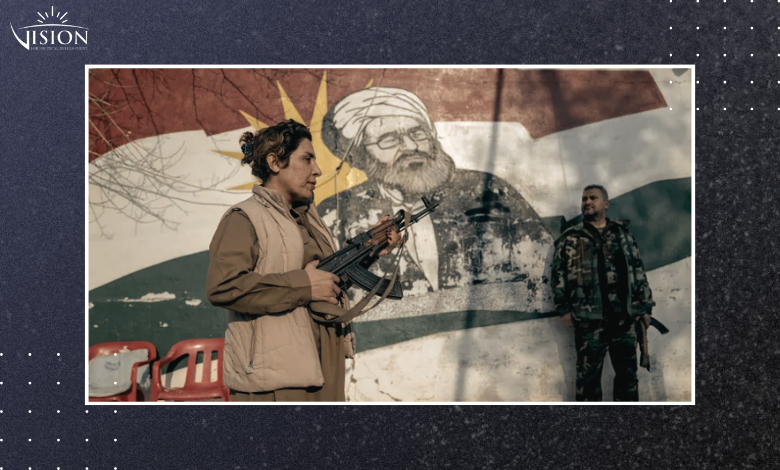
The possibility of a Kurdish rebellion collided with a series of structural constraints. At the military level, Iranian Kurdish factions lack the capabilities required to confront the Iranian army or the Revolutionary Guard units directly; their maximum mobilisation does not exceed 2,500 fighters. This confines their possible role to disruption and attrition rather than decisive confrontation. Furthermore, their near-complete dependence on external logistical and intelligence support makes their ability to sustain operations hostage to the will of supporting powers, which previous experiences have shown can rapidly recalculate their positions, as happened when the Trump administration cut support to the Kurdish Syrian Democratic Forces, who had previously participated in the international coalition campaign against ISIS.
At the political and organisational level, the Iranian Kurdish arena suffers from clear divisions, despite attempts to form common frameworks. Divergence persists between factions over the nature of their objectives, between those proposing self-governance within a decentralised Iranian state and those pushing for broader separatist projects, which weakens their capacity to move as a unified front that can be relied upon in the context of an open war.
The matter is further complicated by the surrounding regional environment. Türkiye regards any Kurdish escalation as a direct threat to its national security, which drives it to coordinate with Iran and Iraq to limit the movements of Kurdish factions. This translated into what media sources reported as a Turkish role in thwarting the plan for Kurdish parties to enter the war against Iran, encompassing diplomatic and security manoeuvring and a threat that “Kurdish entry into the fighting would drive Ankara toward direct military intervention.”
This aligned with joint security agreements with Baghdad, Erbil, and Tehran in 2004, 2018, and 2023, to restrict the activities of these groups, disarm Kurdish opposition groups, and monitor them, to say nothing of the pressures that both states (Iran and Turkey) exert on the Iraqi central government and the Kurdistan Regional Government, making any attempt to convert the Kurdish position into military action fraught with high regional risks.
Alongside this, the internal Kurdish environment remains a determining factor. Despite the existence of discontent within some Kurdish regions in Iran, there is as yet no clear consensus on the option of engaging in a war for the benefit of Americans and Israelis. Nor is the relationship with Iran viewed by some Kurds as one of absolute enmity, particularly given that Iran did not seek to occupy the Kurdish regions of Iraq, and indeed came to their aid in the 1990s against Saddam Hussein, and later against ISIS in 2014. For this reason, Kurdish political engagement with those plans did not go beyond calls for defection led by certain marginal leaders, such as the exiled leader of the Kurdistan Democratic Party of Iran.
In addition, the American-Israeli play on this card, namely the partition of Iran, provoked widespread Iranian opposition even from the most ardent enemies of the Islamic Revolutionary regime. This opposition extended to Reza Pahlavi, who calls for the regime’s overthrow with Israeli-American military support, and who attacked Kurdish ambitions on 25 February, accusing them of seeking separation and conceding the unity and territorial integrity of Iran.
Against these constraints, which condemned the plan to failure from its very inception, Iran, together with Iraqi Popular Mobilisation factions, began targeting Iranian Kurdish opposition camps in Iraqi Kurdistan from the outset of reports about the possibility of a Kurdish military movement, to forestall any possibility of actual military mobilisation. In light of these realities, the Americans and Israelis lowered their ceiling of objectives from toppling the regime to merely preparing or softening the internal environment in ways that might lead to its collapse over a year or more, while retreating entirely from any talk of supporting a Kurdish rebellion.
Conclusion
A Kurdish official summarised the position on the question of American support for plans to back a Kurdish rebellion with the words: “America comes, America goes, but Iran remains.” This simple phrase reveals a fixed regional truth: that the states of the region, particularly Türkiye, Iraq, Iran, and Syria, hold a solid consensus against plans for partition and separation, with a firmness that far exceeds any Israeli or American guarantees or promises. This renders any Kurdish-Israeli rapprochement, as has been the case with historical trajectories of Israeli efforts to penetrate minorities in the region, governed by temporary interests in which Israel seeks to exploit those minorities to serve its own ends, without regard for the political and social consequences those minorities may face.
On the other hand, America and Israel’s capacity to “employ” any minority or ethnic group in the region remains contingent on the relations, policies, and interests of the region’s states. Any change in those matters could lead to the abrupt cutting of American-Israeli support at critical moments, leaving minorities to face accusations of “high treason” in their own countries.
But setting aside the question of Kurdish support, which appeared from the outset of its proposal to be nothing more than a storm in a teacup, those Israeli-American plans and statements, which at one moment advocate supporting a Kurdish rebellion, at another attempt to push the Iranian people to topple the regime, at another demand Gulf Arab states to engage in the war, and ultimately arrive at threats to destroy Iran itself (not merely the Iranian regime), contrary to all their rhetoric about supporting the Iranian people’s freedom and liberation from oppression and tyranny, point to a clear truth: that America and Israel are in serious difficulty, and that the war slipped from their control from its very first moment. And so here they are, now attempting to solicit any support whatsoever, even from 2,500 Kurdish fighters, in hope of achieving what the American-Israeli “Armada” could not.