Escalation of Israeli Coercive Practices in the Al-Naqab Region: “Law Enforcement” as a Tool of Control and Displacement

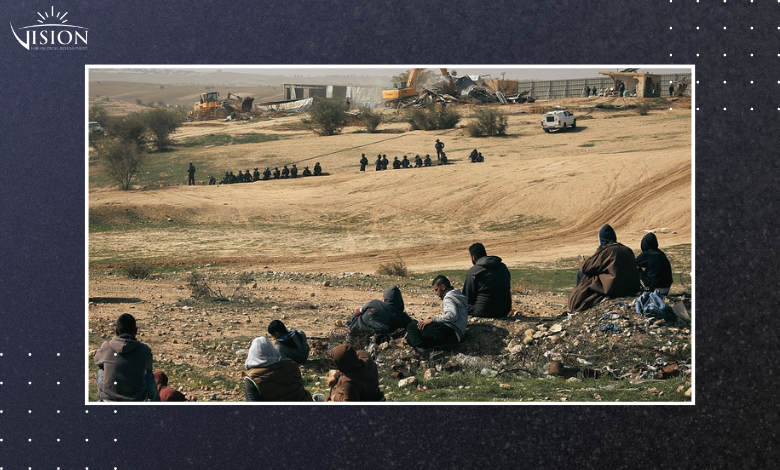
In recent years, particularly in the current period, the Al-Naqab region (also referred to as the Negev region) in the Palestinian territories occupied in 1948, has witnessed a marked escalation of coercive practices against Palestinians manifested in intensive police campaigns, large-scale “enforcement” operations[1], home demolitions, and arrests targeting Arab villages and their residents, under the pretext of “imposing law and order” and “restoring governance.” This escalation unfolds within a prolonged historical and political context that reflects the state’s treatment of Al-Naqab region as a strategic space for population management and spatial regulation, with direct implications for Palestinian Arab presence and rights.
What is taking place is presented in official discourse as ‘a response to security or criminal considerations.’ However, this interpretation intersects with broader political objectives pursued through security and legal instruments, through which the relationship between the state and the Arab residents of Al-Naqab is being reconfigured. In this context, concepts such as “governance,”[2] “security,” and “law enforcement” are deployed as interpretive frameworks that obscure their political functions. This necessitates a critical reading that situates the current escalation within its extended historical trajectory, from the Nakba, through sustained popular mobilization, to the contemporary political-security discourse that links security, development, and settlement.
Within this framework, the killing of Muhammad Hussein al-Tarabin, shot by Israeli police during a security operation in Al-Naqab, in an incident officially justified on grounds of security suspicion without any evidence of an immediate threat warranting lethal force, emerges as a revealing case of the mechanisms of legal-security control and their direct consequences for the rights of Al-Naqab residents.
Historical and Political Context of Al-Naqab: From the Nakba to “Enforcement” Policies
Al-Naqab region has occupied a central place in Israeli policy since 1948, owing to its geographical and strategic importance within the Zionist project of land control and spatial reconfiguration. The Nakba resulted in the displacement of most of the Palestinian population of Al-Naqab, while those who remained were subjected to a military governance regime until 1966, a period characterized by land confiscation, restrictions on movement, and the weakening of traditional social structures.
The end of military rule did not translate into genuine recognition of Arab residents’ rights. Instead, control shifted to legal and administrative mechanisms, most notably the classification of dozens of Arab villages as “unrecognized.”[3] This designation kept residents outside planning frameworks and basic services, while providing a permanent legal basis for demolition policies and the targeting of Arab presence under the pretexts of “unlicensed construction” and “maintaining order.”
Within this context, official plans emerged to reorganize Al-Naqab in line with state priorities, most prominently the Prawer-Begin Plan. This plan represented a comprehensive attempt at forced resettlement and the confiscation of vast tracts of land under the guise of planning and development. It exposed the contradiction between official developmental rhetoric and the coercive nature of the policy, and led to widespread protests known as the “Prawer Uprising” in 2013. These protests marked a pivotal moment in shaping political consciousness among Al-Naqab residents and entrenched an understanding of land and housing issues as a political struggle rather than an administrative matter.
Although the plan was officially frozen, the trajectory it initiated did not cease. Instead, it continued through more fragmented and less comprehensive tools, manifested in intensified demolition policies, stricter “enforcement,” and the expanded use of law as a means of control and regulation. This trend was clearly consolidated during the Al-Naqab Uprising of 2022, when the region was once again framed as a matter of “sovereignty and security,” accompanied by heavy police responses and the association of protests with narratives of “chaos” and “threats to order.”
Parallel to these developments, the Arab-Bedouin community in Al-Naqab has undergone profound social and economic transformations resulting from coercive urbanization and modernization policies that were not accompanied by supportive infrastructures, thereby deepening social and economic precarity. The community has also been affected by political and security transformations since 2000, as well as state economic policies, alongside a notable rise in political participation, particularly among youth who have played an increasingly prominent role in protest movements, employing modern organizational tools and digital platforms that amplified Al-Naqab issues beyond their local context.
The Current Escalation in Al-Naqab: Enforcement and Control Policies
The current escalation in Al-Naqab manifests through an integrated package of field policies that include intensive police campaigns, an accelerated pace of home-demolitions, an expansion of arrests, and mass-targeting of specific towns and families. These measures cannot be understood as isolated security interventions or situational responses to specific incidents, but rather as an organized pattern of “enforcement” employed to recalibrate the spatial and social order in Al-Naqab and redefine the boundaries of acceptable and unacceptable Palestinian Arab presence.
These policies are often implemented by instrumentalizing localized incidents or individual cases to justify comprehensive deterrent measures that transcend individual responsibility and move toward collective punishment. In this way, “enforcement” becomes a tool for population management through the production of a permanent state of instability; demolition orders are imposed, police pursuits intensify, and administrative restrictions expand, rendering everyday life for Arab residents in Al-Naqab contingent on constant threat rather than legal protection.
In this context, legal-security enforcement policies (akhifa / אכיפה) function as political tools for reproducing control. Coercive measures are presented as the application of law, while the structural contexts that produced unregulated housing, most notably exclusionary planning policies, the absence of housing alternatives, the denial of recognition and inhibition of capacity for simplest of infrastructure to unrecognized villages, are systematically ignored. Thus, the law does not operate as a corrective mechanism but becomes part of the exclusionary system itself, with its rulings and mechanisms used to criminalize existence and transform it into a permanent violation.
The unrecognized village of al-Sirr serves as a telling example of this policy pattern, where large-scale demolitions targeting dozens of homes were carried out with the participation of planning authorities and under police protection, illustrating the entanglement of civilian and security arms in managing forced displacement. These operations cannot be separated from the legal-planning structure that produces “non-recognition” as a permanent condition rather than a temporary anomaly. This structure not only denies Bedouin villages recognition and organization, but at the same time transforms that denial itself into a tool of criminalization, redefining housing as a continuous offense that can be invoked at any moment to justify demolition, eviction, and uprooting. In this sense, the law does not address the causes of “disorder” but actively reproduces it, becoming a structural component of the regime of control and exclusion.
Within the same framework, the killing of Muhammad al-Tarabin by Israeli police gunfire emerges as a stark illustration of the logic of “enforcement” when it shifts from administrative regulation to lethal violence. This killing cannot be understood merely as an individual incident or operational error, but as a direct outcome of security policies that treat Arab residents as subjects of perpetual suspicion and legitimize excessive force under the banner of “security.” It demonstrates how a control logic, when exercised through security tools lacking effective accountability, can exceed the law itself and culminate in the taking of life.
The foregoing demonstrates that the current escalation in Al-Naqab is not confined to the management of security incidents or isolated legal applications, but rather points to a systematic policy of spatial and human reorganization, wherein “law enforcement” is deployed as a means of reproducing unequal power relations and entrenching a displacement-oriented reality with enforcement at its core.
Security Discourse and the Legitimation of Settlement
The on-the-ground escalation in Al-Naqab is accompanied by a political-security discourse that reframes developments as matters of “governance” and “restoring order,” linking concepts of “crime control” and “security enforcement” to broader projects of territorial control. In doing so, the discussion is removed from its rights-based and civic context, and the Naqab is reconstructed as a sovereign-security space governed through regulation and deterrence rather than rights and equal citizenship.
In this context, Benjamin Netanyahu’s recent visit to Al-Naqab accompanied by official assertions about “strengthening governance” and tightening security control, and by explicit governmental backing for the policies of National Security Minister Itamar Ben-Gvir, reflects the elevation of “enforcement” from a ministerial approach to a general governmental choice. Coercive policies are presented not as temporary security measures but as components of a national project to reassert control.
“Governance” in Zionist-Israeli discourse does not refer to democratic notions of good governance or expanded civic participation, but rather to the reimposition of state sovereignty over space and society through legal and security instruments. In Al-Naqab, governance functions as a synonym for restoring the state’s monopoly over force, controlling geographic space, and subjecting the indigenous population to discipline and compliance, not as equal citizens, but as a group framed as a “challenge” to be managed.
Accordingly, “governance” operates as a discursive framework that legitimizes the transfer of the Naqab from a space ostensibly governed by civil law and citizenship into a security domain managed through policing, emergency orders, and intensive enforcement policies. Rather than addressing the roots of social or planning crises, “restoring governance” restructures state-society relations on the basis of control and deterrence, providing political and legal cover for intensified repression and deepened displacement and settlement projects.
Ben-Gvir’s rhetoric and field practices constitute the most explicit expression of this trend, particularly through attributing responsibility for alleged “chaos” and “loss of sovereignty” to the Arab community in Al-Naqab and to specific families such as the Tarabin. These statements function less as security assessments than as incitement, reproducing the image of Arabs as a collective threat and legitimizing demolition, arrest, and restriction policies as necessary responses.
This trajectory is inseparable from a Judaization-settlement project led by the current government in the Naqab, advanced by two central ministries; the Ministry for Al-Naqab and Galilee, and National Resilience, and the Ministry of Settlement and National Missions. Their involvement demonstrates that the assault on Al-Naqab is not managed solely through security tools, but within a planning-settlement vision aimed at strengthening “Jewish presence” and treating the region as a demographic battleground. Within this framework, the so-called “demographic problem” is reproduced, portraying Arabs in Al-Naqab as a threatening majority and Jews as a minority to be reinforced through targeted housing and settlement projects.
This vision materializes through “development” and “planning” policies designed to confine Bedouin villages into planned urban concentrations, similar to development towns, resulting in the dismantling of traditional rural spaces and the expropriation of hundreds of thousands of dunams of land. These concentration towns are not read as housing solutions, but as instruments of internal displacement that redistribute populations in accordance with state planning and settlement priorities, rendering residence outside these frameworks a permanent violation.
Concurrently, the project feeds on an inciting security discourse linked to the Egyptian-Israeli border, framing the Naqab as a zone of “security fluidity” exploited for arms smuggling. This narrative has expanded from accusations related to organized crime to more severe claims involving weapons transfers to the West Bank and even hypothetical scenarios of smuggling weapons into Gaza. Such discourse is used to entrench the Naqab as a security front and justify unprecedented escalation in police presence, raids, arrests, and collective restrictions on residents.
This tendency finds its sharpest expression in inciting statements by senior officials, including statements by Naftali Bennett portraying Arab presence in Al-Naqab as a future danger requiring “management,” and Heritage Minister Amichai Eliyahu’s call to isolate Al-Naqab and erect a fence around “the Bedouin of the Naqab.” These positions signal a shift from intensified enforcement within existing space to spatial and collective segregation, transforming the indigenous population into an encircled group governed through security rather than a rights-bearing community.
In this context, security is presented as an overarching justification for policies of demolition and intensive enforcement, and the very existence of Arabs is redefined as a destabilizing factor that requires control. The prevailing discourse reveals a structural entanglement between security considerations and settlement projects, portraying the expansion of Jewish settlement in Al-Naqab as a solution to issues defined as security or demographic concerns. This entrenches the use of security as a pretext for reproducing a modern settler-colonial logic that legitimizes domination and spatial reordering at the expense of the indigenous population, and analytically prepares the ground for linking “law enforcement” with displacement and settlement as an integrated project.
Conclusion
The historical and political trajectory of Al-Naqab demonstrates that the current escalation cannot be read as a series of temporary security measures, but rather as an advanced phase in the reorganization of space and population through renewed legal and security tools. The transition from military rule to ostensibly “civil” frameworks did not dismantle the structure of control; instead, it reproduced it in more complex forms, transforming the law itself into a means of regulating Arab presence, criminalizing housing patterns, legitimizing demolition, and deepening structural precarity.
The prevailing discourse of “governance” and “security” performs a function that exceeds mere description, stripping the struggle in Al-Naqab of its rights-based and political dimensions and recasting it in technical language that conceals the structural entanglement between security enforcement and settlement projects. Security is thus positioned as a prerequisite to rights, and indigenous residents are redefined as objects of management and control rather than rights-bearing communities with claims to land and place.
Field practices, from recurring demolition policies to the use of lethal force, confirm that “law enforcement” has become a tool for restructuring power relations on the ground rather than regulating the public sphere. Accordingly, what is unfolding in Al-Naqab can be understood as a contemporary activation of a settler-colonial logic administered through legal and security instruments, underscoring the necessity of re-centering rights and recognizing indigenous populations as a foundational element in any approach seeking to break the cycle of control and conflict reproduction.
[1] Enforcement (אכיפה): Used in this paper to denote a system of legal-security control policies exercised by the Israeli state through the police and planning and administrative tools. It does not refer to a neutral or technical application of the law, but to the deployment of law as an instrument for spatial reorganization, population control, and the criminalization of housing and existence produced by exclusionary planning policies.
[2] Governance (משילות): Refers here to the state’s use of legal-administrative and security tools to manage space and populations, not in the democratic sense of good governance, but as a framework that legitimizes the reassertion of control and the securitization of civil issues.
[3] “Unrecognized” Arab villages: Palestinian (Bedouin) villages and communities, mostly located in the Naqab, numbering approximately 35 and inhabited by around 150,000 people. Israeli authorities refuse to recognize their land ownership, classify their lands as “state land,” deny them basic services (water, electricity, health, and education), and deem their homes “illegal,” subjecting them to continuous demolition orders. Although 11 villages have been recognized over the past two decades, they remain deprived of basic infrastructure and face ongoing displacement and concentration plans.
NOTE: This text is adapted from original Arabic article.