Water That Does Not Quench: A Tale of Thirst in Gaza in the Time of Genocide
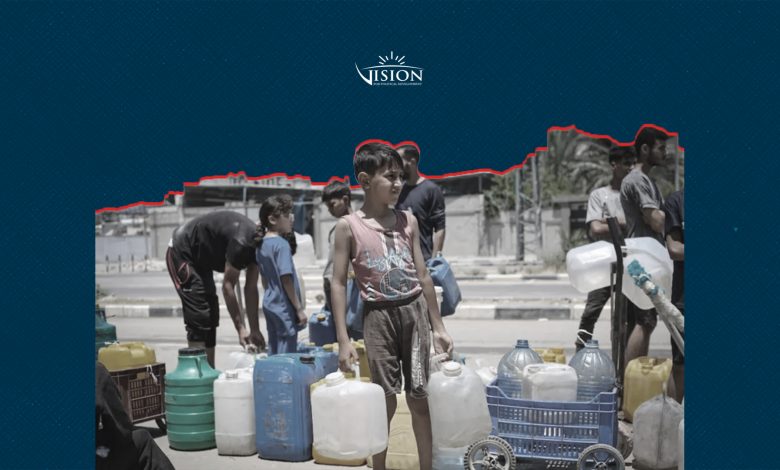
The water blockade and the systematic destruction of the water infrastructure in the Gaza Strip have led to a severe social and humanitarian crisis that has reshaped the daily lives of displaced persons and residents alike; the struggle to obtain a few litres of water has become the primary concern for families in Gaza, giving rise to serious repercussions for the social fabric, children’s health and shifts in family roles amidst the ongoing genocide.
The deaths of fathers and the loss of breadwinners have forced women and children to shoulder burdens beyond their physical capacities. Fetching water, rather than being a basic service provided by the state, has become a daily ordeal that wears children down and deprives them of their fundamental rights to play and education.
This is the case for Jouri (aged 12) and her sister Tala (aged 10), who epitomise the reality faced by hundreds of children whose daily routine begins first thing in the morning. Jouri recounts her struggles, saying “Every day I stand in the queue for water, carrying my water skin to fill it. I wake up in the morning to fetch water after my father has left for work, and my sisters and I are forced to carry the jerrycans until my back is constantly aching.”
With a heavy heart, 10-year-old Karim, who lives in Al-Thaqafa camp, spoke of how his generation is being deprived of the most basic rights to life and childhood as a result of water shortages and the irregular arrival of water lorries, saying “Water doesn’t arrive every day, and the lorry isn’t enough for everyone. We’re forced to fill jerrycans with salty water because there are no barrels in the tent, and if the lorry doesn’t come, we’re left without water or have to take a little from our neighbours,” he adds, asking “Don’t I have the right to live and play instead of carrying a heavy load on my back?”
The situation of Malak (17), from Al-Azza camp west of Gaza City, is not much different from that of those who came before her. “My father is a martyr and I help my brothers carry water. We stand in long queues and then carry the water for over a kilometre because the water lorries cannot reach inside the camp. It has got to the point where I can no longer feel my hands because of the heavy load, and I can’t believe when I finally get to sleep to give my back a rest from the excruciating pain.”
Umm al-Mu’tasim sums up her own tragedy and that of thousands of women who rush after water tankers in search of the bare necessities of life, saying: “My husband was killed and I lost my eldest son in the war; and I am now the sole provider for my four children. My daughter and I are forced to stand in queues for water and run after lorries because there is no one to fetch it for us inside the shelter. Our lives have become unbearable, filled with exhaustion and hardship; all we want is for the slaughter to stop, for us to return to our homes and live a normal life.”
Exhaustion is no longer confined to one particular group; rather, accessing water has become a comprehensive physical and psychological strain on all sections of society, including the elderly and the wounded. Citizens view this crisis as part of a wider scheme to undermine their resilience. Ahmed Abu Loz, who is displaced in the Al-Ramal area, sums up summarises the collective exhaustion the population has reached by saying: “We suffer in every aspect of our lives; from carrying water, to searching for food, to living in tents in the intense heat. All we ask is that they spare us from this war and let us live in peace.”
The Water Blockade in the Context of Genocide
The direct water blockade imposed on the Gaza Strip by the Israeli occupation army has been a key tool in exacerbating human suffering, after the flow of water into the Strip was made contingent on the political and military decisions of the Israeli occupation. At the outset of the genocide, the occupation army proceeded with the destruction of the main water sources and cut off the supply lines through which water reached the population, reducing the water supply to approximately 10–20 per cent of what it had been prior to the aggression.
These sources include groundwater and desalination plants with limited capacity, and water purchased from the Israeli occupation (‘Mikrot’), which caused an immediate water crisis in the early days of the aggression. With ongoing international intervention, the supply rate has risen relatively to reach approximately 35 per cent of what it was before the aggression.
With their homes and water supply lines destroyed, residents have been forced to seek refuge in camps that lack the bare minimum required for a dignified human life, and to wait for water distribution lorries to arrive at their camps to meet their needs, amidst escalating security risks associated with distribution operations in areas close to the front lines, making the very act of obtaining water a perilous undertaking.
According to the United Nations Office for the Coordination of Humanitarian Affairs (OCHA), its partners report that people’s access to water remains a challenge; with the infrastructure destroyed, some 40 partners are delivering nearly 20,000 cubic metres of water by lorry every day, an operation that relies heavily on fuel and sustainable funding to meet the drinking and cooking water needs of displaced people. Families are forced to collect water directly from the lorries at around 2,000 distribution points; however, many lack suitable containers for collecting and storing water, leaving them without access if a lorry fails to arrive on any given day.
According to a report published by Médecins Sans Frontières, the Israeli occupation has used access to water as a weapon against Palestinians. Claire San Felipe, Director of Emergency Affairs at Médecins Sans Frontières, said: “The Israeli authorities know that life cannot go on without water, yet they have deliberately and systematically destroyed Gaza’s water infrastructure, whilst continuing to block the entry of water-related supplies.”
Strategic Destruction of Water Infrastructure
With the start of the genocidal war on the Gaza Strip, the Israeli occupation’s Minister of War, Yoav Galant, announced on 9 October 2023 the imposition of a complete blockade on the Gaza Strip, vowing to cut off water, electricity, fuel and food, After thirty months of bombardment and the destruction of all the essentials of life in the Gaza Strip, which led to the near-total collapse of the water system and its basic infrastructure, what was once an integrated service network has become a shattered structure incapable of meeting the basic needs of the population.
According to the Gaza Strip Water Authority, the scale of destruction inflicted on the water sector as a result of direct and indirect targeting by the Israeli occupation army has exceeded all red lines. Approximately 85–90 per cent of the water and sanitation network infrastructure has been completely destroyed, including main pipelines and private desalination plants, as well as the only public desalination plant in the north of the Gaza Strip. More than 80 per cent of the 400 water wells in the Strip are completely out of service, whilst around 85 per cent of private desalination plants have ceased operations and more than 120 kilometres of main transmission lines have been damaged.
According to Saeed Al-Aklouk, the official in charge of water and sanitation monitoring at the Ministry of Health, more than 90 per cent of pumping stations have been destroyed, and around 800 kilometres of sewerage networks have been destroyed. This has forced hundreds of thousands of families to dig absorption pits next to their tents and destroyed homes, creating a widespread health and environmental crisis as wastewater seeps directly into the aquifer.
The destruction was not limited to water and sewage networks but extended to the machinery and equipment used by local authorities for maintenance and emergency operations. Here, the spokesperson for the Gaza Municipality, Husni Muhanna,[1] points out that the municipality has lost around 85 per cent of its assets and machinery following the destruction of more than 135 vehicles and essential equipment, such as excavators and bulldozers, which were used for maintenance and emergency operations, including network repairs and rubble clearance, thereby paralysing its ability to repair faults or respond rapidly.
The Israeli occupation army did not stop at destroying the infrastructure; it also targeted field staff and engineers whilst they were attempting to repair the networks and wells under bombardment, thereby paralysing the ability to respond rapidly to network faults. According to information from the Khan Yunis Municipality, 15 water sector workers were martyred whilst carrying out their duties, A United Nations report also stated that a worker from a non-governmental organisation was killed and four others were injured as a result of a recent Israeli airstrike on a water well in Gaza City, amidst continuing strikes targeting residential areas and disrupting essential services.
Based on data released by the Water Authority, the killing and destruction have led to a decline in daily production at water facilities, desalination plants and wells in the Gaza Strip, from around 300,000 cubic metres before the genocidal war to less than 120,000 cubic metres in February 2026, a direct shortfall of over 60 per cent, which reflects a structural deficit that is not limited to a specific moment but extends as an ongoing pattern. According to a spokesperson for the Gaza Municipality,[2] water services are currently operating with an operational deficit of up to 70 per cent, with the municipality operating only around 27 wells, whilst fuel rations are provided for some 1,320 small ‘private’ submersible wells owned by residents, as part of specific measures to alleviate the crisis and reduce water shortages.
However, the United Nations and its partners emphasise that the population’s water needs remain far from being met, as around 60 per cent of households in Gaza are unable to access the clean water they require for daily use.
When Water becomes a Source of Health and Environmental Disaster
The results of groundwater quality tests carried out on municipal wells in the Gaza Strip during June 2026 revealed that the aquifer continues to face significant challenges, with 77 out of 93 municipal wells – 83 per cent – being chemically and/or biologically contaminated, rendering the water undrinkable, particularly with regard to high concentrations of total dissolved solids (TDS), as well as the detection of faecal coliform bacteria in 18 wells and Escherichia coli in two wells, according to Munther Salem, Director-General of the Water Authority,[3] who attributed this pollution to the continued exposure of the Gaza Strip’s aquifer to significant environmental pressures resulting from excessive groundwater extraction, seawater intrusion, and pollution from sewage and human activities, which has led to increased water salinity in most municipalities.
In addition to these pollutants, the Director-General of the Al-Shifa Medical Complex, Mohammed Abu Salmiya, revealed that the salinity level of raw groundwater had risen to more than 30 times the normal level, due to the almost complete absence of any treatment or chlorination because of a lack of resources, which has led to unprecedented increases in cases of hepatitis, gastroenteritis and intractable skin diseases, particularly amongst children and pregnant women in the shelters.
Furthermore, the lack of disinfectants and ‘chlorine’ has made bathing in the available water a major cause of the spread of severe skin infections amongst the majority of those living in tents, in addition to cases of ‘blood poisoning’ being reported in pregnant women as a result of acute urinary tract infections.
Conclusion
The fact that more than two million people are forced to walk long distances and carry heavy loads every day to obtain salty or contaminated drinking water reflects the depth of the ‘water blockade’ as a tool for social destruction. The crisis is no longer merely a shortage of resources; it has become a means of dismantling the psychological and physical fabric of Gazan society, and a direct attack on human dignity and that of its children.
[1] Husni Muhanna, spokesperson for the Gaza Municipality, in an interview conducted by the researcher on 4 August 2026.
[2] Husni Muhanna, same source.
[3] Dr Munther Salem, Director-General of the Water Authority at the Water and Environmental Quality Authority in the Gaza Strip. Interview conducted by the researcher on 4 August 2026.
NOTE: This text is adapted from original Arabic article.