Netanyahu’s New Security Doctrine: Implications and Consequences

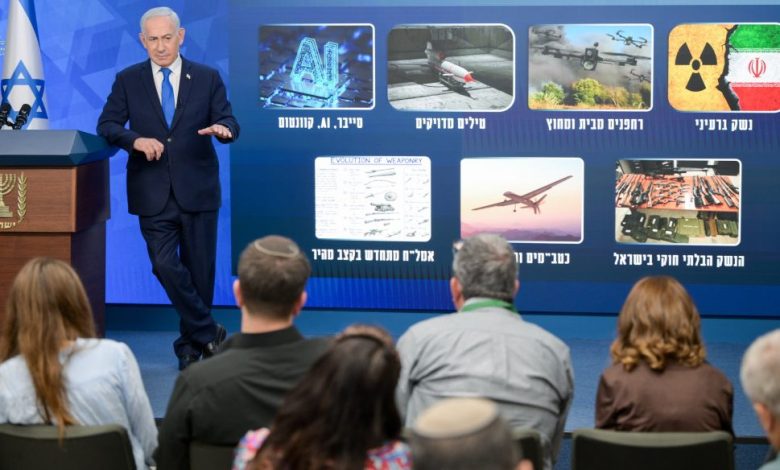
At the start of this week, Israeli Prime Minister Benjamin Netanyahu announced the principles of a new security doctrine. In a statement issued by his office, Netanyahu explained that the new doctrine gives priority to efforts aimed at “preventing threats from taking shape, and adopts the option of attack instead of containment and defence, including pre-emptive strikes, and strengthening the protection of the home front against new threats.” The drafting of the new doctrine was overseen by the head of the National Security Council, Shmuel Ben Ezra, and a number of figures from the Israeli right contributed to its preparation, among them Brigadier General (res.) Erez Vilner, head of the “Security Officials’ Forum,” and Colonel (res.) Gabi Siboni, a researcher at the Misgav Institute for National Security and Zionist Strategy, a right-leaning think tank.
Although Netanyahu has spent longer in power than any previous Israeli prime minister, he had never undertaken a review of the traditional security doctrine whose principles were laid down by Israel’s first prime minister, David Ben-Gurion. It should be noted here that what Netanyahu announced does not yet have the status of an official “national security doctrine”; it is rather a set of general outlines of security concepts that are still being institutionalised.
This article sets out the detailed provisions of the new doctrine document, examines the circumstances of its release, analyses its implications and anticipates its consequences.
The List of Threats
Netanyahu enumerated the strategic threats Israel currently faces, which the new doctrine is supposed to confront, identified the axes from which they emanate, and set out principles of action for dealing with them. According to what the Walla website reported from Netanyahu, these threats include: the Iranian nuclear programme, described as “an existential threat to Israel”; and drones, with Netanyahu committing to build defensive systems against three types — conventional drones, fibre-optic drones (quadcopters), and drones equipped with SIM-K technology — in addition to the threat of remotely controlled unmanned naval vessels.
Netanyahu warned that quadcopters could be launched from inside Israel, from West Bank cities or from beyond the borders. He also cited high-precision, long-range missiles carrying 1,000 kg warheads as a serious threat, since they can reach Israel at extremely high speed, along with the threats posed by cyberspace, artificial intelligence and quantum computing. Netanyahu also referred to what he called “illegal weapons,” meaning the weapons held by Palestinian citizens of Israel, and disclosed that preparations had recently been made in Israel for the possibility that the weapons of the Palestinian Authority’s security services might in future be used against Israel. He also counted Israel’s inability to rely on itself for munitions production as a threat that must be addressed in order to achieve self-sufficiency.
Turning to the arenas that constitute sources of strategic threat to Israel, Netanyahu pointed to two main axes: the Iran-led “Shi’a axis” and the axis led by Türkiye. The Israeli prime minister explained that the scenario Israel fears is that these two axes will join forces against it.
According to Walla, the new security doctrine as announced by Netanyahu rests on the following principles:
- Preventing enemies from acquiring nuclear weapons.
- Deterrence, by building a credible threat against the enemy and by thwarting and disabling its military and civilian systems.
- Early warning, by building an intelligence picture of the enemy’s capabilities and intentions so that Israel is not caught by surprise.
- Defence, including through establishing buffer security zones and permanent readiness for war.
- Achieving self-sufficiency in arms and munitions by investing in research and development.
- Building alliances by drawing on Israel’s own resources.
- Waging a battle for consciousness against hostile states using artificial intelligence.
- Achieving victory, by breaking the enemy’s morale and its belief in its ability to pose a real threat.
- Ensuring internal national cohesion.
The Significance of the Announcement’s Timing
Before analysing the implications and consequences of the principles of the new national security doctrine, the significance of the timing of its announcement cannot be ignored: it came ten days before the Israeli general election. By choosing this moment, Netanyahu clearly wants to influence the priorities of Israel’s domestic debate and to give it a security colouring.
The timing of the announcement does not, however, diminish the importance of engaging with the new doctrine, because Netanyahu ordered the formation of the committee that oversaw its preparation long before the election date was set, as reported by Gili Cohen, political correspondent of the public broadcaster Kan. Moreover, the principles of the new doctrine in practice guide many of the policies adopted by Netanyahu’s government since the events of 7 October. Since those events, Israel has devoted a great deal of its war effort to parties merely because they might become a source of threat in the future, as Israel’s conduct towards Syria after the fall of Bashar al-Assad’s regime clearly shows.
In addition, the debate stirred up by the doctrine’s principles increases the chances of those principles becoming entrenched as part of the strategic narrative embraced by the Israeli public. Opinion polls point to the public’s enthusiasm for continuing to wage war on various fronts, as the results of a recent survey by the Mitvim Institute showed. And although the Israeli opposition was quick to accuse Netanyahu of exploiting the announcement for electoral purposes, it raised no substantive objection to the content of the doctrine’s provisions, as is clear from the statement issued by Gadi Eisenkot, leader of the Yashar party.
What the Shift Means for Israel’s National Security Doctrine
At first glance, some principles of the new security doctrine announced by Netanyahu appear to converge with the traditional doctrine formulated by Ben-Gurion and the amendments made to it by the prime ministers who succeeded him. The principles of both doctrines include deterrence, early warning and building international alliances. “Preventing” enemies from acquiring non-conventional weapons is also consistent with the shift Menachem Begin introduced in practice in 1981, when he ordered the destruction of the Iraqi nuclear reactor, what is known as the “Begin Doctrine”. Likewise, the adoption of “defence” is consistent with the principle that Ariel Sharon introduced into the national security doctrine in 2006, on the recommendation of the “Meridor Committee”, which had been tasked at the time with evaluating the national security doctrine.
On closer examination of the purposes of some of the principles the two doctrines share, however, they turn out to conflict. According to Udi Dekel and Omer Einav, researchers at Tel Aviv University’s Institute for National Security Studies, “deterrence” in the doctrine formulated by Ben-Gurion ultimately aims to secure the longest possible period of calm by instilling in the “enemy” the conviction that betting on armed force is futile, and pushing it to accept political settlements with Israel to resolve the conflict. The new doctrine, by contrast, does not aim at a long period of calm and contains no reference to readiness for political settlements; instead, it speaks of “permanent readiness for war.” This fits with Netanyahu’s talk of the need to act against parties that, in his view, are potential or emerging sources of threat rather than existing threats, which means Israel adopting the option of permanent war.
This is what a paper issued by Tel Aviv University’s Institute for National Security Studies on the trends of Israel’s war effort since 7 October concluded — in contrast to the traditional doctrine, which stipulates the principle of “lightning war” to ensure that the state’s service and productive sectors are not paralysed for long.
At the same time, the foundations of the “defence” principle that Israel added to its security doctrine in 2006 differ from those on which the same principle rests in the new doctrine. Whereas Israel justified adding “defence” at the time by the need to secure the home front against the challenge of rockets that had begun to target Israel’s interior, the new doctrine speaks of “defence” based on seizing enemy territory and turning it into buffer zones or security belts. This is what Netanyahu’s government has already done by occupying areas in Syria, Lebanon and the Gaza Strip and declaring them security belts, a step the Israeli army has called “forward defence.”
On this basis, seizing “enemy” territory and turning it into security belts has become one of the tools the new doctrine legitimises, and that control is not a temporary situation but a new security reality that Israel is trying to impose. This justifies the assumption that Israel may adopt the same conduct in future against other Arab actors or parties.
Netanyahu’s doctrine has also replaced “decisive outcome” (hasm), which was among the principles of the traditional doctrine, with “victory.” In the traditional doctrine, a “decisive outcome” means preventing the enemy from achieving its objectives and from turning any military gains on the battlefield into political gains. This definition offers clear criteria and sets specific conditions for achieving a decision, which helps Israeli decision-makers end a war and halt military operations. Netanyahu’s concept of “victory,” on the other hand, speaks of “breaking the enemy’s power and its belief in its ability to pose a real threat.” It is a concept so loose that it is hard to measure whether it has been achieved, which allows the war to continue.
At the same time, the new doctrine’s commitment to forming alliances by “relying on Israel’s own resources” in fact offers an approach different from the conception of alliances with foreign powers envisaged by the traditional doctrine. Through this provision, Israel defines the nature of the “price” it can pay in return for alliance with foreign powers, a price based on the military, intelligence, technological and cyber resources it possesses. Through this provision, too, the Israeli leadership signals to Arab and Islamic states that wish to reach normalisation agreements with it that it is not prepared to show any flexibility on the Palestinian question in order to conclude such agreements.
Türkiye’s Place in the New Israeli Doctrine
The new Israeli security doctrine’s treatment of the threat posed by Iran, its nuclear programme and “the axis it leads” is unsurprising, given the series of wars Israel has fought against that axis and its various members, and the Israeli leadership’s evident eagerness to resume combat operations against Tehran. But Netanyahu’s doctrine presenting Türkiye as a source of threat on a par with Iran is an unusual precedent, even though relations between the two sides have gradually deteriorated since the Justice and Development Party (AKP) came to power in Ankara, through 7 October and the shifts that followed.
Apart from Türkiye’s rhetorical escalation against Israeli policies, Israel has offered no evidence that Ankara is engaged in serious activities posing a direct and serious threat to Israeli security — which is why Tel Aviv has so far refrained from regarding Türkiye as an “enemy.”
Udi Evental, a former senior figure in Israeli Military Intelligence, rejected the view of Türkiye as an “enemy” or a source of danger, describing it instead as “a competitor whose broad interests conflict with Israeli interests.” He noted that Türkiye regards Israel as a threat that must be strategically counterbalanced, especially after Israel waged the last two wars on Iran. In addition, the fact that Türkiye is an important member of NATO raises questions about the challenges Israel could face in treating it as a source of threat alongside Iran, and about the tools it could use to neutralise that threat.
Israel has not, however, confined itself to declaring that its security doctrine regards Türkiye as a source of threat. Ahead of announcing the new “doctrine,” Netanyahu sent a threat to Ankara, saying he did not rule out the outbreak of war with it, in an interview with Channel 14, a mouthpiece of the Israeli right.
What calls for taking the doctrine’s provisions on Türkiye seriously is the fact that some of those who helped prepare it have begun using the same terminology once used to describe the Iranian danger in their efforts to highlight the gravity of the Turkish threat. Brigadier General Erez Vilner,[1] one of those who helped draft the doctrine, published an article on the “danger” posed by Ankara, saying that Türkiye and the axis it leads are now “surrounding Israel with a ring of fire,” and warning that “this ring of fire may unite with what remains of the Shi’a axis.”
The announcement of Israel’s strategic view of Türkiye, as reflected in the new security doctrine, came after a series of steps that Tel Aviv has taken openly and that can be attributed to confronting the “Turkish danger.” These include military action against Türkiye’s attempt to establish a military presence in Syria, as reflected in the attack Israel carried out two months ago on Abu al-Duhur airport in the north-east of the country. They also include building alliances and strategic partnerships with parties that regard Türkiye as a common enemy or adversary, such as the widening strategic partnership with Greece and Cyprus, which some Israeli media circles do not hesitate to describe as “the Middle Eastern alliance” aimed at shifting the balance of power against Türkiye. At the same time, there are indications that the Israeli army has begun to design its force-building policy so as to provide responses to Turkish superiority in certain military fields. To counter Türkiye’s decisive superiority in strategic submarines, Walla reported that the Israeli army is considering buying anti-submarine aircraft.
In addition, the consciousness strategy Israel is pursuing against its enemies now takes into account targeting the Turkish leadership and public through influence campaigns. In March 2025, the Israeli army appointed a Turkish-language spokesperson tasked with overseeing and running influence operations in the Turkish arena, assisted by a number of reserve officers and soldiers fluent in Turkish.
Material and Social Costs
The new security doctrine requires Israel to expand its strategic commitments, whether in continuing the war effort on multiple fronts, with the resulting increase in the manpower needed to sustain it, or in the larger security budget required to cover military and logistical spending.
There is no evidence, however, that Netanyahu is keen to create the conditions that would allow the Israeli army to obtain the manpower it needs to fulfil its commitments as the new doctrine stipulates. For domestic political reasons, Netanyahu is careful not to take serious steps to compel members of the Haredi religious community to perform military service, at a time when the Israeli army is suffering from an acute manpower shortage, so much so that Chief of Staff Eyal Zamir has warned the government that the army could collapse from within because of the shortfall in soldiers.
The irony is that the new security doctrine was announced after the public broadcaster Kan revealed that the number of draft evaders in 2026 had reached about 110,000, compared with 75,000 in 2025, with 88% of evaders belonging to the Haredi community. Because Netanyahu knows he cannot form a government without the participation of the Haredi parties, he avoids responding to calls for a law obliging the Haredim to perform military service, while his government lavishes billions of shekels on the Haredi public and its various institutions. Entrenching the exemption of particular social groups from military service has deepened internal division and damaged public trust in the government, which now stands at just 14%.
A government’s ability to adopt particular national security policies depends, among other things, on the domestic legitimacy its policies enjoy. Some link the growing levels of emigration, particularly of skilled professionals, to collapsing trust in the government and its decisions. The new doctrine’s reference to “national cohesion” as one of its principles looks like lip service, since reality gives no sign that Netanyahu’s government cares about it. This government ignores warnings from professional circles about the consequences of social polarisation as an existential danger to Israel. Eugene Kandel, former head of Israel’s National Economic Council, and Ron Tsur, an expert in public administration, have warned that the consequences of internal polarisation, especially the flight of “core talent,” particularly in high-tech, could harm economic growth, living standards and security capability, culminating in “the possibility of Israel’s collapse and the end of the Zionist dream.”
As for the material challenge arising from commitment to the new doctrine, the expansion of security spending since 7 October has doubled the size of the security budget compared with what it was before 7 October. In 2022 the security budget accounted for about 16.5% of the overall budget, whereas in 2026 it accounted for about 24.3% of the overall budget.
The continuing state of military onslaught since 7 October has also led to a decline in Israel’s economic growth. Israel’s economic growth rate in 2025 was about 2.9% of GDP, whereas in 2022, before the war broke out, it was 6.4% of GDP. The Bank of Israel expects public debt to reach about 69% of GDP by the end of 2026, and has warned that any further increase in the security budget will widen the deficit and add to public debt.
Conclusion
The new security doctrine announced by Netanyahu gives a conceptual frame to the changes Israel has already made to its concept of national security since the events of 7 October 2023. Its principles reveal Israel’s intention to continue relying on violent force as the sole means of confronting security and strategic challenges, and to disregard the option of political settlements. The new doctrine throws the door wide open for more parties to be added to the list of “sources of threat and danger” that Israel believes it must mobilise and guard against, without any objective grounds to justify it — as the elevation of Türkiye into a danger to Israeli national security shows. The doctrine’s principles also carry a message to Arab and Islamic states: reaching normalisation agreements cannot be tied to Israel showing any flexibility on the Palestinian question.
The enthusiasm for adopting the new doctrine is at odds with the results of the war effort Israel has waged under its influence over the past three years. Although Israel has achieved major operational successes by using force against the resistance in Gaza, Lebanon and Iran, it has so far failed to reach a decisive outcome in any of these arenas by securing political gains. Moreover, there are indications that adhering to the new doctrine does not guarantee the elimination of existing sources of threat but instead generates new ones. Before 7 October, the Ansar Allah movement in Yemen posed no significant threat to Israel; but the genocidal war Israel waged on the Gaza Strip drove the group to target Israel and impose a stifling blockade on it.
In addition, the human and material resources on which Israel’s ability to meet the doctrine’s principles is supposed to depend are limited. The erosion of these resources threatens to give rise to social and political challenges that will diminish the “national” resilience of Israeli society and lower the Israeli public’s trust in the political system. This in turn may limit the political leadership’s ability to continue its current approach to allocating the resources on which commitment to the new doctrine is supposed to rest.
[1] Head of the “Security Officials’ Forum,” a body that brings together right-wing reserve commanders from the army and intelligence services. He belongs to the Religious Zionist current, served as chief of staff of the Israeli army’s Southern Command during the genocidal war, and boasted in an interview with Maariv that he was the architect of the policies of starving Gazans and displacing them from their homes during the war.
By Saleh al-Naami · Vision Center for Political Development · 26 October 2026 · Original Arabic article