Vision Center for Political Development Publishes New Book, “Annexing the West Bank: Reshaping Palestinian Geography and Identity”

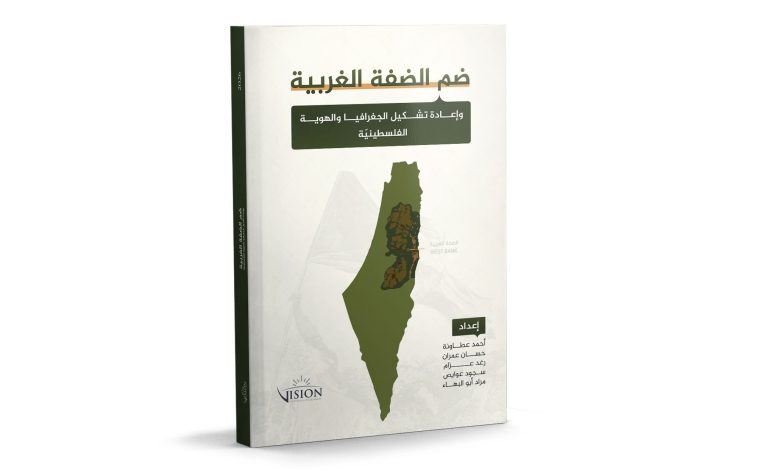
“Annexing the West Bank: Reshaping Palestinian Geography and Identity” is a newly published 126-page book issued by the Vision Center for Political Development. The book is co-authored by Ahmad Atawna, Hassan Imran, Raghad Azzam, Sujood Awais, and Murad Abu al-Baha.
In the book’s introduction, “Prelude: The West Bank from Settlement Expansion to De Facto Annexation,” Raghad Azzam examines the emergence of annexation in the West Bank as a gradual process that has produced a new political and geographical reality. This reality is reflected in figures on the ground and the accelerating expansion of Israeli control through settlements, outposts, roads, the transfer of administrative powers, and the entrenchment of an Israeli legal framework over Palestinian land.
Murad Abu al-Baha’s paper, “Israel and the Strategy of Resolving the Conflict with the Palestinians through Annexation,” offers an analytical examination of the shift in Israeli policies from managing the conflict to attempting to resolve it by imposing de facto annexation in the West Bank. The paper traces the acceleration of settlement expansion, the legalization of settlement outposts, road construction, intensified demolitions and military raids, and escalating settler violence. It also examines instruments of economic strangulation, including the withholding of Palestinian clearance revenues and restrictions on Palestinian employment in Israel. The paper demonstrates how these measures form part of an integrated political vision rooted in the “Decisive Plan,” which presents Palestinians with two options: submission without political rights or confrontation with force and displacement. Israeli occupation policies also seek to undermine the Palestinian Authority and strip it of any sovereign status by imposing financial and administrative constraints and pushing it toward institutional collapse. The paper concludes that the West Bank is witnessing the gradual implementation of a strategy aimed at annexing the land without its population by reshaping its geography and the balance of territorial control.
Ahmad Atawna’s paper, “The Political Dimensions of West Bank Annexation,” explores the ideological and political roots of the annexation project, presenting it as a direct extension of the Zionist narrative based on the notion of “a land without a people” and the exclusion of Palestinians from the political equation. The paper examines current developments driven by Israel’s most far-right government within the framework of what is known as the “Decisive Plan,” portraying them as an attempt to eliminate the Palestinian cause by imposing the options of submission, displacement, or extermination. It also links the genocidal war in Gaza to intensified settlement expansion in the West Bank and the fragmentation of its geography into isolated cantons, thereby foreclosing prospects for the establishment of a Palestinian state. The paper further discusses the regional and international dimensions of annexation and concludes by emphasizing the need for a comprehensive Palestinian reassessment of the national program and political institutions, alongside a transition toward a unified vision that redefines the conflict as a confrontation with a colonial project seeking to eliminate any possibility of independent Palestinian political existence.
Hassan Imran’s paper, “Annexing the West Bank: A Legal Analysis of Its Trajectory, Consequences, and Prospects,” provides a legal examination of Israeli annexation as a prolonged process that began with the occupation in 1967 and evolved through legislative and administrative policies that have produced de facto annexation on the ground, even in the absence of a formal declaration. The paper reviews contemporary instruments of annexation, ranging from symbolic parliamentary resolutions and the legalization of settlement outposts to budget allocations and infrastructure development linking settlements to Israel, as well as recent Knesset legislation reinforcing the imposition of Israeli sovereignty. It also examines the legality of annexation under international law, its implications for Palestinian statehood, and the legal status of Palestinians and the Palestinian Authority, in addition to its consequences for the legal status of the occupation and settlers. The paper concludes that differences in the forms annexation takes do not alter its overall trajectory, which ultimately seeks to consolidate full annexation when political conditions become favorable.
Raghad Azzam’s paper, “Dimensions of West Bank Annexation: Israeli Strategies to Economically Undermine Palestinian Society,” investigates the economic dimensions of annexation as an instrument for reshaping Palestinian society and subjugating it by dismantling its productive structures and weakening its capacity to survive. The paper analyzes policies of land confiscation, control over resources, the imposition of closures and checkpoints, restrictions on trade and employment, and the deliberate creation of financial crises. It also examines projects aimed at forcibly integrating infrastructure and tying the Palestinian economy to Israeli companies and networks as practical mechanisms for consolidating annexation without a formal declaration. The paper focuses on three main areas: the dismantling of Palestinian economic structures; Israeli developments and projects in the West Bank and their role in consolidating control; and annexation scenarios and their economic and social implications. It concludes that annexation manifests itself through the creation of isolated economic cantons, restructuring the Palestinian market into fragmented enclaves that are easier to control. Under such conditions, any vision of Palestinian sovereignty without control over resources amounts to little more than disguised dependency.
Finally, Sujood Awais’s paper, “Palestinian National Identity in the Face of Annexation: Dismantling Identity, Fragmenting Geography, and Resettling Refugees,” examines annexation as a project targeting the symbolic and political foundations of Palestinian identity alongside the land itself. The study analyzes annexation as a mechanism within a settler-colonial structure that seeks to dismantle geographical unity, reclassify Palestinians into isolated communities, and reduce the Palestinian cause from a struggle for national liberation to a manageable humanitarian issue. The paper connects land confiscation, the spatial reconfiguration of Palestinian territory, attempts to resettle refugees, and the weakening of representative institutions as instruments aimed at eliminating Palestinians’ collective political agency. It also discusses the impact of annexation on the unity of the Palestinian people in their homeland and the diaspora, raising a central question about the future of national identity amid policies of fragmentation. The paper concludes that the challenge extends beyond resisting annexation to rebuilding a unified national framework capable of transforming identity into an instrument of renewed political action.
The first edition of the book is available at the Vision Center for Political Development in Istanbul.