Why Is the West Bank’s “Powerful Image” Absent from the International Media Agenda?

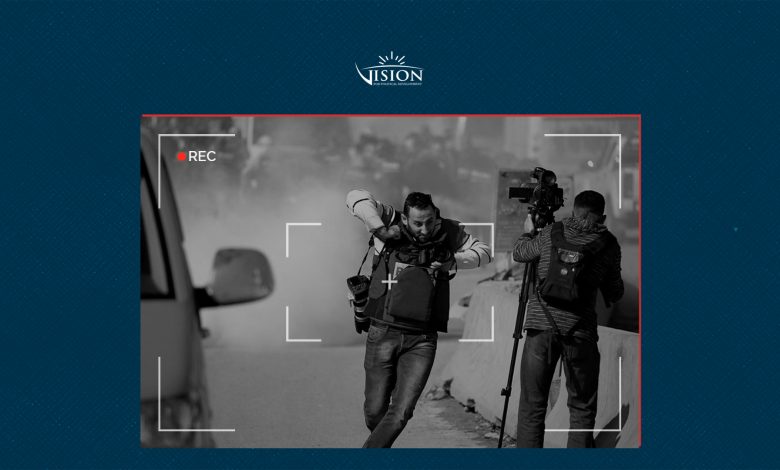
Despite the escalating violations and developments on the ground in the West Bank as a result of the occupation’s practices and settler attacks, events there remain unable to impose themselves on the international news agenda as a “framing narrative,” leaving room for Israeli propaganda to shape the dominant narrative. This reality raises a pressing question about the reasons why the West Bank’s powerful image remains “absent” or “marginalized” from international media screens and agendas at a time when breaking events and visual footage have become key drivers of public opinion and political attitudes.
This article seeks to examine the factors that hinder the formation of an influential journalistic discourse capable of representing the reality of the West Bank within the global media landscape.
First: Field Restrictions and the Engineering of Event Zones
Field data show that journalists in the West Bank operate in a hostile and highly dangerous environment, where direct violence is used to restrict the reporting of facts. The Palestinian Journalists Syndicate documented at least 108 attacks against journalists in July alone, in addition to the arrest of 22 journalists since the beginning of this year.
This direct intimidation is accompanied by an Israeli strategy aimed at “isolating event zones” and preventing powerful and impactful images from being captured from the outset. This strategy takes the following forms:
Restricting movement through various forms of military checkpoints. The United Nations Office for the Coordination of Humanitarian Affairs (OCHA) documented 925 movement obstacles in the West Bank, preventing photographers from quickly reaching locations to document events. This is compounded by the military closure of event zones and bans on media crews entering them, particularly in areas surrounded by settlements and those classified as Area C, preventing the humanitarian consequences from being reported as they unfold.
These restrictions weaken coverage of events and limit the ability to convey them to international media in accordance with the standards required for coverage. This brings us to the structural and institutional factors within international media organizations that affect how they approach events in the West Bank and Palestine more broadly.
Second: “News Values”
News production in international media organizations is governed by “news values,” criteria used by editors to assess an event and determine whether and how it should be covered. When applied to events in the West Bank, international media can be seen as approaching them through several frameworks.
The first is the presence of the “shock and surprise” factor.
These outlets tend to treat events in the West Bank as routine, familiar, and repetitive, lacking elements of visual intensity and shock. As a result, scenes of daily violations in the West Bank are excluded from leading coverage because they are no longer classified as “breaking news” according to competitive news-value criteria. This contrasts with direct wars or large-scale confrontations, as seen during the most recent Israeli war on the Gaza Strip, when the magnitude of events compelled global news organizations to report on developments as they unfolded, albeit, in most cases, through a narrative biased in favor of the occupation.
The second framework is the adoption of the official narrative of security agencies.
Most Western media outlets rely on statements from the Israeli army and the occupation’s political leadership and avoid using terms that characterize the reality on the ground, such as “apartheid” or the de facto “annexation” of the West Bank. Developments and the terminology surrounding them are therefore framed primarily according to Israeli statements and, secondarily, in alignment with the foreign policies of the countries to which these media organizations belong. Events are portrayed using neutral expressions such as “clashes between two sides” or “security operations in areas of conflict between Palestinians and Israelis,” stripping the images of their material, political, and humanitarian significance.
Focusing on the diplomatic dimension rather than developments on the ground. News is often presented through the lens of official political positions. During recent events in the town of Qusra in Nablus, for example, international media focused on condemnations by Western diplomats and U.S. officials of attempts by Israeli settlers to seize the homes and property of Palestinians holding U.S. citizenship. This reduced the victims’ humanitarian suffering to little more than a backdrop for a “routine inspection visit” within the framework of largely symbolic diplomatic activity, without linking these events to the broader system of occupation and the ongoing de facto annexation of the West Bank.
For example, Reuters published a report on August 20, 2026, titled: “U.S. envoy Huckabee tells Israeli settlers not to take Palestinian Americans’ land.” The report focused on remarks by Washington’s ambassador to Israel, Mike Huckabee, concerning settlers’ attempts to seize Palestinian homes, as well as his broader defense of settlers, saying that they “are trying to live in safety and peace in Judea and Samaria (the West Bank).”
The third framework involves structural constraints and self-censorship.
International media organizations have reduced the number of staff and correspondents they employ across the Palestinian territories, affecting the nature and quality of their coverage from the West Bank. They increasingly rely on freelance journalists working on a per-piece basis, who often lack the logistical support and legal protection associated with major media organizations. This limits their ability to be present in high-risk event zones out of concern for their safety.
At the same time, international media organizations exercise self-censorship over what they publish to avoid accusations of “antisemitism,” which the occupation state and its various affiliated bodies use to attack media outlets reporting on Israeli violations against Palestinians. As a result, fewer materials reach international media organizations, and those that do often fall short of the threshold required to become prominent news stories or major events.
Third: Digital Restrictions
Traditional media coverage is also influenced by the digital sphere, where strict policies govern the management of published content. Powerful visual material documenting confrontations or violations is often classified as “sensitive content” or “incitement.” When applied to footage coming from the West Bank, particularly scenes of killings and severe beatings, digital platforms restrict or ban such material on these grounds. This reduces its reach and prevents it from developing into a trending public issue capable of compelling media organizations to cover it.
Fourth: The Gap in Palestinian Media Discourse
Palestinian media organizations bear part of the responsibility in relation to their discourse and the mechanisms they use to address international public opinion. Some local media outlets often rely on emotional rhetoric and slogans rather than employing a rational discourse capable of influencing editors at international media organizations. Palestinian media also frequently focus on official statements, casualty figures, and breaking events rather than individual human stories that have the potential to break through the news and editorial criteria of Western media.
From the above, it becomes clear that the absence of powerful images from the West Bank on international news screens and websites is not merely the result of an incidental editorial decision. Rather, it is the product of political agendas, news values, and editorial contexts that frame events in ways that serve interests fundamentally shaped by double standards in their treatment of the Palestinian issue. Ultimately, this leads either to turning a blind eye or to fragmented media coverage that strips events of their humanitarian dimension, weakening the Palestinian voice in the face of a powerful Israeli media machine with global influence.