The Gaza Management Committee: Is a New Political Model Emerging?

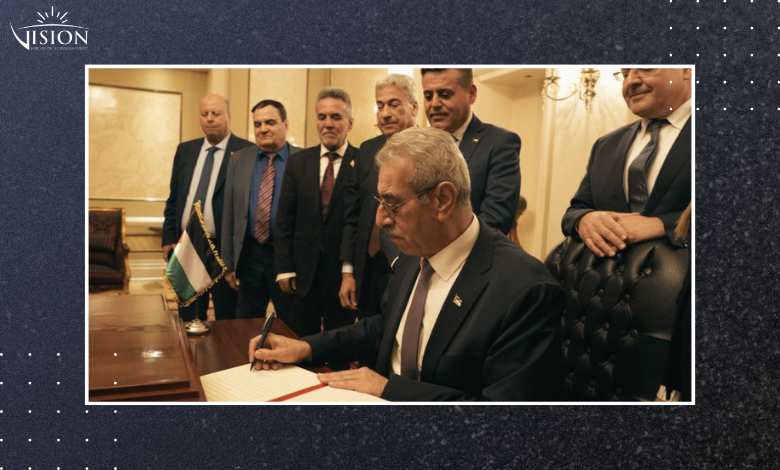
On January 16, 2026, the Palestinian National Committee for the Administration of Gaza (NCAG) officially began its work from the Egyptian capital Cairo, in preparation for moving to the Gaza Strip and launching an emergency relief plan for the Palestinian people. This coincided with the announcement of the start of the second phase of the agreement to end the war on Gaza, by US Middle East envoy Steve Whitcomb.
This announcement was met with Israel’s refusal to allow members of the committee to enter the Gaza Strip directly. It also came amid continued Israeli violations of the terms of the first phase of the ceasefire agreement and delays in reopening the Rafah crossing, which is considered part of the transition to the second phase of the agreement, despite the US announcement of the structure of the members and executive council of the “Board of Peace”[1] in Gaza.
Vision Center for Political Development, a leading think-tank in Istanbul, gathered the opinions of a number of political experts to understand the nature of the challenges that the Palestinian National Committee for the Administration of Gaza (NCAG) may face, and the future of its work in light of Israeli obstacles, and the possibility of this path transforming into a new political model that is in line with the American-Israeli perspective on the Palestinian issue.
Opinions were reviewed through the following topics and questions:
- What are the factors for the success of the Palestinian Committee for the Administration of Gaza? What are the obstacles and challenges it faces?
- In what context can we understand US political support for this committee?
- To what extent does Israel want this committee to succeed in the coming phase?
- In the absence of a national “factional or institutional” authority, how will the Palestinians deal with this new entity?
- What are the risks posed by the ‘Board of Peace’ and the ‘Executive Council’, which are “devoid of Palestinians,” to the Palestinian national project and political future?
- Could this committee become an alternative body for a future Palestinian political entity?
The experts’ views can be summarized as follows:
- The administrative committee needs genuine Palestinian support and backing on the ground from all parties; factions, the Palestinian Authority, and civil society institutions.
- The committee’s success requires real cooperation on the ground, particularly from Hamas, including the transfer of all responsibilities in Gaza, including political and security institutions.
- One of the key conditions for its success is having a clear and specific mandate to manage services, relief efforts, and the restoration of essential facilities, without drifting into an open-ended political role.
- The committee’s success depends on its ability to enter Gaza and operate on the ground with relative freedom, secure stable funding and transparent spending mechanisms, and establish practical coordination with Egypt, the United Nations, and international relief agencies.
- The committee faces a major challenge in managing high public expectations within an exhausted humanitarian environment, where performance is judged by quick results rather than promises.
- U.S. political support for the administrative committee stems from Washington’s desire to advance Trump’s plan and its investment projects in Gaza, not from concern for Palestinians.
- The objective of U.S. political backing is to produce a transitional administrative formula that stabilizes the humanitarian and security situation and prevents the return or rise of forces that do not align with its vision.
- The main obstacle facing the committee is Israel’s conduct on the ground and its failure to adhere to the terms of the agreement.
- Israel may resort to using armed militias it has established in Gaza as a tool to obstruct the committee’s work, or to undermine the Palestinian model in favour of models linked to the occupation.
- The occupation’s willingness to see the committee succeed is conditional and limited; it may accept success in the service sector if it serves its security plans, but it shows no readiness to grant any sovereign or political horizon.
- There are real concerns about transforming the Gaza administrative committee model into one that could extend to the West Bank, effectively undermining the Palestinian dream of establishing a state on the 1967 borders.
- The political legitimacy of any entity cannot be granted from the outside; rather, it stems from the Palestinian national heritage and collective experience. No Palestinian party will accept transforming into a model subordinate to, and dependent upon American policies.
- Palestinian concerns should not undermine trust in or support for the Administrative Committee. Priority must be given to ending the suffering of Palestinians and keeping the threat of genocide away from them.
- Palestinians are likely to approach the committee with conditional pragmatism; that is, offering it temporary acceptance if it succeeds in improving daily living conditions, while resorting to political and popular opposition if it appears to be externally imposed or operating outside the national framework.
- The absence of Palestinian representation in the ‘Board of Peace’ and Executive Council carries deep political risks, most notably that of bypassing the concept of national representation and opening the door to a top-down international administration over Gaza.
- In light of Israel’s rejection of any Palestinian reference bodies overseeing the committee, this would require the creation of a separate entity, outside the officially announced structures, to serve as a shadow reference body, with the approval of the Palestinian Authority, the resistance factions, and the head of the committee.
- The Palestinian Authority behaves as if it is waiting for the world to hand it responsibilities and powers on a silver platter, which will not happen in light of Israeli ambitions. The Authority must struggle to reclaim its powers and role, and this struggle should be directed at Israeli ambitions, domination, and guardianship, not against the role of Hamas and the resistance factions.
Expert Opinions
Dr. Mokhaimer Abu Saada, Professor of Political Science at Al-Azhar University in Gaza
- The success of the administrative committee depends on two main aspects. The first is Palestinian support for the committee from all parties. While there have been statements of support from the factions and the Palestinian Authority, genuine support must take the form of real cooperation with the administrative committee, particularly from Hamas, by transferring all responsibilities in the Gaza Strip, including political and security institutions.
- The second aspect is that Israel must refrain from placing obstacles to undermine the committee. I believe Israel can sabotage the committee through two means. The first involves the armed militias it has formed, which are present in four areas of Gaza; Israel may push them to stir unrest, thereby drawing the committee into distractions that divert its central efforts. The second would be Israel obstructing the opening of crossings and blocking the entry of humanitarian, medical, and reconstruction materials.
- Regarding the Palestinian reference authority of the committee, there is an unclear contradiction. Israel agreed to the presence of Palestinian Authority personnel at the Rafah crossing, yet at the same time refuses to allow the Authority to serve as the reference body for the administrative committee. This creates inconsistency. While Israel does not want there to be a Palestinian reference authority, it cannot prevent communication with Palestinian national leadership, because this is tied to the needs of the people in Gaza. This situation recalls what happened during the Oslo Accords, when Israel refused to meet any delegation representing a Palestinian reference authority, yet at the same time the late President Yasser Arafat was the reference authority for the entire Palestinian delegation. Thus, there is a difference between Israeli preferences on one hand and the realities imposed by Palestinian national, political, and humanitarian circumstances on the other.
- S. political support for the Gaza administrative committee remains ambiguous. The U.S. administration is not a charitable or humanitarian organization, and it would be naïve to assume its actions are solely for the benefit of Palestinians. In my view, the plan put forward by Jared Kushner and Steve Witkoff regarding a “new Gaza” reminds us that Kushner was the first to describe Gaza’s coastline as ‘a real estate investment opportunity.’ It is clear that the Trump administration has its own interests, and the plan presented at the Davos conference confirms this. Therefore, any American support for the Gaza administrative committee primarily serves the implementation of the U.S. project.
- Israel will likely attempt to undermine the work of this committee, especially over the next three months, as Israel approaches Knesset elections. The Israeli focus will likely be on avoiding withdrawals from Gaza and imposing restrictions on reconstruction materials. Moreover, Israel has not abandoned the idea of displacing Palestinians from the Gaza Strip. All of this indicates how Israel may deal with the committee and its tasks on the ground.
- There are many real fears and risks concerning the liquidation of the Palestinian dream of establishing a state on the 1967 borders. If the experience of administering Gaza succeeds according to the Israeli-American vision, it may be applied to the West Bank by creating an alternative administrative body to replace the official Palestinian structure. Therefore, caution is necessary.
Wesam Afifa, Writer and Political Analyst, Gaza
- The chances of success for the administrative committee depend on a set of essential factors, foremost among them possessing a clear and specific mandate to manage service and relief affairs and to restore basic facilities, without slipping into an open-ended political role. Success is also linked to its actual ability to enter the Gaza Strip and operate on the ground with relative freedom, secure stable funding and transparent, accountable spending mechanisms, and establish practical coordination with Egypt, the United Nations, and international relief agencies to ensure the steady flow of aid without field-level obstruction.
- Conversely, the committee faces several obstacles, most notably the possibility of Israeli obstruction through security restrictions or targeting infrastructure and personnel, in addition to the fragility of the security environment and the absence of a locally agreed-upon enforcement force. This is especially true if the continued recruitment and sponsorship of gangs managed by the occupation persists. The crisis of legitimacy and representation also constitutes a central challenge, amid factional and popular fears that the committee could become an instrument of political guardianship, as well as the pressure of high public expectations in an exhausted humanitarian environment, where performance is judged by rapid results rather than promises.
- In the absence of a unified national reference, whether factional or institutional, Palestinians are likely to approach the committee with conditional pragmatism; temporary practical acceptance if it succeeds in improving daily living conditions, but rejection and political and popular escalation if it appears externally imposed or operating outside the national framework.
- Factions will likely seek to exert indirect influence over the committee’s course of action rather than confront it outright, while civil society institutions and municipalities will calibrate their level of cooperation based on the degree of transparency and the protection available to their staff.
- The existence of a ‘Board of Peace’ and Executive Council devoid of Palestinian representation carries profound political risks, most notably bypassing the concept of Palestinian national representation and opening the door to a top-down international administration over the Gaza Strip, thereby weakening the principle of self-determination.
- This model would also entrench a functional and political separation between Gaza and the rest of the Palestinian geography, turning the Strip into a humanitarian–investment file whose priorities are managed from outside, rather than within a comprehensive national project.
- As for U.S. political support for the administrative committee, it can be understood within the framework of the “day after the war” approach, whereby Washington seeks to produce a transitional administrative formula that stabilizes the humanitarian and security situation and prevents the return or rise of forces that do not align with its vision. This support does not necessarily reflect a commitment to building a Palestinian political path, but rather risk management, containment of the war’s repercussions, and linking reconstruction to governance arrangements subject to international oversight.
- In contrast, the occupation’s willingness to see the committee succeed appears conditional and limited; it may accept success in the service sphere if it serves its security plans, but it shows no readiness to grant any sovereign or political horizon. The experiment remains subject to disruption at any moment if its outcomes conflict with Israeli security or political calculations.
- As for the possibility of the committee evolving into an alternative political body representing Palestinians in the future, this remains theoretically possible by force of circumstance if its mandate is prolonged and its powers expanded. However, it would remain weak in legitimacy and closely tied to the absence of alternatives.
- In the absence of a clear national reference, broad consensus, or an electoral process, the committee will at best remain a transitional administrative framework, not a sustainable substitute for Palestinian political representation.
Dr. Ma’moun Abu Amer: Palestinian academic and political analyst.
- The success of the committee depends on several factors. One is political: it must enjoy international political support, especially from the United States, in order to overcome Israeli obstacles, alongside active efforts by mediators and an effective European role with clear positions.
- Another is economic: the availability of funding for relief and reconstruction, and for covering the needs of the Gaza Strip, including public sector employees.
- There must also be a Palestinian pillar of support from two sides. The first is Hamas and the resistance factions in Gaza, by facilitating the committee’s work and transferring government departments to it. There is reportedly a decision from Hamas to do so, which is a positive step. The second is the Palestinian Authority, which should play a central role in supporting the existing ministries in Ramallah in assisting their counterparts in Gaza. This support is important both administratively and politically, and the Authority has acted wisely in welcoming the committee.
- A fourth factor relates to the personal dimension and the competence of the committee members, their ability to withstand work pressures and confront the social, psychological, and economic challenges faced by the population, as well as their readiness to cooperate with institutions and actors within the Strip on the basis of neutrality and avoiding political rivalries, especially given the polarization within Palestinian society.
- On the other hand, the main obstacles to the committee’s work stem from the Israeli side. Preventing committee members from entering Gaza, controlling the crossings, blocking aid, and ongoing violations all indicate not a supportive environment, but rather one that obstructs the committee’s work.
- Given the committee’s lack of a political character, it is necessary to work on linking it to the officially recognized political entity, the Palestinian Authority. However, this effort should not precede the primary task of rescuing and providing relief to Gaza’s residents. Strengthening the Palestinian political character requires factions and political forces to overcome their differences with the Palestinian Authority and engage in unified national action to reinforce political identity, so that the national identity is not diluted and the separation between the West Bank and Gaza is avoided.
- As for the ‘Board of Peace’, it represents a cover for Trump’s vision of the global order outside the framework of the United Nations. This poses a danger to the international system and extends beyond the Palestinian case. According to his outlook, Trump does not see a need for a Palestinian role. Therefore, it is important to strengthen the Palestinian identity of this committee and reinforce its national character through cooperation among all Palestinian forces.
- Regarding the Executive Council, since the United States does not currently view the Palestinian Authority as a partner, this gap could be compensated by countries that support the Palestinian people, Arab and Islamic states, as well as friendly nations, because their involvement could serve as a counterweight to Israel’s allies within the Executive Council.
Akram Attallah: Palestinian writer and political analyst
- The obstacles and challenges facing the administrative committee revolve around two main issues. The most significant are the obstacles that Israel may create through its control of crossings and the economy, as current indicators suggest that it is unwilling to grant the committee sufficient space to operate successfully. The second challenge concerns how Hamas will deal with the committee, whether it will transfer governance smoothly and without placing any conditions in return.
- It is clear that Palestinians are dealing with the committee pragmatically, even in the absence of a political reference authority, because they view it outside the political dimension. This may have made it easier for the factions to accept it. The primary goal at this stage is to stop the genocide and to provide relief to the people of the Gaza Strip, away from political considerations.
- S. support for this committee is understood within the framework of broader American strategic interests. President Trump has spoken about his desire to take control of Gaza, and for this reason the U.S. administration appears invested in ensuring the committee’s success, paving the way for the projects discussed by Kushner, including references to a “new Gaza,” its coastline, and the untapped gas off its shores.
- It is also evident from internal Israeli debate that there is opposition from leading government figures such as Itamar Ben-Gvir and Bezalel Smotrich. Therefore, Israel is unlikely to provide facilitation to the committee. It signalled this during the departure of the committee’s delegation from Gaza and the West Bank through the Kerem Abu Salem crossing and the King Hussein Bridge, when members were delayed for several hours, in addition to the continued Israeli pattern and scale of violations.
- As for the possibility of the committee evolving into an alternative political body or title, I do not believe this will happen, it is not that simple. The Americans may attempt to assign it political roles, but I believe its humanitarian and service-oriented mission will overshadow such efforts. Although it has acquired a form of legitimacy and political cover, political legitimacy cannot be granted from the outside; it derives from the Palestinian national legacy embodied in the history of the Palestine Liberation Organization. Therefore, the gateway to political legitimacy is Palestinian, and no Palestinian party or group will accept acquiring its legitimacy from external actors.
Nihad Abu Ghosh: Writer and analyst specializing in Israeli affairs, Ramallah
- From an objective standpoint, there are serious and realistic conditions for the committee’s success, given the international and regional momentum surrounding President Trump’s plan, the relative Palestinian consensus on the committee’s role and composition, and the acknowledgment by various Palestinian parties that this phase requires focusing on ending the genocide and displacement, and prioritizing recovery and reconstruction. However, all of this remains subject to Israeli decisions, especially in light of the prohibitive conditions set by the Israeli government for moving to the second phase, its evasion of commitments stipulated in the plan, and its demand that Palestinians comply one hundred percent. The greater problem lies in the Trump administration’s absolute support for Israel and its adoption of Israel’s interpretation of the plan.
- Thus, the U.S. administration’s delay in implementing the steps outlined in the plan, including the formation of a stabilization force, clarifying its structure and tasks, and defining the relationship between the various overlapping bodies, has left considerable ambiguity. Israel exploits this ambiguity to impose its own interpretation and vision of Trump’s plan.
- Ongoing Palestinian internal fragmentation and the repeated failure to implement national dialogue agreements have produced an abnormal reality in Gaza and in Palestinian political life more broadly. This situation has shaped the course of the genocide in Gaza and influenced all related arenas of conflict and negotiation, ultimately contributing to the adoption of Trump’s plan and the formation of the committee to administer Gaza. In my view, people and factions in Gaza are likely to approach the committee and its mandate pragmatically, given that its authority is limited to service-related functions, though even this role will remain dependent upon the extent of Israeli interference.
- As for the Palestinian Authority, it acts as though it is waiting for the world to hand it responsibilities and powers on a silver platter. This will not happen given Israeli ambitions. The Authority must struggle and fight to reclaim its powers and role, and this struggle should be directed against Israeli ambitions, domination, and guardianship, not against the role of Hamas and the resistance factions.
- There is something resembling dark comedy in the composition of the ‘Board of Peace’, which appears more like the management of a family business belonging to Trump. Benjamin Netanyahu, who is wanted by the International Criminal Court, has become a member of the board, while Palestinians, the primary stakeholders, are not members. Major European countries have refused or expressed reservations about participating for several reasons, including Trump’s hostile stance toward Europe and fears that the board could replace United Nations bodies, especially since it would address multiple international issues, not just Gaza. This structure poses a danger to the Palestinian future, as it implies the absence of international law and disregard for commitments. Trump’s reversal of international law in several files provides an opportunity for Netanyahu and a green signal to act as he wishes in Gaza and Palestine more broadly.
- Therefore, contradictory American positions and statements, saying one thing while doing another, cannot be trusted. Political support for the administrative committee may not be consistent, and U.S. backing thus far remains merely rhetorical. The United States has not even ensured safe and dignified passage for the committee members to Gaza, so how can it enable the committee to carry out its responsibilities amid ongoing Israeli violations? Even more dangerous is the continued commitment of Israel’s right-wing government to the option of displacing Palestinians, reoccupying Gaza, and reestablishing settlements there.
- Just as Israel reduced the first phase to the issue of retrieving captives, it now seeks to reduce the second phase to a single clause: disarming the resistance. Accordingly, it wants all bodies, especially the stabilization force, to help it implement this objective. Israel is also working to entrench a formula in which obligations are required only of Palestinians, while Palestinian rights are tied to prohibitive conditions. Israel may deal opportunistically with the committee and could use any relationship between the committee or any of its members and the Palestinian Authority or Hamas as a pretext to intervene and undermine its role.
- In the foreseeable future, it seems unrealistic for the administrative committee to become an alternative political body. However, the persistence of internal division and the dramatic shifts taking place in the international system and their regional repercussions, could make this option more plausible. Over the past five decades, Palestine, represented by the Palestine Liberation Organization, was present and influential in everything related to Palestinian affairs. Yet throughout the context of the genocide and the negotiations surrounding it, the PLO was sidelined, even from Arab meetings that discussed Palestinian issues, and effectively excluded from the deliberations in Sharm el-Sheikh and the Peace Council. Israel’s strategy in this regard is clear and publicly declared: to deny recognition of the Palestinian people and to reject the existence of any unified body representing them, instead treating Palestinians as population groups, clans, and local communities with humanitarian and livelihood rights, rather than as a people with national and political rights, foremost among them the right to self-determination.
Firas Yaghi, writer specializing in Israeli affairs, Jerusalem
- The committee possesses internal, regional, and international factors that could enable it to succeed in its work, especially given the full support from the factions, particularly Hamas. Therefore, there are no internal obstacles preventing its success. Most of its members were nominated by Palestinian factions, and the Palestinian Authority has also announced its approval of the committee and its readiness to coordinate with it in all matters related to its service and administrative work in the Gaza Strip.
- The primary obstacle is the Israeli occupation and its rejection of any practical role for the committee unless the occupation government’s declared objectives are achieved. Accordingly, Israel will work to obstruct the committee’s activities through its stated conditions. The opening of the Rafah crossing will remain conditional and subject to Israeli discretion; there will be no withdrawal without disarmament, and no reconstruction without assurances that Gaza no longer poses a threat to Israel’s security.
- The greatest challenge for the committee is the presence of the occupation on the ground and the continued policy of procrastination in implementing agreements related to the second phase. The second challenge lies in attempts to impose a new model that divides Gaza geographically and demographically, separating the population between those considered part of the resistance environment and those opposed to it. The challenge, therefore, is how to confront and prevent such plans. Naturally, the third challenge concerns relief for the population, this is an urgent issue that imposes itself strongly and represents a key benchmark for the committee’s success, especially as the occupation places obstacles in its way.
- According to Trump’s plan as officially announced by the U.S. administration, the reference authority for the Gaza administration committee is the High Representative, Nikolay Mladenov. Thus, there is no factional or Palestinian Authority reference. Matters will therefore depend on effective coordination between the committee, the factions, and the Authority to prevent the emergence of a new, non-national leadership whose reference and direction are American. This would require creating a body outside the officially declared structures to function as a shadow government that directly supervises and serves as a reference for the committee, something that cannot occur without agreement between the Palestinian Authority and the factions, as well as the approval of the committee’s head.
- The risks of the committee transforming into an alternative political administration depend on the ability of the Palestinian side and Arab and Muslim mediators to prevent deepening the division between the West Bank and Gaza, and to prevent the emergence of separate Palestinian leaderships, one for Gaza and another for the West Bank. Otherwise, the Palestinian cause as a whole would be at risk, and the national project would become hostage to developments on the ground in Gaza and to the broader Palestinian capacity to overcome division and resist attempts to create a new Palestinian leadership.
- As for U.S. support for the committee, it comes within the framework of advancing President Trump’s plan, given that Gaza has effectively become an American project. It remains unclear whether this project, according to the plan, will lead to a credible path toward Palestinian self-determination, or whether it will amount to the liquidation of the Palestinian cause as part of an American project of dominance and expansion of occupation, an approach pursued by American and Zionist actors under the banner of geopolitical change.
Ahmad Rafiq Awad: Head of the Jerusalem Center for Strategic Studies, Al-Quds University
- This committee will face many obstacles and difficulties, foremost among them Israeli acceptance. “Israel” is not interested in implementing the second phase or in ensuring the ceasefire succeeds as agreed. In addition, the committee will need to coordinate its steps and tasks with multiple parties; Palestinian actors within Gaza, Arab and regional parties, and international actors including the United States, as well as a stabilization force, should one be formed. Therefore, the committee’s mission is tied to its ability to coordinate with all parties, a major challenge. While the committee’s success would mean success for all parties involved, the powers granted to it remain unclear so far, as do its financial, technical, and logistical capacities. This means it faces an extremely difficult task and may well be the weakest link among the three bodies that were announced (the Board of Peace, the Executive Committee, and the Administrative Committee). Accordingly, decision-making does not lie in the hands of the Administrative Committee as much as it serves as an executive instrument.
- The nature of the roles and tasks assigned to the committee will determine how Palestinians and factions relate to it. If it functions merely as an executive tool for international policies without addressing Palestinians’ actual needs, this may create a trust gap between it and the Palestinian public. However, if it succeeds in alleviating citizens’ suffering, it will earn respect and appreciation, especially given the assumption that it comes with international support. Thus, doors and resources should be open to it so it can deliver tangible improvements that reduce people’s hardship.
- The ‘Board of Peace’ and the Executive Council are, in practice, international bodies aimed at achieving a concept of comprehensive prosperity based on American interests. They were not formed to establish a Palestinian state, but rather to foster a situation in which the Gaza Strip is not under direct Palestinian control. For this reason, there is talk of international-level investment projects, which Trump referred to as the “Riviera.” These projects are far removed from Palestinian aspirations to link the West Bank and Gaza. Instead, they seek to move the Palestinian national project to an entirely different place from where it currently stands, reinforced by the composition of these councils, whose members carry a background and legacy far removed from what Palestinians desire.
- Political support for the national administrative committee comes in the context of maintaining Israel’s security and calm, eliminating Palestinian resistance, making Gaza an investment zone separated from the West Bank, and transforming political demands into economic and humanitarian ones. Perhaps the most difficult scenario would be the actual division of the Gaza Strip into two areas, one impoverished and deprived, and the other prosperous and developed.
- What “Israel” seeks is the disarmament of the resistance and the full military reoccupation of the Strip. These two issues are the benchmark for Israel’s dealings with the committee. Consequently, Israel will attempt to limit the committee’s role in ways that serve Israeli objectives. In fact, Israel is actively working to hollow out the second phase of its core elements, as evidenced by obstructing the entry of the Administrative Committee and preventing the establishment of the international stabilization force.
- There may also be efforts to transform the Administrative Committee into an alternative Palestinian reference authority to replace the current Palestinian political umbrella, possibly under a form of international trusteeship, a new model of dominance and colonialism, or a transitional phase that later becomes permanent, especially given Trump’s desire to turn the ‘Board of Peace’ into a global club, thereby creating new models for dealing with conflicts.
[1] The so-called ‘Board of Peace’ (BoP) is an international organization established by Donald Trump and led by the US government, with a stated purpose of ‘promoting peacekeeping around the world’. It is named in UN Security Council Resolution 2803 as a body tasked with overseeing the processes of the Gaza Peace Plan. The board was proposed in September 2025 and formally established on the sidelines of the 56th World Economic Forum in January 2026. Resolution 2803 authorized the board to aid with reconstruction efforts in the Gaza Strip, via the National Committee for the Administration of Gaza (NCAG), and to deploy a temporary peace-keeping force.
NOTE: This text is adapted from original Arabic article.