What Does Netanyahu’s Presence on the “International Board of Peace” Mean?
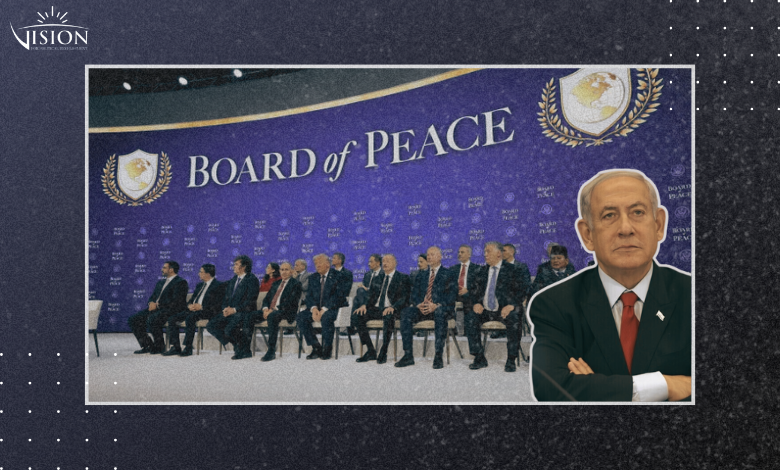
The recent Davos conference marked a dangerous turning point in the trajectory of the Palestinian cause, as it witnessed the announcement of the formation of the ‘International Board of Peace’ and the signing of its charter, alongside the presentation of the plan proposed by the U.S. administration, delivered by Jared Kushner.
The Board of Peace has become the highest authority controlling Palestinian affairs in Gaza, which is not limited to the Gaza Strip, but extends to include a comprehensive vision for the region and the world, alongside an executive council consisting of a group of diplomats, special envoys, and American and international businessmen.
It is pertinent to note that the Board of Peace is completely devoid of any Palestinian representation, while Benjamin Netanyahu, the head of the occupation government and wanted for arrest by the International Criminal Court, will be a member of this council, which raises fundamental questions about the name and functions of this council.
The real danger lies in the fact that this step clearly revealed the existence of institutional bodies, a plan, and a course of action that has begun to take shape on the ground with regard to the Gaza Strip, placing the Strip under full international trusteeship and removing it completely from the Palestinian national framework.
The Palestinian committee that has been formed has no Palestinian national authority, either official or unofficial, and will have no authority from the PLO, the Palestinian Authority, or any of the national or resistance factions.
The authority of this committee, as defined, is the Executive Council emanating from the Board of Peace, and the new High Representative Nickolay Mladenov. Consequently, this path removes the Gaza Strip from the Palestinian national situation in favour of placing it under international trusteeship with a clear American authority.
A Palestinian Committee or Employees of an International Body?
If we look at the formula that has been formed, we find that the Palestinian “technocratic” committee that will administer the Gaza Strip, with all due respect to the figures participating in it, is closer to Palestinian employees of a foreign administration.
This is very similar to the Palestinian employees who worked for the Israeli “civil administration” under the occupation before the Oslo Accords, where there were sectors such as health, education, and civil service in which Palestinians worked, but which were administered by the occupation’s civil administration.
The irony here is that the occupation has been relieved of its duties as an occupying power and transferred to an international council and international trusteeship, which will effectively administer the Palestinians through a technocratic committee. This committee has no sovereign status and is completely devoid of any political functions. It will operate only in the civil service framework, and its actual head is the new High Representative, not any of its Palestinian members.
Are We Facing a New Oslo?
The Palestinian cause, along with the Palestinians and the Palestinian national movement, has endured three difficult decades linked to the Oslo Accords, which placed the Palestinian people in a restrictive international framework. While it established the Palestinian Authority, it was not built on foundations that would lead to a Palestinian state, leaving progress toward statehood to be controlled by successive Israeli governments and US administrations.
As a result, the Palestinians were unable to achieve statehood or liberation from occupation. Instead, it was a period in which the occupation shed its responsibilities towards the Palestinian people and intensified its colonial presence, with the number of settlers in the West Bank quadrupling and the Judaization of Jerusalem escalating. In recent years, under right-wing governments, the foundations of Palestinian political existence have been undermined.
The Palestinians have tried, especially in recent years, to break free from the constraints of Oslo and seek a new framework, whether through political and diplomatic channels, such as working through the United Nations and its agencies to establish the Palestinian state and its legitimacy, or through various confrontations and uprisings to put pressure on the occupation.
However, these attempts have not been successful so far, and today, it seems that the Palestinian people are entering a new phase that could be called “Oslo 3,” after “Oslo 1” and “Oslo 2,” in which it was agreed to withdraw from Gaza and Ariha (Jericho) first and establish the Palestinian Authority, then classify the West Bank into areas “A,” “B,” and “C,” in which the Palestinian Authority was supposed to gradually spread with full powers as a prelude to the establishment of a state.
What distinguishes this stage is that it begins with the guardianship of the Gaza Strip and an attempt to remove it from the Palestinian national situation, but it will not end there. It is likely that the next step will be the West Bank, where the “decisive” plan adopted by the Israeli government, which is based in part on the establishment of “emirates” in the north, center, and south of the West Bank, may be implemented.
The United States may press for the imposition of trusteeship over the West Bank as a second stage, on the pretext that the Palestinians do not have the capacity for self-government, that the Authority is corrupt and has failed to reform itself, and that they therefore lack the “eligibility or capacity” to govern.
Which is Worse: International Trusteeship or British Mandate?
Some compare what is happening today to the British Mandate that began in 1917, but closer examination reveals that what is happening today is much worse.
The British Mandate, bad as it was, covered all Palestinian lands and all the Palestinian people, and was supposed to be a transitional phase for the establishment of a state in all of Palestine. Regardless of the subsequent British behaviour that paved the way for the establishment of the Zionist entity, it did not, in theory, divide the geography and the people as is happening now, and it was completely subject to the United Nations.
The current trusteeship, however, is American, not international, as the team is mostly American, the plan is American, and the chair of the Board of Peace is American.
What is more dangerous is that this guardianship does not speak of any political horizon or project, but rather of economic projects, investments, and “turning the Gaza Strip into a Riviera,” as if the Palestinian people had no national cause and did not aspire for freedom and independence.
This is exactly what the Palestinians were promised at the beginning of Oslo when they were told that the West Bank and Gaza would become the “Singapore of the Middle East.” All of that evaporated, and the Palestinians got nothing.
This plan tramples on Palestinian national rights and ignores the nature and reality of the conflict, and therefore its chances of long-term success are very slim.
Some of its projects may be implemented in the first phase, but they cannot be sustainable, and the region will explode again because the foundations are unsound, justice is lacking, national dignity is violated, and the desired freedom is not on the horizon.
The conflict with the occupation will remain unresolved until the Palestinian people achieve their national rights and aspirations. The majority of the population of the Gaza Strip are Palestinian refugees, accounting for 65-70% of the population. It is known in Palestine as the reservoir of Palestinian nationalism, and it is from here that most of the resistance factions and nationalist activity originated.
The Strip, like other Palestinian territories, will remain far from achieving security and stability as long as the occupation continues, and the Palestinian territories will not be a suitable environment for investment or tourist resorts as long as the Palestinian people are deprived of their basic national rights.
What Should be Done in Palestine?
In light of an objective reading of the political environment and the balance of power that gave rise to this project, the most pressing question becomes: What should the Palestinians do, and what can they do?
In this context, several points can be noted:
First: Legitimacy: No one can give legitimacy to this path or any other path related to the Palestinian cause except the Palestinian people and their various forces.
Historical responsibility dictates that this path, in its American form, should not be given any national legitimacy. Throughout the history of the occupation, the Palestinians have succeeded in denying legitimacy to the occupation and its projects, which is why it continues to insist on and push for normalization and agreements. The United States, the central sponsor of the occupation, is exerting all possible pressure to push Arab and Islamic countries to normalize relations with the occupying state in the hope of bypassing the Palestinians.
Second: Preventing the Occupation From Achieving its Goals: Although the Palestinians were unable to liberate their land or build their state, they prevented the Zionist movement from achieving its overall and ultimate goals.
They thwarted the settlement project in Sinai in the 1950s (the Rogers Plan), challenged and defeated the idea of transfer, resisted and aborted the idea of an alternative homeland, and confronted all attempts by the occupation to form an alternative Palestinian leadership loyal to it.
This prevented the occupation and its supporters from liquidating the Palestinian cause and providing stability for the Zionist entity. Today, despite the harsh conditions surrounding them, they must think and work to thwart the American plan because of the strategic danger it poses to the Palestinian cause.
Third: Preserving National Memory and the National Project: This requires a collective Palestinian effort that is not only linked to political factions or institutions, but is also the responsibility of national elites, academics, intellectuals, and civil society institutions.
Fourth: National Unity, even at a Minimum Level: Despite the frustration that has crept into many Palestinians’ ability to formulate a common formula and emerge from division, we must always work to reunify the national movement and Palestinian factions.
The factions must realize that they are all being targeted, and that the targeting is not only aimed at the resistance in Gaza or the Hamas movement, but that the West Bank and the rest of the factions, as well as the national project and the Palestinian political entity, will be targeted next.
Conclusion
It is true that the Palestinian situation is harsh and requires great flexibility and wisdom, and that it is necessary to seize opportunities that allow for recovery in Gaza and healing of the Palestinian people’s wounds. However, the greatest challenge is to respond to these temporary requirements without compromising the strategic goals of liberation and freedom from occupation.
Survival and permanence belong to the Palestinian people and not to any formula or body that targets them. The Palestinian people have resisted occupation for over 100 years. Since 1917, they have moved from one situation to another and from one uprising to another, but they have not surrendered or bowed down. They steadfastly resist and persevere and remain determined to achieve their national rights and complete liberation from occupation. The fate of Trump’s council will not differ significantly from that of previous projects and attempts to liquidate the Palestinian cause, for the cause is sustained by a vigilant, steadfast, and resolute people who neither relinquish their rights nor tire of striving to realize them. It is upheld by a determined and devoted people who have resiliently endured trials and tribulations, and who today, more than ever, are surrounded by friends, supporters, and allies across the world.
*This article was published on Al Jazeera’s website.