Winter in the Gaza Strip as It Turns into a Weapon
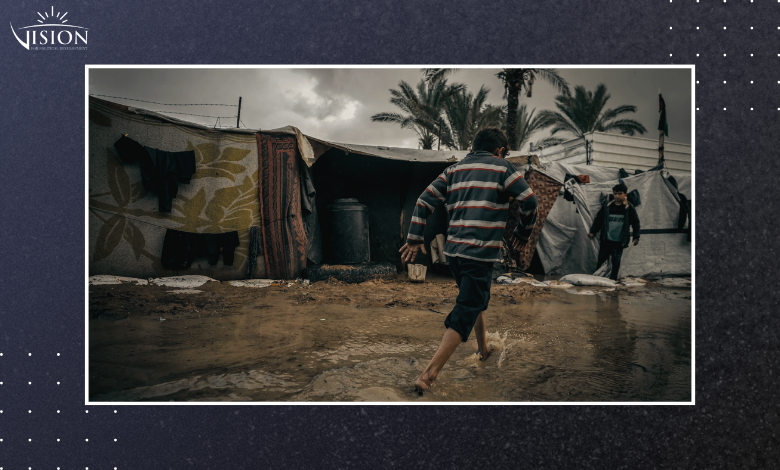
Severe weather conditions have exposed the catastrophic reality in the Gaza Strip, revealing the dire condition of destroyed homes and the tattered tents in which citizens are forced to live as a result of the ongoing genocide and the prevention of entry of humanitarian, relief, and winterization supplies. This has led to a worsening humanitarian disaster for Palestinians in Gaza, with tents flooded by rainwater, partially destroyed buildings collapsing on their inhabitants, and seawater inundating tents set up along the coast, while strong winds have uprooted others, turning the lives of displaced people into a state of complete homelessness.
In addition to the lack of warm shelter, the people of Gaza suffer from severe shortages of food, medicine, and basic winter necessities such as clothing, blankets, and heating supplies. This significantly increases the risk of the spread of diseases and epidemics, making winter a harsh and life-threatening ordeal, particularly for children and the elderly, should the Israeli occupation continue its intransigence and refusal to allow the entry of humanitarian aid and temporary housing units (“caravans”).
This report sheds light on the most prominent aspects of Palestinian suffering in the Gaza Strip during the winter season, amid the ongoing genocide that has exacerbated the humanitarian situation and pushed it into a catastrophic state due to the absence of effective humanitarian response and the strangulating blockade imposed by the occupation on the Strip.
First: The Reality of Housing and Shelter
Hundreds of thousands of displaced Palestinians in the Gaza Strip are living through a tragedy unlike any other, deprived of even the most basic necessities of life; including safe shelter, warm housing, adequate food, and medical care, after Israeli occupation forces destroyed nearly all facets of life in Gaza, leaving no residential buildings, no infrastructure, and no essential services.
The occupation has further deepened this crisis by opening the Gaza Valley waterway, which had previously been blocked by dams and water barriers constructed along the border to disrupt its natural flow into the Strip. This led to massive volumes of water surging into residential areas and camps near the valley, washing away a number of displacement tents spread across its surroundings.
According to the Global Shelter Cluster, affiliated with the Inter-Agency Standing Committee (IASC), approximately 260,000 Palestinian families in the Gaza Strip, nearly 1.5 million people are still facing rain and cold without adequate protection. They lack the basic necessities needed to survive the winter, sleeping in worn-out tents that are damaged and flooded with the first rainfall, leaving families exposed without real shelter.
With the first winter weather systems hitting Gaza, the fragility of the tents sheltering displaced families became evident after the genocide destroyed their homes and forcibly pushed them into makeshift shelters that provide no protection from freezing nighttime temperatures or daytime winter rains.
The weather depressions damaged thousands of tents, rendering nearly 127,000 tents uninhabitable[1], after they were flooded by rainwater, inundated by seawater, or torn away by strong winds. Over the course of two months marked by four consecutive weather systems, each harsher than the last, displaced families lost their temporary shelters, clothing, bedding, and blankets, compounding their suffering to unprecedented levels.
With the first rainfall of winter, water seeped into the tents, soaking mattresses and blankets that displaced families had barely managed to obtain after losing their homes and possessions.
Narrating her agony, Mirvat Mushtaha[2], who was displaced with her family to the Mawasi area of Khan Younis, said:
“During the first weather depression over Gaza, rainwater entered our tent while we were asleep. I woke up to find two of my children’s bedding and clothes completely soaked, along with most of the blankets inside the tent, for which we have no replacements.”
The suffering of the displaced is worsened by the absence of alternatives to tents or plastic tarpaulins, which the Global Shelter Cluster has described as inadequate for prolonged emergencies such as Gaza. These shelters lack flexibility in size and placement, are unsuitable during strong winds or heavy rainfall, and provide minimal thermal comfort that does not match Gaza’s extremely cold winter temperatures.
This reality has been confirmed by the lived experience of displaced families over four successive weather systems, as strong winds caused numerous tents to tear apart or be uprooted entirely. This was the case for Roula Abu Hashem[3], who described “a night of terror” during the most recent storm, saying:
“I don’t know how many times my children, young and old, woke up in fear from the sound of the wind and rain pounding the tent with all its force, without regard for the bodies inside. I don’t know how many times I woke up consumed by anxiety, fearing the tent would collapse on our heads as it swayed violently all night, until it finally collapsed over us at dawn. I don’t know how many nights like this await us before winter ends.”
Along Gaza’s coastline, families forcibly displaced from their destroyed homes and unable to find shelter elsewhere have taken refuge along the shore. This follows the Israeli army’s control of nearly 60% of Gaza’s territory, while rubble covers much of the remaining area. They erected fragile tents that offer no protection from freezing cold, strong winds, or even the sea air and waves that advance toward the tents with the tides.
Anas Al-Samri[4], displaced and living in a tent on Gaza’s western shoreline, said:
“Every day we live the nightmare of our tent being flooded or torn away, as happened during previous storms. We face sea winds that rip or displace the tent, rainwater torrents flowing from the east, and seawater advancing from the west. Our children spend the night soaked and shivering from the cold, without adequate winter clothing.”
The suffering does not end there. More than 620,000 Palestinians have been forced to live in structurally unsound homes damaged by tens of thousands of Israeli shells and missiles over two years, fearing their collapse at any moment. With no alternatives, families inhabit cracked walls, damaged roofs, and rooms where water leaks freely. The Israeli occupation’s destruction of buildings and its ban on the entry of mobile homes and construction materials has led to the collapse of many homes, killing 25 civilians, according to Palestinian Civil Defense spokesperson Mahmoud Basal[5]. He stated that since the onset of winter weather systems, 18 residential buildings have collapsed completely, causing severe human and material losses, while more than 110 buildings have suffered dangerous partial collapses that pose a direct threat to thousands of residents.
The bitter cold further compounds the suffering, especially amid shortages of clothing, blankets, and heating equipment. Abu Muhammad Abu Hamida[6], displaced with his family to western Gaza City, said:
“The cold is unbearable. Adults shiver, children cry and cannot sleep. In the morning, their limbs are swollen and sometimes turn bluish. There are no winter clothes, no blankets, and no heating. We no longer wish for winter, if this continues, none of our children will survive.”
According to Mohammed Abu Salmiya[7], Director General of Al-Shifa Medical Complex, six children have died from extreme cold over the past two months, bringing the total number of cold-related deaths since October 7, 2023, to 21. Hospitals are overwhelmed with severe cases of hypothermia, respiratory infections, bronchitis, and pneumonia—most patients living in tents that provide no warmth or protection.
This tragic reality exposes the genocidal mindset dominating Israeli society toward Gaza. Hebrew media platforms openly host Israelis who mock Gaza’s suffering, competing over who appears more brutal and inhumane. A meteorologist on Israel’s Channel 14 commented: “I estimate not a single tent will remain standing,” adding sarcastically, “I don’t mind if there are no people either,” to which the host replied, “You’re making us happy.”
Second: The Energy and Heating Crisis
With the launch of the genocidal onslaught on Gaza, Israeli forces destroyed electricity infrastructure, leading to the total collapse of the energy system. Residents turned to solar power systems, both domestic and commercial, as a minimal alternative. However, winter cloud cover severely limits their effectiveness, plunging daily life into near paralysis and isolating Gaza from the world due to near-total reliance on solar energy.
With the absence of sunlight, electricity disappears, halting daily life. Residents are unable to charge phones, laptops, or internet routers, cutting them off from news and work.
Journalist Mari Fathi[8] said: “Weather depressions have become an obstacle to completing my professional tasks and staying connected, unless I conserve phone battery.”
University student Haneen Abdo[9] added: “Whenever the sun disappears, I feel frustrated, because it means my power system shuts down, preventing me from attending lectures or submitting exams.”
At night, Gaza is plunged into darkness, with only faint battery-powered lights. One displaced resident explained: “We wait for the evening prayer, then sit in darkness until sleep overtakes us. When the sun sets, we know darkness will be our companion that night.”[10]
Cloud cover also halts solar-powered water pumps, worsening the drinking water crisis. The lack of energy and fuel prevents families from heating their tents or damaged homes. Electricity outages prevent electric heating, fuel shortages prevent the use of heaters, and firewood scarcity disrupts cooking. This has led to widespread respiratory illnesses and child deaths due to extreme cold.
The crisis is worsened by shortages of winter clothing and bedding due to Israel’s ban on their entry. A displaced resident said: “We fled under heavy bombardment without our belongings. Our homes were destroyed. What little we managed to find in 2023 was lost during repeated displacement, and what remains is sold at unaffordable prices.”[11]
Third: Limited Humanitarian Response
Winter suffering reveals a stark gap between needs and aid. Despite a ceasefire agreement, Israel continues to violate its humanitarian provisions, blocking the entry of winter tents, mobile homes, and blankets. UNRWA reports that Israel is preventing the entry of 6,000 aid trucks carrying hundreds of thousands of tents, blankets, winter clothes, and food sufficient for three months, held at Gaza’s borders in violation of international humanitarian law and Article 55 of the Fourth Geneva Convention.
Despite the already weak humanitarian response, Israel has banned 53 international NGOs and revoked the licenses of 37 organizations in January 2026, including key humanitarian actors such as Médecins Sans Frontières, the Norwegian Refugee Council, and Oxfam. Although Israel claimed this was due to security registration issues, Haaretz reported the decision was purely political.
Conclusion
As winter begins in Gaza in 2026, the scale of the humanitarian catastrophe becomes undeniable. Hundreds of thousands of Palestinians struggle to survive in flooded, collapsing tents amid continued Israeli violations of the ceasefire and the paralysis of humanitarian organizations. The ongoing blockade and restrictions have created an unprecedented humanitarian disaster extending beyond direct military destruction.
The continued prevention of tents, mobile homes, fuel, heating equipment, medical supplies, and reconstruction materials amounts to a slow death sentence for children and the elderly. This places full responsibility on the international community to pressure Israel to open crossings unconditionally, lift restrictions on humanitarian organizations, and ensure the immediate flow of aid, because delay no longer means shortages alone, but more lives lost to winter cold and global silence.
NOTE: This text is adapted from original Arabic article.
[1] Government Media Office, December 2025, Press Release No. (1035).
[2] Interview conducted by the researcher with Mirvat Mushtaha, who was displaced from Gaza City to the Mawasi Khan Yunis area, on 24 December 2025.
[3] Interview conducted by the researcher with Rula Abu Hashim, who was displaced from northern Gaza to the Mawasi Khan Yunis area, on 27 December 2025.
[4] Interview conducted by the researcher with Anas al-Samri, who was displaced from eastern Gaza City to the Gaza coast, on 27 December 2025.
[5] Interview conducted by the researcher with Mahmoud Basal, spokesperson for the Palestinian Civil Defence in the Gaza Strip, on 30 December 2025.
[6] Interview conducted by the researcher with Abu Muhammad Abu Hamida, a displaced person in Gaza City, on 29 December 2025.
[7] Interview conducted by the researcher with Dr. Muhammad Abu Salmiya, Director of Al-Shifa Medical Complex, on 30 December 2025.
[8] Interview conducted by the researcher with media personality Mari Fathi in Gaza City, on 1 January, 2026.
[9] Interview conducted by the researcher with journalist Mari Fathi in Gaza City, on 1 January, 2026.
[10] Interview conducted by the researcher with Hiba Abu Kamil, a displaced woman living in a tent in Gaza City, on 1 January, 2026.
[11] Interview conducted by the researcher with Sharifa Shaheen, displaced from the Karama area to western Gaza City, on 1 January 2026.