Why we should be concerned about the displacement of the village of Yanoun?

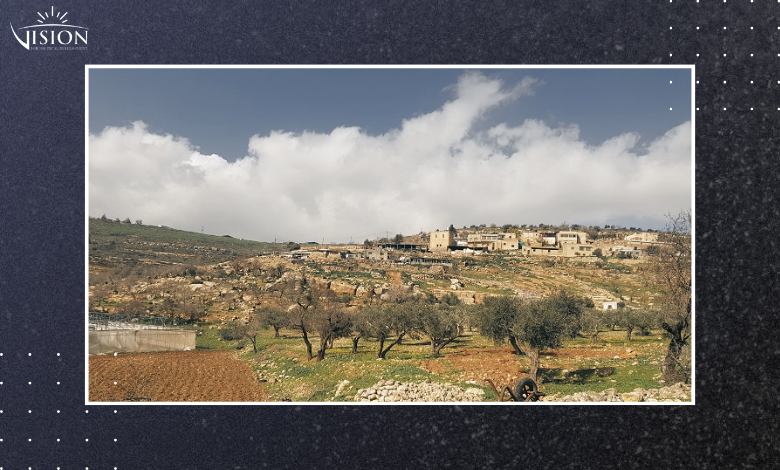
Estimates indicate that more than 100 Bedouin communities across the West Bank have been completely or partially displaced since the beginning of 2023, although some reports put this number at over 180 communities. Khirbet Yanoun, located southeast of Nablus, stands out as a unique case among the other abandoned communities, having been a settled village for centuries, distinguished by its stone houses and public facilities.
The case of Yanoun raises a fundamental question about the mechanism by which a small village is demographically and spatially exhausted until it is entirely depopulated, and what this signifies within a settler colonial project that combines formal and informal means, from land confiscation and the establishment of formal settlements to the unleashing of settler violence, outposts, and pastoral and settlement expansion?
This paper analyses the relationship between the expansion of surrounding settlements and the decline of Palestinian demographic presence in the village, within the context of an unequal struggle for survival between a settler whose government pumps millions of dollars annually to consolidate his presence, and a landowner who has faced existential pressures for decades with limited international and local support.
The significance here lies in the fact that this community was not a temporary Bedouin encampment but an ancient, established Palestinian village, signalling a genuine danger now threatening Palestinian rural areas on the peripheries of urban centres. Yanoun represents a case study for understanding what may be called “slow spatial and human attrition,” in which urban and pastoral settlement expansion intertwines with settler attacks, progressively narrowing the boundaries of Palestinian rural survival as a space of permanent residence rather than a transient passage.
Yanoun: A Village Where Life Never Ceased
According to the oral narratives of local residents, Yanoun, or Yano in Canaanite, means “the peaceful and kind village.”[1] It is a village of pristine nature, cherished by its inhabitants and captivating to its visitors. Yanoun was not merely an agricultural hamlet designated for the seasonal grazing of sheep and livestock; rather, it was a fully integrated rural community where human presence remained continuous for centuries.
Statistics on villages issued during the British Mandate indicate that its population reached approximately 71 people in 1922, a figure that grew only modestly over time to reach around 150 at its peak in the contemporary period. This demographic stagnation is attributed to the policy of silent displacement from which the village long suffered, as will be detailed below. Administratively, the village has been affiliated with the town of Aqraba since 2012.
The village includes Yanoun Basic School, established in 1970, which is considered one of the smallest schools in the Middle East. Historically, the number of its students ranged between 8 and 12, reaching 14 students before the village’s displacement. Yanoun also contains an old mosque dating back to the Umayyad era, distinguished by a panel with mosaic ornamentation. The village is further notable for historical landmarks dating to the Ottoman period.[2]
According to local oral tradition, as documented by the late social historian Hamza al-Aqrabawi, the village contains a shrine attributed to the Prophet Nun. Al-Aqrabawi also notes that the village’s history carries important information on land ownership: Lower Yanoun (Yanoun al-Tahta) was owned primarily by the Bishnaq family alongside the Ajouri family, while Upper Yanoun (Yanoun al-Fawqa) was distributed among several families including the Bani Jabir (Dar Subayh), the Agha family, Dar Malik, the Circassian Arslan family, and others. He adds that a significant portion of the landowners were non-resident, having settled in Jordan, Bosnia and Herzegovina, or other countries, a circumstance that rendered Yanoun’s lands increasingly vulnerable to encroachment.
The original area of Yanoun’s lands is approximately 16,450 dunams (roughly 16.5 square kilometres), extending from the village of Awarta to the Jordan Valley. The occupation has confiscated approximately 13,000 dunams of these lands for the benefit of settlements, while the remaining areas have been classified as Area C, meaning construction is prohibited and landowners’ access is restricted to prior coordination with occupation forces.
Following its Area C classification, the Israelis renamed it “Khirbet Yanoun,” subsequently erased it from maps, and imposed a complete ban on construction. This entrenched an effective geographic division of the village into two parts: Northern Yanoun (formerly Ayn Yanoun, named after a water spring), and Southern Yanoun, classified as Area B and inhabited by ten families totalling 42 individuals.
The village thus came to be divided into two parts: one in Area C known as Yanoun al-Fawqa, and one in Area B known as Yanoun al-Tahta. Over many years, the residents of Yanoun al-Fawqa were subjected to settler attacks, producing a sustained state of displacement and demographic attrition until only six families totalling 37 individuals remained, before the last family departed on 28 December 2025 under threat of arms from the occupation and its settlers.
Over many years, settler attacks on residents, their livestock, and their property recurred with increasing frequency. These attacks were not necessarily linked to the events of 7 October 2023, their roots extending back many years before that date. However, the pace of settlement activity and settler attacks escalated markedly after October 2023, compounding the suffering of Yanoun’s residents and intensifying the dangers they faced.
A Trajectory of Displacement That Began in 2000
The occupation pursues a policy known as “silent displacement” as an indirect method of emptying Palestinian communities, particularly Bedouin ones. Yet the case of Yanoun is distinctive as a stable rural community whose residents live in stone houses and which possesses a school, a mosque, and some basic amenities, as described above. Yanoun has passed through multiple phases since the first displacement in 2002, through long years of suffering, endurance, and steadfastness. Until the year 2000, approximately 18 Palestinian families lived there, but many were compelled to leave the village and relocate to Yanoun al-Tahta or to the town of Aqraba. Of the 18 families that had resided in Yanoun al-Fawqa (Northern Yanoun) before 2000, only 6 remained by 2025.
It must be noted that the year 2000 marked the turning point toward silent displacement in Yanoun. Settler attacks began assuming an escalating trajectory: what had been limited to harassment short of direct violence or assault evolved, over long years, into “the total displacement of Northern Yanoun under armed threat.”[3] In that year, settlers closed the village’s sole entrance and assumed control over when it was opened or closed and who was permitted to pass. Closures lasted hours or an entire day, without regard for any humanitarian consideration, compounding the daily suffering of residents. According to one village resident, “everyone who entered Yanoun was interrogated, who are you visiting? What are you carrying? When will you leave?”[4]
Alongside this, a gradual process of confiscation of the village’s agricultural lands for the benefit of settlers was carried out, and farmers were prevented from accessing, cultivating, and harvesting what remained of their lands. In this context, Fawzi Jabir, one of the village’s residents, states: “For many years we have not been able to harvest the olives properly because the settlers give us only 3 days to pick the olives, while we need more than two weeks to complete the harvest. The settlers come and pick the bulk of the season’s yield after our time expires, causing us great losses, we were not given the opportunity to care for the olive trees, to prune them, plough the soil, or fertilise it, and production declined because of the settlers’ restrictions, who seize whatever remains of the harvest.”[5] Village residents attempted to resort to Israeli courts to access their lands, submitting several petitions to the Israeli Supreme Court, but these proved futile in light of the complicity of the Israeli judiciary and occupation institutions in advancing the settlement project and their support for settlers driven to seize ever more land.
The widespread confiscation of agricultural lands and the restrictions imposed on farmers contributed to the beginning of the actual displacement of the village’s residents from the early twenty-first century, after their primary livelihoods were destroyed. In addition to this, settlers employed violence against village residents over many years. According to a report in Afaq al-Bi’a wa al-Tanmiya magazine from 2016, settlers routinely stormed the village armed, and also released wild boars into the village’s agricultural lands to destroy crops.
These practices later evolved to include releasing their cattle into cultivated fields to consume everything in their path and cause widespread damage to harvests. According to residents’ accounts cited in the report, the role of this cattle extended beyond grazing and crop destruction to other functions: residents affirm that they are “recruited and trained cattle,” with collars fitted with listening and recording devices, and sometimes cameras, to monitor everything that occurs in Yanoun.
Confronted with these attacks and assaults, unprecedented at the time, the Palestinians of Yanoun faced their first catastrophe through a mass forced displacement on Friday, 18 October 2002. The remaining 6 Palestinian families in Khirbet Yanoun fled fearing for their lives, following years of harassment by settlers from the Itamar settlement. These assaults included the destruction of the village’s infrastructure: burning the sole electricity generator, emptying the water tanks, and sabotaging the water network installed only one year prior. Settlers further desecrated and contaminated the spring water tank, the primary source of drinking water, by bathing in it, in a clear attempt to sever the means of life and poison the foundations of survival.
At that time, residents raised cries of protest against the violations they had suffered, demanding an end to the attacks and the right to return to their homes. These appeals found resonance among foreign solidarity activists and local popular committees, who moved to establish a presence in the village and make it a base for defending it and the neighbouring threatened villages and areas. From that point, Yanoun became a prominent symbol of popular resistance and steadfastness in the face of settlement.
Yet these efforts ultimately proved unable to withstand the relentless settlement expansion in the area, fully supported in favour of settlers in the displacement project, against the absence of effective Palestinian support to reinforce the steadfastness of residents on their threatened land, as is the case across many other Palestinian areas.
Since October 2023, settler presence in the area has intensified, with settlers preventing residents, backed by the army, from accessing their grazing lands and restricting their movement, as documented by B’Tselem. Pastoral settlement and the conversion of thousands of dunams in Yanoun into grazing lands for surrounding settlements have also produced a rapid and practical transformation in the control over lands and the spatial living space of the village’s residents, eliminating any possibility of continued survival.
The Settlement Expansion That Consumed Yanoun
The Itamar settlement, located on the outskirts of Nablus approximately two kilometres south of the Balata and Askar refugee camps, was the first settlement established on part of Yanoun’s lands. Itamar was founded in 1984, and from it, over time, six outposts spread outward, deepening settlement expansion toward the villages south of Nablus and down toward the Jordan Valley. These outposts, together with the parent settlement, have seized more than 6,000 dunams from the lands of five neighbouring Palestinian villages, including Yanoun.
Before the establishment of settlements and outposts in the area, the occupation authorities declared in the 1970s a military training zone designated A904, seizing vast tracts of lands belonging to the villages of Yanoun, Aqraba, and Majdal Bani Fadil, barring the villages’ residents from accessing them. Over time, it became evident that this classification was merely a cover for settlement expansion: several outposts were subsequently established in this zone, including one called “Hill 777,” established in the late 1990s. Despite its classification as a closed military zone, the outpost was never evacuated; the government has recently moved to legalise it.
Today, the settlement outposts encircle Yanoun in the shape of a horseshoe with a narrow opening, fronted by the Itamar settlement.[6] Military observation towers mounted on these outposts monitor the movements of the village’s residents, a scene that reflects the total security and settlement encirclement imposed on Yanoun, thereby achieving yet another settler objective of creating an expulsive environment for Palestinians: settlements encircling the place, and a single village entrance opened and closed at the settlers’ command.
With the expansion of settlements and the escalation of attacks, Palestinian presence in Yanoun has contracted as a result of policies of direct land confiscation or the imposition of effective control over remaining spaces, pursuant to the genocide methodology adopted by the settlers. This attrition led to a progressive decline in population to only 37 individuals by October 2023, before the last two families of Yanoun al-Fawqa were displaced on 28 December 2025.
Armed settlers stormed the village and threatened to kill all residents if they did not leave within hours; they departed, leaving everything behind, to join three families that had been displaced the previous day. Yanoun was thus emptied entirely of its people, leaving behind only its abandoned houses as witness to the crime. This was the second time the village was displaced, the first being in 2002, after which residents had managed to return, in a time when the settlement project had not yet acquired the dominance and entrenchment it commands today.
Conclusion
Israeli settler colonialism operates on a substitutive logic whose essence is the seizure of land as the first and final objective. This form of colonialism does not content itself with expansion or concentration in a limited space, but goes further in seeking to empty the land of its indigenous inhabitants. The very presence of the native population is perceived by the coloniser as a problem, driving him to adopt policies aimed at their removal by various means, including the principle of elimination. Alongside elimination, there is the policy of displacement (transfer) employed by the Zionist project since the Nakba of 1948.
This picture accords with Patrick Wolfe’s argument in his article “Settler Colonialism and the Elimination of the Native,” where he contends that the primary motivation of the settler coloniser is control over land, a reality vividly embodied in the case of Yanoun. Accordingly, all policies of Zionist colonialism revolve around this objective. Elimination, according to Wolfe, is a means to achieving that objective, not driven by considerations of religion, ethnic origin, or level of civilisation, but by the principle of the “removal” or “erasure” of the indigenous population in order to seize their land.
In light of this, what occurred in Yanoun and what continues to occur across the West Bank against Bedouin communities, villages, and others, is part of that policy, which takes the form of genocide in the Gaza Strip while taking the form of elimination and silent displacement in the West Bank.
The case of Yanoun is the product of long years of suffocation, siege, and assault that eroded the residents’ capacity for survival, amid a deafening silence and abandonment experienced by Palestinians who held out for more than two decades against displacement and resolved not to repeat the first catastrophe, but who in the end lost every foundation of steadfastness and had no path remaining but to leave their land under compulsion.
On the other hand, the case of Yanoun constitutes a dangerous precedent and a major advance for the project of displacement and annexation. What is at stake here is a settled village with roots stretching back decades and fixed stone houses, not a Bedouin community that the Zionist settlement project regards as easy prey by virtue of the nature of Bedouin life in tent and tin dwellings suited to movement.
It is true that Yanoun is a small and relatively isolated village, but what is dangerous is that the displacement of a settled rural community has finally succeeded, as the Aqraba municipality described in a press statement issued following the most recent displacement, characterising it as the result of “long and bitter years of harassment, siege, and isolation,” despite the steadfastness shown by the few remaining families against these conditions.
It warned that the case of Yanoun should not be viewed as a limited local matter but as an indicator of what other Palestinian communities may face, unless serious steps are taken to protect what remains of these Palestinian villages and hamlets. What this means is that there is now a dangerous precedent for the displacement of a Palestinian village, not a Bedouin community.
This points to the fact that the Zionist settlement project, having nearly completed the displacement of all Bedouin communities in Area C, is now moving to displace entire urban villages. And though Yanoun is only a precedent, the current landscape of settler violence striking Palestinian villages in Area B, particularly in eastern Ramallah and southern Nablus, is an alarming indicator of the settlers’ objectives and their coming steps.
[1] Fawzi Bani Jaber, a resident of Yanoun, in-person interview, February 16, 2026.
[2] Salah Jaber, Mayor of Aqraba, in-person interview, February 17, 2026.
[3] Ibid.
[4] Fawzi Bani Jaber, as mentioned earlier.
[5] Ibid.
[6] Salah Jabir, op. cit.
NOTE: This text is adapted from original Arabic article.