Toward Annexation of West Bank: Transferring Israeli Law-Enforcement Powers from Army to Police


Israeli Defense Minister Israel Katz announced, on August 14, 2026, that he had instructed the Israeli army leadership to prepare a plan to transfer Israeli law-enforcement powers in civil matters concerning Israeli settlers in the occupied West Bank to the Israeli police. Katz said that the army should focus on what he described as “combating Palestinian terrorism,” while the Israeli police would assume responsibility for law enforcement and for maintaining security and public order in civil matters concerning settlers.
In the context of the declared policies of Benjamin Netanyahu’s government, the move does not appear to be merely a redistribution of responsibilities between two security institutions. If implemented, the transfer of powers being pursued by the Israeli government would place one segment of the population—“settlers in the West Bank”—under the responsibility of an Israeli civilian institution, while Palestinians would remain subject to Israel’s military rule.
This paper examines the rationale, context, and potential implications of the Israeli defense minister’s decision in light of a series of rapidly accelerating decisions and measures undertaken by the Israeli government as part of a process of the West Bank’s “de facto annexation.”
West Bank: Two Systems for Residents of One Territory
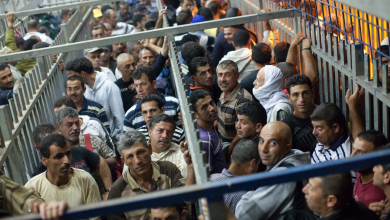
Since occupying the West Bank in 1967, “Israel” has imposed a system of military rule over it, retaining supreme authority in the hands of the Israeli army’s so-called “Commander of the Central Command”, who exercises broad powers relating to security, movement, land, and military regulations.
Following the Oslo Accords, specifically the Taba Agreement, known as “Oslo II,” the West Bank was divided into Areas A, B, and C. Under the agreement, the Palestinian Authority exercises civil and security control in Area A and civil control in Area B, while Israel retains security powers there. Area C, which constitutes about 60% of the West Bank, remains under full Israeli control. This division, however, did not effectively end the military occupation of the West Bank, where settlement expansion quadrupled between the signing of the Oslo Accords and 2023.
Against this backdrop, and amid the significant expansion of Israeli settlements and the sharp increase in the number of settlers in the West Bank, the relationship between the Israeli army and police has been characterized by overlapping responsibilities in enforcing the law on Israeli settlers in the West Bank. The Israeli police already handled a substantial portion of investigations and prosecutions involving crimes attributed to settlers, while soldiers had the authority to detain settlers and hand them over to the police.
The army, the Civil Administration, and the police thus jointly participate in the enforcement system under the overall authority of the military commander. A practical problem arises when settlers commit violations in areas that the Israeli police do not routinely enter, particularly Areas A and B under the Oslo divisions, where the army has been the force present on the ground and capable of intervening and making arrests.
This is precisely what makes the decision to transfer law-enforcement powers from the army to the Israeli police so significant. It does not simply transfer administrative powers from one institution to another; rather, it opens the door to expanding the presence of an Israeli civilian agency into the occupied West Bank to apply Israeli civil law to one segment of the population—the “settlers”—while the army retains supreme military authority and the system of military laws continues to govern Palestinians.
This starkly exposes the application of a system of racial segregation against Palestinians—“apartheid”—and reveals the Israeli government’s vision for its relationship with Palestinians. Amnesty International documented in its 2026 report Israel’s continued reliance on military orders and regulations in the occupied Palestinian territory, alongside clear legal discrimination between Israeli settlers and Palestinians in the West Bank, including within the judicial system.
Katz’s Decision and the Project to Annex West Bank
The Israeli defense minister presents the decision as a functional correction: the army’s mission, he argues, should be limited to security and combating Palestinian organizations, while the police should be responsible for enforcing civil law. His office also announced that the police would establish an appropriate force to deal with such matters and would be granted the necessary powers and budgets.
Yet the political significance of the decision goes beyond its administrative justification. Israel’s National Security Minister Itamar Ben-Gvir welcomed the move, describing it as “an important stage on the path toward imposing Israeli sovereignty over the West Bank.” He also called for transferring responsibility for the Border Police operating in the West Bank to the police force under his authority, as well as transferring powers concerning administrative detention and administrative restrictions on West Bank settlers from the defense minister and the army to the Ministry of National Security.
Yesha Council chairman Israel Ganz also directly linked the move to the annexation project, describing it as another step toward applying full Israeli sovereignty and administering civilian life in the settlements in the same way it is administered inside “Israel.” These statements reveal how leading figures in the settlement movement view the decision: not as a purely security-related measure, but as part of a gradual transition toward the de facto annexation of the West Bank through the application of Israeli civil law to settlements there.
According to the Israeli newspaper Haaretz, Israeli army assessments indicate that transferring law-enforcement powers in the West Bank from the army to the Israeli police cannot be implemented under the current legal framework and that doing so would require a change in the West Bank’s legal status. Legislation would be needed to define the source of legal authority in the territory, the chain of command, and responsibility for activities conducted there. The army reportedly believes that the comprehensive legal solution would be to impose Israeli sovereignty over, or annex, the West Bank.
The army also warns that transferring powers to the police without changing the West Bank’s legal status would not end Israel’s responsibility for the territory before the international community. According to the security assessment, as long as “Israel” has not formally applied its sovereignty to the West Bank, it will remain responsible for obligations associated with administering the territory, even if some law-enforcement duties are transferred to the police. The military position also points to the possibility that Israeli officials could continue to face legal responsibility before international bodies and courts for events occurring in the West Bank.
This move is part of a long series of measures adopted by the Israeli government to strengthen Israeli civilian control over parts of the West Bank. Among the latest were Israeli decisions issued in February 2026, which included repealing the Jordanian law prohibiting the sale of Palestinian land to Jews in the West Bank. The decisions also stripped Palestinians of certain powers and entrenched Israeli control. Restrictions on movement, demolitions, evictions, settlement expansion, and land seizures are all cumulatively reshaping the environment in which Palestinians live.
The West Bank at the Heart of Israeli Electoral Competition
Israeli Defense Minister Katz’s decision cannot be separated from the context of Israeli electoral competition. “Israel” has entered the run-up to the Knesset elections scheduled for October 27, 2026, while Netanyahu’s Likud party, to which Defense Minister Katz belongs, held its primaries in August amid intense competition. Issues concerning sovereignty over the West Bank and the confrontation with the judiciary featured prominently in internal party discourse.
Analyzing the occupation leadership’s extreme decisions through the lens of electoral competition in “Israel” and attempts to appeal to the Israeli public appears persuasive when viewed against trends within Israeli society. The West Bank and the broader treatment of Palestinians thus become part of a competition within the right-wing camp itself. The strength of right-wing tendencies within Israeli society is particularly evident among young people and Generation Z.
According to a Maariv poll published on April 2, 2026, 56% of those aged 18–22—who will be voting for the first time—identify as right-wing, while 22% lean center-right, 14% identify with the center, and only 8% with the left. Netanyahu and his allies are therefore being pushed by increasingly extreme currents and by a society shifting significantly to the right, encouraging them to transform existing Israeli control over the West Bank into formally declared sovereignty. At the same time, the Israeli government is presenting its public with gradual approaches to the West Bank, framing them as security and national achievements without formally announcing comprehensive annexation, which could provoke opposition and deepen Israel’s international isolation.
It is therefore difficult to view the transfer of law-enforcement responsibility concerning settlers in isolation from this reality. It is also worth noting that the move is being announced at a time when the Israeli army faces mounting criticism over settler violence. Gilad Kariv, an opposition Knesset member from the Democrats party, says the measure sends “a clear message to Israeli army forces in the field: do not confront Jewish terrorism and the hilltop gangs, and anyone who does so will be punished.”
Meanwhile, Israeli police officials said Katz’s decision could, in part, be an attempt to shift criticism from the army to the police. Yedioth Ahronoth quoted an unnamed senior police official as saying: “Defense Minister Israel Katz’s move is intended to shift criticism from the Israeli army, which is the sovereign authority in the area, to the police.”
Conclusion
The Israeli minister’s decision to transfer responsibility for enforcing civil law concerning settlers from the army to the Israeli police has not yet entered into full effect in its final form. The army has been tasked with preparing a plan, while details concerning the powers involved, the geographical scope, and implementation mechanisms still need to be determined. Its political significance, however, became apparent even before these details were finalized.
From the perspective of international law, the West Bank remains occupied Palestinian territory, while “Israel” is gradually moving toward integrating settlers and extending the reach of the state’s civilian institutions into the structure through which it controls the territory. Notably, this integration is not being carried out through a single formal declaration of annexation, but through a series of decisions concerning land, planning, administration, security, and law enforcement.
For this reason, describing the decision merely as a “transfer of powers” may obscure its political essence. If implemented in the form demanded by the Israeli right, it would make the status of residents of any West Bank settlement comparable to that of residents of Tel Aviv and would make the presence of Israeli “civilian state” institutions in the West Bank increasingly routine and less exceptional. Ben-Gvir and settler leaders have explicitly expressed such an interpretation by linking the move to the concepts of sovereignty and annexation.
At the same time, the continuation of violence, displacement, and settlement expansion, coupled with the international community’s limited ability to translate condemnation into deterrent measures, creates an environment that allows the occupation to alter realities on the ground. As “Israel” heads toward Knesset elections in October, amid competition among its various parties to win the support of an electorate shifting sharply to the right, the West Bank once again appears as an arena of political competition rather than merely a security issue.
Thus, the most important question raised by Katz’s decision is not simply: Who will stop a settler if they commit an offense? Rather: Which law will govern the lives of settlers in the West Bank in the future, and which system will continue to govern the Palestinians living alongside them?
NOTE: This text is adapted from original Arabic article.