The Yellow Line… an Attempt to Entrench the Occupation in the Gaza Strip and Continue the Genocide

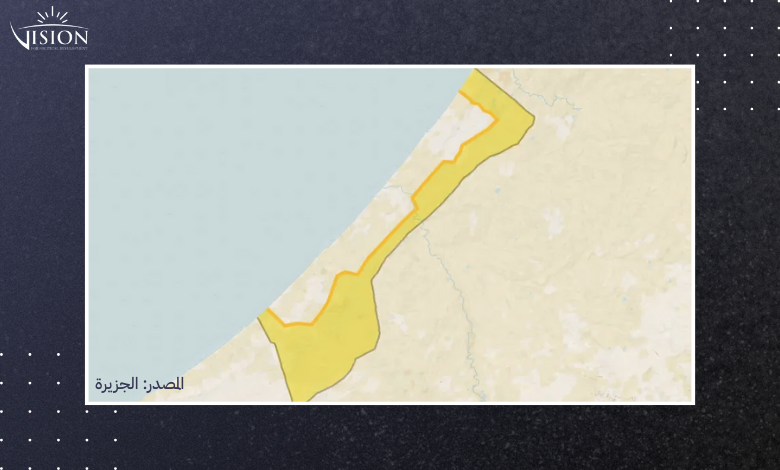
Since the announcement of the ceasefire agreement, the lives of Palestinians in the Gaza Strip have been subjected to an imaginary line drawn by the Israeli occupation army across the Strip from north to south, known as the “Yellow Line.” This line represents the boundary between life and death. Any movement by a Palestinian, whether approaching it or accidentally crossing it, is considered tantamount to a death sentence, as Israeli occupation army snipers positioned on the eastern side of the Yellow Line open fire directly.
In this report, we shed light on the temporary Yellow Line, which prevents Palestinians in the Gaza Strip from returning to their homes, lands, and farms, and even puts the lives of those who are several kilometres away from it at risk.
What is the Yellow Line?
The Yellow Line is a temporary, imaginary line stipulated in the first phase of Trump’s plan to end the war on the Gaza Strip. Under this plan, a ceasefire was announced on October 10, 2025. The line aims to separate occupation forces from civilian areas from which they were supposed to withdraw following the announcement of the agreement. It was drawn on military maps as a temporary buffer zone that the Israeli occupation is supposed not to cross, as it is a provisional line to be followed by the withdrawal of occupation forces from the rest of the Strip as subsequent phases of the ceasefire are implemented.
The imaginary line divides the Gaza Strip into two parts: a western area, where most Palestinians reside, estimated to constitute 47% of the Strip, and expanded eastern areas controlled by the Israeli occupation army, estimated at 60% of the Strip’s area. In this way, more than half of the total area of the Strip, 365 square km is effectively taken.
On October 20, 2025, footage emerged showing the beginning of the placement of yellow concrete blocks outside the line to mark its boundaries on the ground. These were placed at various points according to the topography of roads and open areas in the eastern part of the Strip.
The Yellow Line extends from the northern part of the Gaza Strip, passing through the central areas, and reaching the outskirts of Rafah in the south. In doing so, it encroaches upon entire cities and neighbourhoods, starting with the complete city of Beit Hanoun, the city of Beit Lahia and Jabalia refugee camp, the neighbourhoods of Shuja‘iyya, al-Tuffah, and al-Zaytoun east of Gaza City, the towns of al-Qarara, Bani Suheila, and Abasan east of Khan Younis Governorate, and the entirety of the city of Rafah.
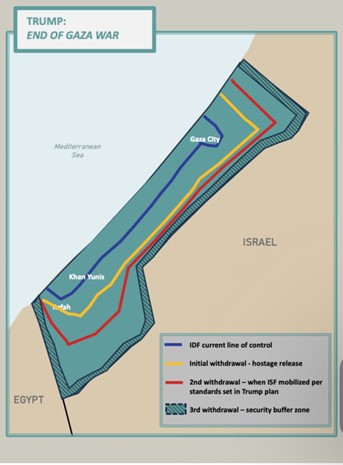
It is noted that the plan announced by U.S. President Donald Trump and Israeli Prime Minister Benjamin Netanyahu on September 29, and formulated without Palestinian participation, stipulates a gradual withdrawal in three phases, each distinguished by a color on the accompanying map:
– Phase One (the Yellow Line): An immediate ceasefire and the withdrawal of the army to agreed-upon positions, in exchange for Hamas releasing all remaining hostages, both living and deceased.
– Phase Two (the Red Line): The deployment of an “International Stabilization Force” (ISF) to monitor security, while the Israeli army withdraws further, reducing its direct presence in Gaza.
– Phase Three (Security Buffer Zone): A final withdrawal to a defined border area, with governance responsibilities transferred to an international administrative body during a transitional period.
Expanding the Yellow Line
The Israeli occupation army has not been satisfied with controlling more than 50% of the Gaza Strip’s area. Over the past two months, it has continued to expand westward in several areas by altering the temporary demarcation line and relocating the yellow concrete blocks that mark the areas under its control. This has increased the proportion of land controlled by the occupation army to 60% of the total area of the Gaza Strip, constituting a blatant violation of the ceasefire agreement and Trump’s plan to halt the war on the Strip.
During November, three expansion operations were carried out in which the yellow blocks were moved westward. The first took place in the Shuja‘iyya neighbourhood, where the “yellow” zone was expanded to run adjacent to the Shuja‘iyya junction, consuming the entire neighbourhood. This led to further displacement and widespread destruction of homes and residential buildings in the area. The second occurred in the Bani Suheila area, where residents of a shelter run by the United Nations Relief and Works Agency for Palestine Refugees (UNRWA) awoke to find themselves besieged after the school in which they were staying was incorporated into the Yellow Line, obstructing the delivery of humanitarian aid and exacerbating their living conditions. The third expansion took place in the Jabalia refugee camp, where the yellow blocks were moved several dozen meters westward.
In the latest westward encroachment, according to residents’ testimonies, Israeli occupation drones on the evening of December 24 placed yellow-painted barrels an additional distance of more than 100 meters westward, spanning a width of more than 300 meters, in the al-Tuffah neighbourhood. This was followed by the deployment of collaborator militias by the occupation army east of Gaza, who stormed residents’ homes and informed them of the complete evacuation of an entire residential block within the green zone east of al-Tuffah, in preparation for its demolition.
Each of these movements has been accompanied by intense bombardment and heavy preparatory fire, forcing people to flee under a hail of tank gunfire and shells. Mohammed al-Tattar, a resident of the Shuja‘iyya neighbourhood east of Gaza City[1], stated that he was taken by surprise by the advance of tanks firing toward homes and tents nearly a kilometre away from their positions. This was accompanied by a military vehicle that moved the yellow block dozens of meters westward, bringing it to the edge of Salah al-Din Street. “This forced us to flee under bursts of gunfire and drone bombs after our presence in that area became a serious threat to our lives and the lives of our children,” he said.
The continuation of military operations and demolitions east of the line, along with westward expansion and the lack of effective protection or sufficient humanitarian assistance west of it, coincides with repeated statements by leaders and officials of the Israeli occupation forces. These developments have fuelled Palestinian fears that the temporary Yellow Line may turn into a permanent separation line that prevents them from returning to their homes and confines them to temporary tents. In a statement, Israeli Chief of Staff Eyal Zamir said: “The new withdrawal line of the Israeli army inside the Gaza Strip, known as the ‘Yellow Line,’ now represents an actual boundary between ‘Israel’ and the parts of the Gaza Strip it occupies.” He added: “We have operational control over large parts of the Gaza Strip, and we will remain on these defensive lines.”
Israeli Defense Minister Israel Katz made a similar statement, saying: “When the appropriate time comes, Israel will establish Nahal outposts in northern Gaza.” His office later denied this in a clarification statement, saying: “Defense Minister Israel Katz’s remarks about the intention to establish settlement nuclei in the northern Gaza Strip were made solely in security contexts, and the government has no intention of settling in the Gaza Strip.” However, Katz himself reaffirmed his statements on December 25, saying: “Israel will never leave Gaza.” He added: “In the northern part, and according to my vision, it will be possible in the future, in an organized manner, to establish settlement nuclei. That is what I said, that is what I am saying now, and that is what I continue to say.”
Simultaneously with Katz’s statements, the reported that, ahead of Netanyahu’s meeting with Trump, discussions within security circles are raising the possibility of requesting American cover to transform the “Yellow Line” into Israel’s new border with the Gaza Strip, a move that would entail control over approximately 58% of the Strip’s area.
Continuation of the War East of the Yellow Line
Since the ceasefire in the Gaza Strip came into effect on October 10, 2025, the Israeli occupation has continued systematic demolition and destruction of residential buildings and infrastructure, as well as the bulldozing of agricultural land in the areas under its control, known as east of the “Yellow Line.”
According to the BBC UK, satellite images reviewed by BBC Verify show that Israeli occupation forces destroyed more than 1,500 buildings in areas of Gaza that remained under their control after the ceasefire began. The images also show that entire neighbourhoods were levelled in less than a month through intensive demolition operations, while the actual number of destroyed buildings is estimated to be significantly higher.
France 24 correspondent Noga Tarnopolsky described what she witnessed in areas east of the Yellow Line in the Gaza Strip as “a barren land, nothing but piles of rubble,” following her participation in a “limited and restricted” press tour permitted by the Israeli occupation forces for 20 foreign journalists.
Accordingly, the daily machinery of destruction has not stopped, from airstrikes by warplanes and the execution of heavy fire belts, to the use of explosive-laden vehicles and artillery shells, and extending to the systematic bulldozing of agricultural lands consumed by the “Yellow Line,” estimated at around 50% of the agricultural land in the Gaza Strip.
This violates the Fourth Geneva Convention, which prohibits extensive destruction of property not justified by imperative military necessity and considers it a “war crime,” as well as international humanitarian law, which forbids the systematic targeting of civilian objects and vital infrastructure with the aim of forcible displacement—something evidenced by the reinforcement of the Israeli occupation’s military presence behind the Yellow Line.
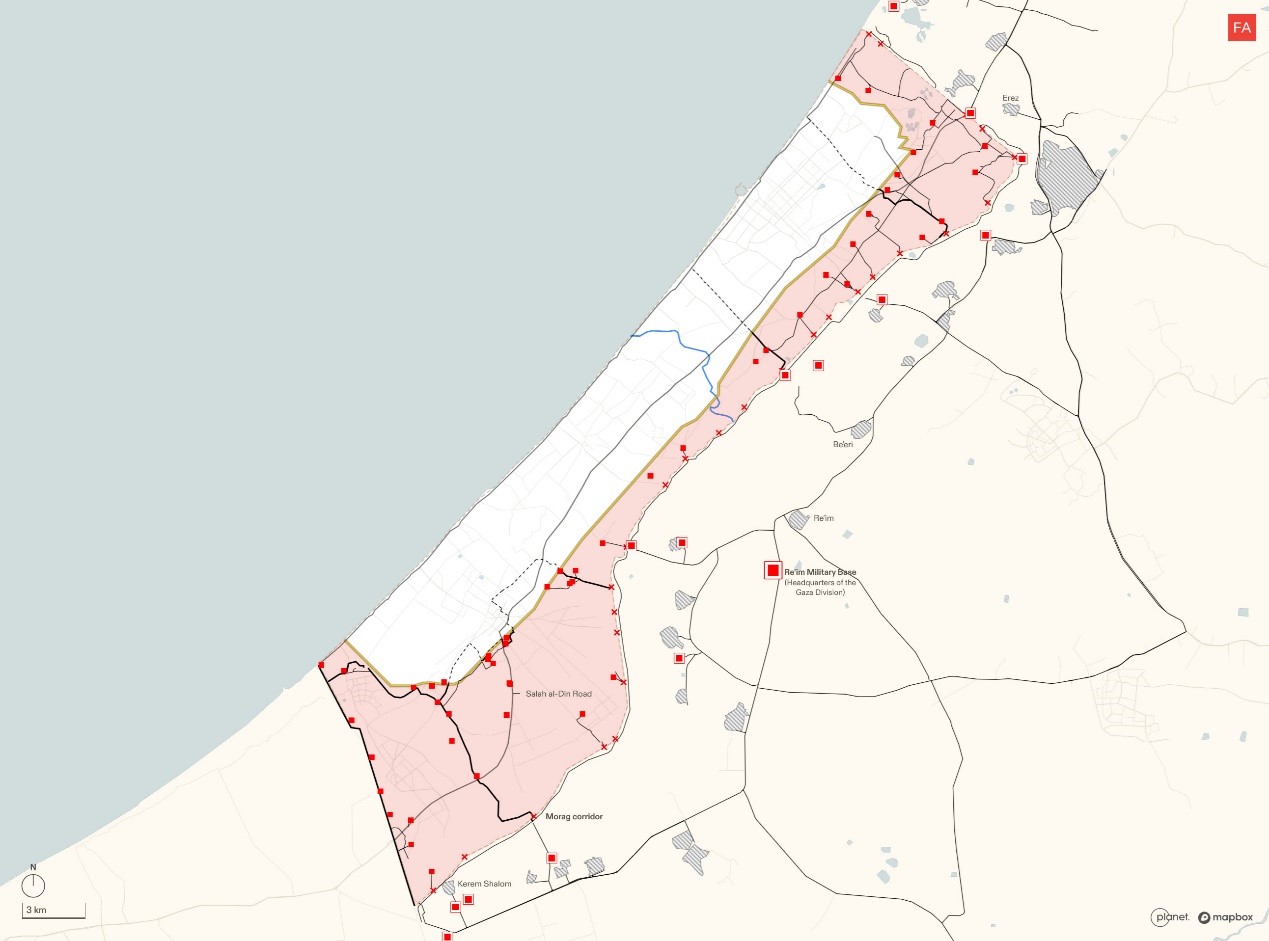
Although Israel’s control over 58% of the Gaza Strip’s area is supposed to be temporary under Trump’s plan to end the war, the realities on the ground point to what the occupation has historically excelled at: gradual entrenchment leading to permanent military presence. The research group Forensic Architecture reported, in an analysis of satellite imagery, that the Israeli occupation maintains 48 military camps along the Yellow Line, including 13 new camps established after the ceasefire, in an effort to advance its long-term objective of displacing the Palestinian population to other areas.
All of this reflects a fixed strategic position of the Israeli occupation: imposing a new reality in the Gaza Strip based on maintaining military presence and security control, rather than withdrawal or ending its domination.
Until the Israeli occupation achieves its objective of entrenching its control behind the Yellow Line, it has moved to form scattered militias throughout the Gaza Strip. These groups operate under its supervision, are stationed in areas it controls behind the “Yellow Line,” and receive direct guidance and support from the Shin Bet security service as well as Unit 8200 of the Israeli army, which specializes in electronic intelligence. They carry out missions inside the Gaza Strip on behalf of occupation soldiers, including the abduction of civilians and the killing of Palestinian civilians west of the Yellow Line.
The Line of Death
As for the western side of the “Yellow Line,” especially the areas adjacent to it, its defining features are displacement, killing, and humanitarian pressure. Despite being designated as a civilian residential area, it has witnessed repeated internal displacement, severe overcrowding, and shortages of health and food services, in addition to daily military attacks that leave many dead and wounded. The imaginary line thus becomes a “line of death,” extinguishing any fragment of safety a Palestinian might hope to live with.
Many residents living just tens of meters from the imaginary “Yellow Line” endure constant terror and fear of direct targeting by aircraft, tanks, and even drones, or indirect harm from tank shell shrapnel or ricocheting bullets striking their tents. This is compounded by constant anxiety over the yellow concrete blocks placed by the Israeli occupation army to mark the imaginary line, fearing they may be pushed westward, forcing them into further displacement and forcible expulsion from their place of residence, after having already endured the pain and suffering of displacement repeatedly throughout the war. In a testimony by one resident living in the eastern areas of the Shuja‘iyya neighbourhood, he says while carrying his belongings:
“Leave, displacement; leave, displacement. What crime have we committed against the world? At 2:30 in the morning, we were shocked to find that the yellow stone had moved closer, and the tent sheltering me and my children, 12 people, was now inside the line. From October 7 until now, this is the sixteenth displacement. I moved from one street to another, from one city to another, from north to south, from south to north. What do they want from us? They killed our dearest ones and left us with nothing.”
Mo‘tasem Akkasha, a resident of the Jabalia camp[2], describes in his testimony the situation east of Jabalia camp as “terrifying and frightening.” He says: “We spend most of our time inside the house and only go out when necessary, such as to fetch water or food supplies for my family. My house is only 100 meters from the Yellow Line, and occupation drones and helicopters frequently fire at us to force us and our neighbours to abandon our homes and the tents we erected on top of the destroyed houses, despite the fact that none of the residents have engaged with them or approached the yellow blocks marking the area under their control.” As he recounted this, Mo‘tasem referred to the story of the boy Zaher Shamiya (12 years old), whom occupation soldiers killed in cold blood after he approached the area from which the army had withdrawn, and then ran over his body with a tank, tearing it in half.
This reflects a growing number of cases of ongoing internal displacement, mounting pressure on relief services, and the obstruction of return to eastern areas, leaving Gaza’s residents confined to western zones under conditions that lack the most basic requirements of a dignified human life.
Overall, the Gaza Strip has witnessed continuous field escalation from the moment the ceasefire came into effect until the time of writing this report, alongside serious and systematic violations of the agreement and a deliberate undermining of the essence of the ceasefire and the provisions of the humanitarian protocol attached to it. Palestinians in the Gaza Strip continue to live in constant fear of killing and systematic destruction, day and night, from direct gunfire against them to incursions by military vehicles into nearby areas; from the bombardment and targeting of their homes and tents to demolition and destruction in their immediate surroundings. According to the Palestinian Ministry of Health in Gaza’s daily statistical report, which recorded near-daily killings and injuries in the vicinity of the “Yellow Line” and even in western areas far from it, 405 civilians have been killed and 1,115 others injured since the announcement of the ceasefire to date.
Conclusion
The temporary “Yellow Line” constitutes an imaginary, provisional boundary imposed by the United States as part of its ceasefire proposal, allowing the Israeli occupation army to remain east of it on a temporary basis. However, the occupation’s practices and continuous statements demonstrate that it seeks to entrench this line as a permanent one. The destruction of infrastructure east of the line, its westward expansion, and its demarcation with concrete blocks represent a direct occupation of land, similar to what occurred with major checkpoints in the occupied West Bank, such as the Qalandiya checkpoint, which began with a single concrete block and continues to this day as a barrier that fragments Palestinian territory and strangles the lives of its residents.
These practices coincide with Israeli intransigence regarding the transition to the second phase, its rejection of the international force in its agreed form, and the proposal of reconstruction plans for areas east of the line but not west of it. This indicates that Israel’s intentions regarding Gaza do not align with the ceasefire agreement, and that the Yellow Line constitutes a central axis for understanding Israeli actions and a primary starting point for its subsequent steps.
NOTE: This text is adapted from original Arabic article.
[1] Interview conducted by the researcher with a resident of Jabalia camp, Mu’tasim Akasha, on 22 December 2025.
[2] Interview conducted by the researcher with Mu’tasim Akasha, a resident of Jabalia camp, on December 22, 2025.