The Israeli Targeting of Humanitarian Organizations: A Systematic Destruction of What Remains of the Foundations of Life in the Gaza Strip
Humanitarian work in the Gaza Strip is undergoing profound changes that go beyond its emergency response to humanitarian needs. Due to the occupation, it is gradually becoming a tool of slow death and a means of driving the Palestinian people from their land and homeland.
The suffering of Palestinians in the Gaza Strip has deepened as a result of the Israeli occupation preventing the United Nations Relief and Works Agency for Palestine Refugees (UNRWA) from carrying out its work and revoking the licenses of 37 other international humanitarian organizations. This has deprived Palestinians of their right to legal and humanitarian protection and access to medical and relief assistance. Through these actions, the occupation seeks to make the environment in the Gaza Strip inhospitable and unliveable for its inhabitants.
This report seeks to identify the mechanisms of domination over humanitarian work in the Gaza Strip, its transformation into a tool subject to the security control and political domination of the Israeli occupation, and the implications of this for the future of humanitarian response in the Palestinian territories.
Humanitarian Action Between International Law and Occupation Policies
Humanitarian action is considered a focused relief response in an area affected by a natural or man-made disaster, relying on coordinated efforts to meet the needs of those affected and provide them with assistance. According to the Dictionary of International Law, humanitarian assistance in international humanitarian law includes all medical relief activities and food supplies provided to military personnel, civilians, and victims of events and their direct consequences.[1]
To guide the work of actors in the humanitarian field, a number of humanitarian principles have been established, endorsed by the United Nations General Assembly, and characterized by neutrality, independence, and impartiality. International conventions have affirmed these principles, including the Fourth Geneva Convention 1949, relative to the Protection of Civilian Persons in Time of War. In particular, Article 27 stipulates that “protected persons are entitled, in all circumstances, to respect for their persons, their honour, their family rights, their religious convictions and practices, and their manners and customs. They shall at all times be humanely treated.” Moreover, under Article 55, the occupying power has the duty to ensure the provision of food and medical supplies to the population, and under Article 59, it must permit relief schemes on behalf of the population and facilitate them.
Article 7 of the Rome Statute of the International Criminal Court classifies crimes against humanity, and obstructing relief supplies is considered a war crime under the Geneva Conventions.
However, the Israeli occupation, which has imposed a comprehensive blockade on the Gaza Strip since 2007 following the takeover by the Islamic Resistance Movement (Hamas), has violated these laws in their entirety throughout the years preceding the genocidal onslaught. This blockade has affected international institutions operating in the Gaza Strip, imposed restrictions on their relief work, and resulted in the prevention or delay of humanitarian aid deliveries. Médecins Sans Frontières/ Doctors Without Borders, has highlighted the challenges faced by medical personnel and hospitals due to the Israeli blockade imposed on Gaza prior to October 7, 2023, noting that importing essential medical supplies such as mobile X-ray devices (C-arms) necessary for orthopaedic surgeries was extremely difficult, significantly limiting the capacity of healthcare facilities to provide timely and adequate treatment.
For many years, Amnesty International has documented in its reports that the Israeli occupation has prevented or delayed the entry of human rights researchers and international staff, as it requires prior registration to obtain permits to enter the Gaza Strip. In one of its statements, it said: “The Israeli authorities have repeatedly refused requests from both Amnesty International and Human Rights Watch to enter Gaza via the Erez crossing, which is controlled by Israel.”
Escalation in Targeting Humanitarian Organizations and the Systematic Obstruction of Their Work During the Genocide
Since the Israeli occupation launched the genocide on the Gaza Strip on October 7, 2023, it has intensified the siege on Palestinians, restricting their access to medical aid and humanitarian assistance. What began as limitations on the work of international organizations has evolved into systematic obstruction through the imposition of complex security coordination mechanisms and burdensome registration procedures involving unreasonable requirements, particularly given Israel’s control over Gaza’s border crossings and supply chains. This has significantly reduced the flow of humanitarian aid and the presence of humanitarian personnel in Gaza.
The United Nations Relief and Works Agency for Palestine Refugees in the Near East (UNRWA) has been the most prominent example during the genocide of the occupation’s efforts to target humanitarian organizations. For years, Israel has sought to undermine the agency’s work and has waged smear campaigns against it. These efforts escalated during the genocide, in an attempt to dismantle and replace it with alternative mechanisms under Israeli control. The year 2025 was described as the “most dangerous” year for UNRWA since its establishment in 1949, with the agency reportedly “on the brink of collapse,” according to the 302 Center for the Defense of Refugee Rights and the UNRWA File at the Popular Conference for Palestinians Abroad.
According to UNRWA spokesperson Adnan Abu Hasna, millions of dollars were spent to damage the agency’s reputation in the media and on social platforms[2], culminating in the screening of a film titled “Dismantling UNRWA” in New York, promoting the termination of the agency and the integration of refugees into host countries.
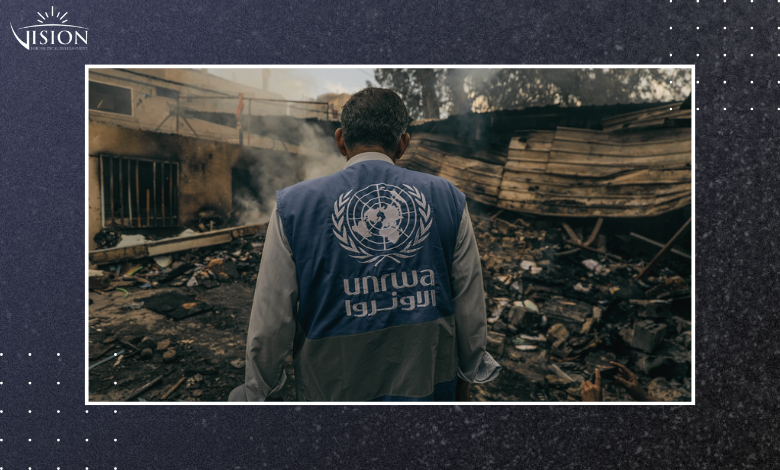
On the ground, Israeli forces have killed 380 UNRWA staff members in Gaza and destroyed more than 90% of its facilities and buildings. Israel continues to prevent the entry of food aid and shelter materials prepared by the agency sufficient for approximately 1.3 million Palestinians. It has also barred the agency’s Commissioner-General, Director of Operations, and international staff from entering Gaza, the West Bank, and occupied Jerusalem, where UNRWA schools and clinics have been closed and its headquarters in the Sheikh Jarrah neighbourhood seized, the UN flag removed and replaced with the Israeli flag. Demolitions and forced displacement have also continued in refugee camps in Jenin and Nur Shams in Tulkarem[3].
This policy has not been limited to UNRWA but has extended to various humanitarian organizations. Israeli authorities have imposed complex security restrictions on international NGOs operating in the occupied Palestinian territories, including prolonged procedures for movement permits in Gaza, sometimes ending in rejection, and interference in the activities and areas of operation of organizations that do receive entry approval.
According to the United Nations Office for the Coordination of Humanitarian Affairs (OCHA) in the occupied Palestinian territory, administrative restrictions imposed by Israeli authorities have obstructed the movement of individuals and humanitarian convoys inside Gaza. Access to affected communities and essential services remained severely hindered throughout May 2024 due to several obstacles, including:
- Complex and inconsistent notification and coordination procedures
- Inconsistent checkpoint processes
- Rejection of coordination requests for aid missions
Although a humanitarian notification system exists to coordinate movements, repeated obstacles, delays, and refusals have significantly restricted humanitarian operations, leading to a 67% decrease in aid flows compared to April 2024, levels already insufficient to meet escalating needs.
OCHA further reported that 85% of 41 requests to coordinate aid missions to North Gaza were denied. Lisa Doughten, Director of OCHA, summarized the restrictive environment as including:
- Israeli military operations and activities of Palestinian armed factions
- Limited crossing points into Gaza
- Insecurity affecting humanitarian workers
- Israeli refusal or delay of aid convoy movements
- Prohibition on entry of logistical, security, and communications equipment
- Lengthy and burdensome inspections of aid
- Imposition of new customs regulations on humanitarian assistance
A survey of international relief organizations operating in Gaza found that 100% believed Israeli procedures for aid entry were ineffective, systematically obstructive, or insufficient to meet immense needs. Additionally, 95% reported experiencing regular delays, some exceeding two months.
Beyond obstructing humanitarian movement, Israeli forces have directly targeted aid convoys and facilities belonging to international organizations and the United Nations, despite clear markings and prior coordination. According to the United Nations, at least 562 humanitarian workers have been killed, including 376 UN staff and 15 staff members from Médecins Sans Frontières (MSF). A convoy of 15 Palestinian paramedics, including UN and Palestinian Red Crescent personnel, traveling in clearly marked vehicles was also targeted; all were killed, and the vehicles bulldozed with bodies buried beneath.
Escalation Following the Suspension of War
In early 2026, the Israeli government introduced new licensing conditions for international humanitarian NGOs operating in the occupied Palestinian territories. These require registration with a joint governmental committee under Israel’s Ministry of Justice, supervised by the Ministry of Diaspora Affairs, with oversight from multiple Israeli intelligence and security agencies. Registration is mandatory for continued operation and for obtaining or renewing work permits for foreign staff.
The system requires:
- Detailed disclosure of organizational structure, funding sources, and field activities
- Full personal data for all employees, including Palestinian staff
Registration is contingent upon compliance with broad political and security criteria, which may be used to deny or revoke approval. These criteria include:
- Alleged “delegitimization” of the Israeli system or support for accountability mechanisms such as investigations by the International Criminal Court
- Public support for boycott campaigns by any employee or partner within the past seven years
- Statements denying Israel’s existence as a “Jewish and democratic state”
- Full compliance with detailed reporting requirements including complete staff lists and identification details
Accordingly, any organization documenting Israeli violations, supporting accountability, or adhering to international law and Palestinian rights principles risks deregistration and being deemed illegal.
MSF reported receiving official notice that its registration would not remain valid as of January 1, 2026, and that it must cease operations by March 1, 2026. Despite submitting required documentation, neither MSF nor the AIDA network, representing over 100 NGOs in Gaza and the West Bank, received a response. MSF expressed concerns about sharing staff data without guarantees of protection, particularly amid repeated harassment, detention, and attacks against humanitarian workers.[4]
In addition to MSF, the decision affects 36 major international organizations forming the backbone of Gaza’s humanitarian response, including Action Aid, Norwegian Refugee Council, Oxfam, CARE International, and International Rescue Committee.
These developments indicate a broader effort to politicize humanitarian aid and link relief to political considerations aligned with Israeli policy. Reports by MSF using terms such as “collective punishment” and “systematic destruction of the healthcare sector” have reportedly contributed to international legal scrutiny, placing such organizations under political targeting.
Restrictions on UNRWA also serve broader goals of demographic engineering, refugee displacement, and reframing the Palestinian issue from a political matter to a humanitarian crisis, undermining the legal dimension of refugee rights and the right of return.
Impact on the Humanitarian Situation in Gaza
There is no doubt that the suspension of international and UN humanitarian organizations would have profound repercussions on the humanitarian situation in the Gaza Strip, given the severe crisis it has endured as a result of years of genocide, conflict, and blockade. These organizations play a vital role in operating health facilities and providing essential care services.
According to Médecins Sans Frontières (Doctors Without Borders), its activities serve nearly half a million people in the Gaza Strip through crucial support to the devastated healthcare system. It currently provides at least 20% of hospital beds in Gaza and operates around 20 health centers. Last year alone, the organization conducted more than 800,000 medical consultations and assisted in over 10,000 births, in addition to supplying drinking water[5]. Consequently, most of these services would cease if the organization were forced to halt its operations, placing Palestinian lives at serious risk, leaving patients and the wounded searching merely for what keeps them alive, rather than the medical care and treatment they rightfully deserve.
Médecins Sans Frontières believes that revoking licenses would have catastrophic effects on patients, wounded civilians, children, women, elderly individuals, and persons with disabilities, and would directly result in the loss of lives that could otherwise have been saved, “particularly in light of the near-total collapse of the healthcare system in the Gaza Strip”[6]. It would also endanger the safety of staff working in international organizations, thereby affecting the continuity of humanitarian and medical services in an already challenging operating environment.
For many months, the Israeli occupation has refused to allow the entry of aid from the Norwegian Refugee Council. According to the Council’s director, repeated responses to requests for the entry of assistance stated that its registration remains under review and that it is not authorized to bring in any materials. This has deprived hundreds of thousands of displaced people of tents, plastic sheeting, and other forms of shelter amid harsh weather conditions.
According to Ruth James, Oxfam’s Regional Humanitarian Coordinator for the Middle East and North Africa, these restrictions have been imposed continuously over the past two years and three months, preventing organizations from accessing Gaza and delivering essential humanitarian assistance to the population. This has further compounded the humanitarian crisis, and the latest announcement represents an escalating humanitarian catastrophe in light of the widespread and acute needs facing civilians in the besieged Strip.
As for the United Nations Relief and Works Agency for Palestine Refugees (UNRWA), it alone provides health, education, and relief services to more than 1.3 million Palestinians in the Gaza Strip[7].
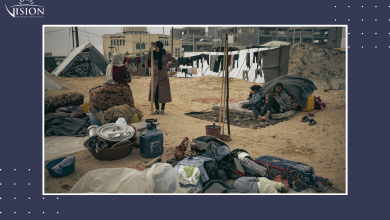
Regarding this, Hiba Abu Kamil, whose apartment was destroyed by the Israeli occupation and who was forced to live in a tent at one of the shelter centers, said: “We are suffering from harsh living conditions amid shortages of food, medicine, and shelter supplies. The food assistance we receive is barely sufficient. Even the plastic sheeting is not enough to set up a proper tent, so we find ourselves flooded whenever there is a low-pressure system. What are we supposed to do if even this limited aid stops?”
Accordingly, the suspension of the work of international and UN humanitarian organizations in the Palestinian territories would lead to a reduction in essential care services and a worsening of the catastrophic humanitarian situation. It would turn basic needs such as food, medicine, and shelter supplies into instruments of suffering, further deepening the tragic reality endured by Palestinians in the Gaza Strip, marked by hunger, illness, cold, a deteriorating economic situation, a collapsed health infrastructure, and ongoing military operations.
Conclusion
The Israeli government’s decision to halt the work of dozens of international humanitarian organizations in the occupied Palestinian territories threatens the collapse of the humanitarian and medical relief network in Gaza. It undermines the principles of neutrality and independence of humanitarian action and reflects a shift from reluctant allowance of aid operations to functional control over them.
After nearly two and a half years of devastating genocidal war, destruction of infrastructure, and loss of life, efforts to restrict humanitarian aid risk deepening what many observers describe as a slow, silent humanitarian catastrophe. Preventing medical and relief supplies from entering Gaza leaves civilians facing hunger, disease, displacement, and despair, conditions that may drive forced migration and align with broader demographic objectives.
There is therefore an urgent need for decisive action by the international community and UN institutions to protect civilians and humanitarian workers, ensure the independence of humanitarian organizations, guarantee the entry of medical supplies, and allow the unrestricted flow of aid, rather than allowing humanitarian assistance to become a mechanism of prolonged suffering.
NOTE: This text is adapted from original Arabic article.
[1] Aqila Afiri, “The Concept of Humanitarian Action within the Framework of International Humanitarian Law,” Algerian and Comparative Public Law Journal, Vol. 9, No. 1, 2023, p. 225.
[2] Interview conducted by the researcher with Adnan Abu Hasna, spokesperson for the United Nations Relief and Works Agency for Palestine Refugees (UNRWA), on January 15, 2026.
[3] Interview conducted by the researcher with Adnan Abu Hasna, previously cited.
[4] Interview conducted by the researcher with Nour Al-Saqqa, a member of Médecins Sans Frontières (Doctors Without Borders) in Gaza, on January 17, 2026.
[5] Interview conducted by the researcher with Nour Al-Saqqa, previously cited.
[6] Interview conducted by the researcher with Nour Al-Saqqa, previously cited.
[7] Interview conducted by the researcher with Adnan Abu Hasna, previously cited.