The Health and Environmental Impacts of Waste Accumulation in Gaza During the Genocide

With the onset of Israel’s genocidal onslaught on the Gaza Strip, the occupation army placed infrastructure among its primary targets, destroying nearly all facilities across various areas of the Strip. This included the destruction of service facilities, municipal heavy equipment, and government infrastructure. According to official statistics from the Palestinian Central Bureau of Statistics, the occupation army has destroyed approximately 90% of the infrastructure, facilities, and vital installations since the beginning of its assault on the Gaza Strip on October 7, 2023, as part of a systematic policy aimed at rendering the Gaza Strip uninhabitable.
This policy has coincided with the imposition of a suffocating blockade on the Strip and the occupation of several vital areas, such as the Juhor al-Dik area east of the central governorate, which includes a landfill site designated for waste collection. This has led to a severe waste accumulation crisis since the beginning of the war. The waste crisis has been further exacerbated by the near-total halt of regular waste collection and transportation operations, the disruption of basic services, and the prevention of municipal teams from accessing the main specialized landfill sites located along the eastern peripheries of the Strip.
These developments suggest the existence of deliberate intentions by the occupation to impose a systematic policy aimed at destroying the population on multiple levels. Among these measures is the restriction of access to waste disposal sites, resulting in large quantities of waste remaining piled up among residential areas. This accumulation has become a latent threat, endangering both the lives of residents and the surrounding environment.
This article sheds light on the phenomenon of “waste accumulation” in the Gaza Strip as a result of the ongoing genocide on the territory. It seeks to highlight its harmful consequences and impacts on public health and the environment, presenting it as one of the instruments of “silent genocide” employed by Israel against the residents of the Gaza Strip.
The State of Waste in Gaza Before the War
Waste in its various forms had already been a significant problem in the Gaza Strip before the escalation of the genocide. The issue was exacerbated by the continuous increase in the quantities and types of waste produced daily, as well as the limited availability of land required for establishing sanitary landfills and safe treatment facilities. This situation unfolded under the ongoing Israeli blockade on the Gaza Strip, which prevented the entry of spare parts and essential equipment that could have helped improve the quality of waste management and disposal processes. The blockade also restricted the expansion of existing landfill sites because of their proximity to the border. These constraints constituted a structural obstacle to the development of the solid waste management sector, thereby worsening environmental and public health deterioration in the Strip.
Gaza produced approximately 1,800 tons of solid waste per day, averaging about 0.8 kilograms per person. This waste consisted mainly of organic materials, plastics, paper, glass, and metals. Most of it was disposed of through sanitary landfilling at the Juhor al-Dik and al-Fukhari landfill sites. Agricultural activities also generated around 550 tons per day of livestock waste, which was utilized as fertilizer, in addition to approximately 200 tons of organic agricultural waste. Furthermore, about 1,300 kilograms of infectious medical waste were produced daily; these were treated using microwave sterilization devices at the Juhor al-Dik and Khan Younis units before being buried. Used batteries also posed a significant environmental challenge amid the electricity crisis, with the quantities collected for recycling estimated at around 10,000 tons annually.
These wastes were disposed of in three main landfill sites: the Juhor al-Dik landfill, which received approximately 1,000 tons per day and required expansion as it approached the end of its operational lifespan; the al-Fukhari landfill, which served the southern governorates and received about 600 tons daily; and the Deir al-Balah landfill, which had been closed after reaching its maximum capacity. In addition, four open, unregulated dumping sites were scattered across the Strip, used by some municipalities due to transportation and waste transfer difficulties faced by the local government sector under the blockade.
The Waste Catastrophe After the Genocide
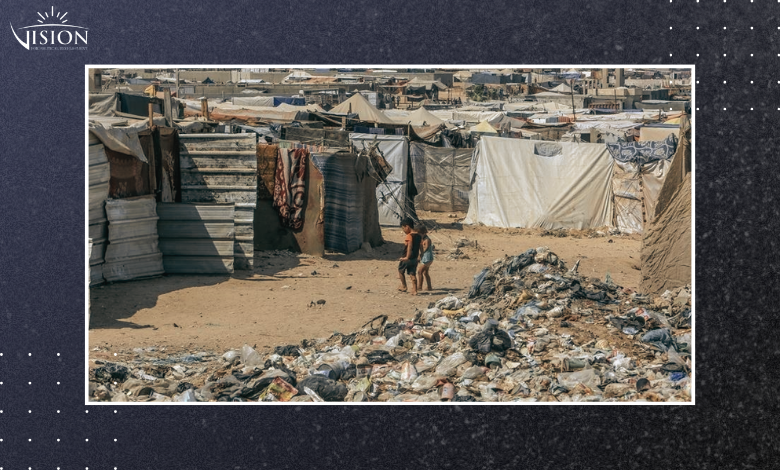
With the outbreak of the genocide in October 2023, the waste crisis escalated dramatically, reaching catastrophic levels of accumulation. This was compounded by the occupation of eastern areas of the Gaza Strip that previously contained the territory’s official landfill sites, particularly the Juhor al-Dik and al-Fukhari landfills, from the very first weeks of the genocide. The Gaza Strip produces approximately 1,100–1,300 tons of waste daily; consequently, the volume of accumulated waste since the beginning of the genocidal war has now exceeded one million tons. These quantities continue to increase day after day as the occupation persists in keeping Gaza’s border crossings closed and preventing the entry of the equipment necessary to transport waste to designated landfill sites[1].
This situation has forced Gaza’s municipalities to transfer and collect waste in “temporary” random dumping sites. Among them is a site located on the land of the historic Souq Firas in eastern Gaza City, covering an area of about 33 dunams, as well as other improvised dumping sites scattered across different parts of the Strip. In total, nearly 200 such sites have emerged among residential areas and places where displaced people have sought shelter. The danger is compounded by the fact that none of these dumping sites are equipped to handle such large quantities of waste.
Most treatment facilities and regular waste collection services have also ceased operating due to the destruction of infrastructure, severe shortages of fuel and electricity, and the lack of equipment and plastic bags under the conditions of the ongoing blockade. In addition, intensive bombardment has produced millions of tons of rubble mixed with household waste and even medical waste, which has been disposed of in temporary random dumping sites located close to residential areas.
Serious Repercussions for Health and the Environment
This situation has led to the accumulation and widespread presence of large quantities of waste among the population, placing nearly two million people at increasing health risk. This is occurring in an environment highly susceptible to the spread of diseases and epidemics, combined with a healthcare system of limited capacity that is suffering from severe depletion of resources and capabilities. For this reason, the United Nations Relief and Works Agency for Palestine Refugees in the Near East (UNRWA) has warned of the spread of diseases among displaced persons in the Gaza Strip due to the accumulation of waste in streets, roads, and shelter centers as a result of the genocidal war.
Meanwhile, the World Health Organization warned, in a study published in February 2025, of serious health consequences, including outbreaks of acute watery diarrhoea. Thousands of cases of severe diarrhoea have already been recorded, with a real risk of a cholera outbreak amid the lack of safe drinking water. In addition, skin infections and eye diseases, such as scabies, dermatitis, lice infestations, and conjunctivitis have spread, particularly among displaced children living in unhygienic conditions.
These wastes also cause respiratory diseases such as asthma and bronchial infections due to inhalation of contaminated dust and toxic fumes from burning waste, which releases carcinogenic substances such as dioxins[2]. In addition, vector-borne diseases are becoming more prevalent, as stagnant water and waste create an ideal environment for the breeding of disease-carrying mosquitoes, increasing the risk of diseases such as dengue fever[3]. Waste also leads to food poisoning and bloodstream infections (sepsis) due to severe contamination of the food chain and infected wounds[4]. Among the most prominent microbes that thrive in waste-accumulation environments are bacteria such as gastrointestinal bacteria, wound and skin bacteria, and leptospirosis-causing bacteria[5]. Waste also provides an ideal environment for viruses to persist for extended periods, facilitating their transmission to humans and animals, including hepatitis A viruses, diarrhoea-causing viruses, intestinal worms, and intestinal amoebae[6].
On the other hand, the waste scattered among residents in streets has created a fertile environment for the proliferation of vertebrates and invertebrates such as stray dogs and cats, rats and rodents, insects, and mosquitoes. These organisms infiltrate living spaces and cause devastating effects on both human health and the environment. Furthermore, due to the occupation’s prevention of fuel and gas from entering the Gaza Strip, many people have resorted to burning large quantities of waste, plastic and other materials, to provide an alternative source of fuel for cooking, heating, and other needs. Waste burning has thus become a major source of hazardous air pollutants, including compounds with carcinogenic properties and fine particles capable of penetrating the respiratory system and affecting its vital functions. The danger of these emissions increases significantly in densely populated areas. According to official statistics, 1.8 million cases of respiratory diseases have been recorded since the beginning of the war[7].
The United Nations Environment Programme (UNEP) has also confirmed that the accumulation of waste, contaminated rubble, and the flow of sewage near displacement areas has created a fertile environment for the spread of epidemics. It warned of long-term effects on public health and of contamination of soil and groundwater. The program indicated that solid waste disposal sites have become unsuitable or inaccessible to civilians since 2023, forcing residents to use temporary sites near homes that lack basic sanitary standards. These sites increase health risks and pollution and expose residents to contaminated water, sewage, and disease hazards.
On another level, the sight of accumulated waste scattered among tents and alleyways has had a significant impact on the mental health of Gaza’s residents. Waste generates what is known as “visual pollution,” which can cause internal psychological distress and depression among individuals, sometimes leading them to feel unable to accept living in such an environment.
The serious effects of waste are not limited to human health alone. The environment itself is experiencing profound risks that may render it unfit for life in the long term if appropriate solutions are not found. This is especially critical given the absence of waste-sorting processes and the mixing of all types of waste together, in addition to the rubble resulting from the bombardment of homes and infrastructure.
It should be noted that the two main landfill sites: Juhor al-Dik and al-Fukhari, currently lie within the “red zone” controlled by the occupation army. These sites are properly equipped to receive waste and contain a polyethylene lining layer, a leather-like material that prevents the leachate produced by waste from seeping into the soil. However, the makeshift dumping sites currently in use are not prepared for this purpose and lack this important lining, allowing waste and its leachate to seep into the ground and contaminate groundwater, which is the primary source of fresh water in the Gaza Strip[8].
As days pass, the problem becomes increasingly complex with the growing quantities of waste. This may eventually lead to the complete absence of places to dispose of waste, particularly as the occupation continues to seize vast areas of the Strip and place them under its control. Consequently, residents are forced to concentrate in limited spaces, placing the environmental situation under severe threat.
Conclusion
The continued accumulation of waste in the Gaza Strip, driven by systematic constriction and strangulation policies, the blockade, and control over more than 60% of the territory, measures considered tools of genocidal warfare, has transformed the environment itself into both a deadly weapon and a victim. These actions form part of efforts to make the Strip an uninhabitable, hostile environment. Therefore, allowing this situation to persist will have catastrophic long-term consequences, potentially increasing mortality rates due to pollution and diseases caused by waste.
Moreover, this environmental catastrophe, combined with the ongoing blockade, restrictions on reconstruction, and daily military violations of ceasefires, contributes to the forced displacement schemes openly declared by the occupation, which it seeks to implement by any means necessary.
[1] Interview conducted by the researcher with Abdul Rauf Al-Mana’meh, Dean of the Faculty of Health Sciences, Islamic University, on January 18, 2026.
[2] They are a group of toxic chemical compounds that persist in the environment, often resulting from incomplete combustion or certain industrial activities. They accumulate in the food chain, particularly in animal fats, and are linked to serious health effects such as immune system disorders, hormonal disruption, cancer, and adverse effects on growth and reproduction.
[3] An acute viral illness caused by dengue viruses, transmitted to humans through the bite of an infected Aedes mosquito. It is characterized by a sudden fever, severe headache, muscle and joint pain, and a rash; in some cases, it may progress to dengue haemorrhagic fever or life-threatening shock.
[4] An interview conducted by the researcher with Abdulraouf Al-Mana’ma, Dean of the College of Health Sciences at the Islamic University, on January 18, 2026.
[5] A bacterial disease caused by spiral-shaped bacteria of the genus Leptospira, transmitted to humans through contact with water or soil contaminated with the urine of infected animals, particularly rodents. Symptoms range from fever, muscle pain, and headache to severe cases that may include kidney or liver failure and bleeding.
[6] Abdulraouf Manna, as mentioned earlier.
[7] An interview conducted by the researcher with Dr. Abdelfattah Abd Rabbo, Professor of Environmental and Marine Sciences at the Islamic University of Gaza, on January 17, 2026.
[8] An interview conducted by the researcher with Saeed Al-Aklouk, the official in charge of water and environmental monitoring at the Ministry of Health in Gaza, on January 17, 2026.
NOTE: This text is adapted from original Arabic article.