The Bondi Attack, A Zionist Opportunity to Bring in New Immigrants: Opinion Makers Report

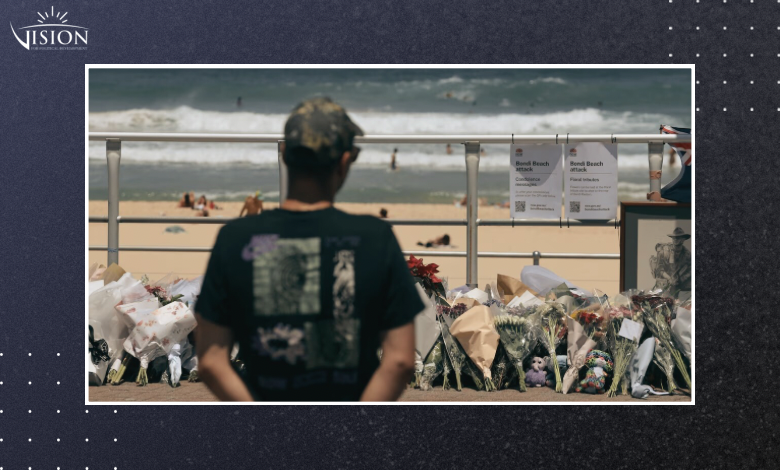
This report presents an analysis of the main narratives circulated by Israeli research centers, newspapers, and media platforms regarding the armed attack that targeted a Jewish Hanukkah celebration at Bondi Beach in Sydney, Australia, in December 2025. The report analyzes 27 Hebrew-language publications, including major newspapers such as Globes and Makor Rishon; right-wing platforms such as Israel National News; left-wing platforms such as Sicha Mekomit; as well as research institutes including the Jewish People Policy Institute.
Executive Summary
- The Bondi attack is instrumentalized to promote active immigration policies aimed at attracting Jews from around the world through tax incentives and extensive procedural facilitation.
- Declared plans link immigration to the expansion of settlement in the West Bank, the Galilee, and the Negev, revealing settler-colonial and demographic objectives behind the discourse of global Jewish security.
- Western Jewish capital is framed as a strategic resource to be attracted, with immigration presented as a rational economic decision rather than a purely ideological one.
- Emotional testimonies and comparisons to the 1930s are deployed to psychologically prepare audiences for pro-immigration narratives and to weaken discourses of integration within host countries.
- The dominant discourse seeks to detach antisemitism from Israeli policies and present it as a historically rooted hatred, thereby exempting Israel from accountability.
- The concept of the “globalization of the intifada” is used to conflate solidarity with Palestinians with anti-Jewish violence.
First: Framing the Attack within a Global Jewish Crisis
- Most Israeli sources converge on presenting the Bondi attack as part of an escalating series of assaults against Jews worldwide. This framing seeks to situate the incident within the context of a global Jewish crisis that transcends Australia’s local conditions.
- emphasizes that the incident is not isolated from a cumulative series of attacks targeting Jews in Australia. The Executive Council of Australian Jewry (ECAJ) documented a sixfold increase in antisemitic incidents following the war on Gaza, rising from an annual average of 333 incidents to 2,062 in 2024. The dominant Israeli discourse also explicitly accuses the Australian government of ignoring repeated prior warnings, while data from Israel’s Ministry of Immigration indicate a 70% increase in immigration applications from Australia in 2025.
- Writers at expand the analytical frame beyond the Australian context to a broader global level, linking the Bondi massacre to previous attacks in Boulder, Washington, and Manchester. They note a recurring pattern of violence coinciding with major Jewish religious occasions, from Yom Kippur to Hanukkah. This line of framing employs concepts such as the “globalization of the intifada” to describe discursive shifts that equate Jews with Zionists, criminalize Zionists by labelling them perpetrators of genocide, and ultimately frame violence against Jews as a continuation of political struggle.
- Yitzhak Laks, writing in Israel National News, argues that the current wave is not a local phenomenon but an extension of a historical trajectory within the Western sphere, citing data from international organizations showing sharp increases in antisemitic incidents across several liberal democracies since 2022. Rabbi Shmuel Eliyahu, writing on the same platform, links the Bondi attackers to historical persecutors of Jews throughout the centuries, asserting that while the stated justifications change, the essence remains the same: a deeply rooted hatred of Jews that is not dispelled by political concessions.
- This reading aligns with an argument advanced in that antisemitism constitutes a persistent condition within Western societies, and that the late twentieth-century perception of its disappearance was an illusion resulting from a temporary decline following the Holocaust.
- Israel National News further situates the incident within a geopolitical framework, referring to an “antisemitic tsunami” allegedly driven by states such as Qatar, and calls on Israel to treat global antisemitism as the “eighth front” within its overall threat matrix.
- In contrast, Sicha Mekomit links the rise in hostile incidents against Jews worldwide to Israeli violence in Gaza, warning against instrumentalizing the attack to suppress solidarity with Palestinians under the guise of combating antisemitism.
Analytical Reading
- The views expressed in above sources reveal deliberate efforts to transform the Bondi attack from a specific, isolated incident into an indicator of a global antisemitic phenomenon, serving multiple objectives. On the one hand, linking the attack to an extended historical continuum, from the Inquisition to the Holocaust, frames antisemitism as an essentialized phenomenon unrelated to Israel’s current policies, thereby contributing to absolving Israel of accountability for the impact of its conduct on the security of Jews worldwide. On the other hand, the concept of the “globalization of the intifada” is employed to deliberately conflate movements of solidarity with Palestinians and anti-Jewish violence, providing justification for policies that restrict political freedom of expression in Western countries.
- Critical voices that draw connections between rising antisemitism and Israeli policies remain marginal within the broader public discourse and are largely confined to limited left-wing platforms such as Sicha Mekomit. This marginalization serves the vision of the right-wing current, which seeks to reinforce a narrative of “eternal victimhood,” while exploiting the attack to legitimize active immigration policies and to undermine the legitimacy of independent Jewish existence in the diaspora.
Second: The Political Instrumentalization of Victim Narratives
- Israeli discourse relies heavily on individual testimonies from Jews around the world to construct a narrative of Jewish insecurity in the “Diaspora” (the term used by Zionism to refer to Jews living outside Israel). Davar focuses on statements by Jews from Australia and Britain that reinforce this narrative.
- Israel National News mobilizes stories of survivors and volunteers, highlighting an intergenerational list of victims (children, rabbis, Holocaust survivors) to depict the attack as part of a continuous targeting of Jewishness.
- In Davar, Udi Revivi draws explicit comparisons between contemporary attacks on Jews and the 1930s. Reports from Manchester describe ten-year-old girls requesting armed escorts to attend a Hanukkah celebration, illustrating how the Australian attack has extended into the security imagination of Jewish communities elsewhere.
- The Jewish People Policy Institute offers a different perspective, with Sarah Horowitz emphasizing a deepening embrace of Jewish identity among youth and an increased willingness to express it publicly rather than conceal it. This intersects with testimonies in Globes from activists encouraging the public wearing of the Star of David and participation in communal events as a counter-response.
- In contrast, Sicha Mekomit questions the viability of pursuing security as framed by the dominant discourse, proposing instead an alternative based on solidarity among multiple threatened groups; Jews, Palestinians, Muslims, and refugees.
- Overall, the perspectives presented reveal a systematic deployment of emotional appeal to achieve political objectives. Individual testimonies are not presented primarily as lived experiences but as evidence of the impossibility of safe Jewish life outside Israel. Comparisons to the 1930s serve to psychologically prepare audiences for pro-immigration discourse. Moreover, both proposed responses, immigration or heightened identity rootedness, ultimately serve the Zionist project: the former demographically, and the latter by reinforcing Israel as the central point of attachment.
Analytical Reading
The emotional dimension is strategically employed in Israeli discourse to advance political objectives that go beyond sympathy for victims of attacks. By emphasizing a pervasive sense of insecurity, this framing seeks to weaken narratives of integration within host societies and reproduces the classical Zionist thesis that Jewish existence outside Israel is inherently fragile and endangered, regardless of the degree of apparent integration. This framing ultimately supports the project of positioning Israel as the sole safe center of Jewish existence, thereby legitimizing active immigration policies.
Third: State Responses
Davar highlights a transnational state of security alert following the attack, noting that Israel requested several countries to enhance security around Hanukkah events worldwide for fear of further attacks, and issued recommendations to avoid unsecured gatherings. Security services in New York, Germany, the United Kingdom, and Canada responded with increased deployments around Jewish institutions.
Israel National News notes that these security measures are not temporary. Jewish institutions are now being secured with measures previously reserved for airports and military facilities, entrenching a mode of life structured around permanent security. At the same time, such measures are not uniformly implemented across Europe. In Belgium, for example, the Ministry of the Interior decided to withdraw half of the security presence from the Jewish quarter in Antwerp despite ongoing threats.
by contrast, calls for moving beyond an emphasis on security measures toward the implementation of an organized immigration policy. The Israeli government has adopted an emergency plan to bring in 30,000 immigrants in 2026, accompanied by procedural facilitation and tax incentives.
Fourth: Israel from Refuge to Jewish Representation and Active Immigration Policy
A range of commentaries address the redefinition of Israel’s role, from being merely a geographical refuge for “threatened” Jews worldwide to acting as a sovereign representative that speaks for them and constitutes their next destination.
In Davar, Udi Revivi reformulates the function of the state through an article that draws parallels between Hanukkah commemorations and the Bondi massacre, linking the historical memory of persecution with the contemporary reality of continued attacks on Jews despite the existence of a sovereign state that claims to represent them. Revivi calls on Israel to define itself not merely as a refuge, but as a compass.
Dov Maimon, writing in , articulates a more institutionalized extension of this logic, asserting that Israel was not established merely as an “emergency shelter,” but as a sovereign response to the structural insecurity of Jewish existence worldwide. He criticizes reliance on diplomatic condemnations and demands for enhanced protection abroad, arguing that the true and effective response to Bondi lies in proactively encouraging immigration to Israel through planning rather than panic. He calls for the creation of a supra-ministerial national authority dedicated exclusively to removing obstacles to Jewish immigration, particularly from Western countries, pointing out that the current absorption system was designed for limited migration waves and is slow, bureaucratic, and ill-suited to professionals and academics. He proposes accelerating recognition of professional credentials, issuing temporary work permits, implementing intensive Hebrew-language programs, and guaranteeing housing and educational integration for children.
A report in translates this vision into an emergency government policy, presenting a plan to attract immigrants in 2026 through extensive tax incentives, housing assistance, and major procedural facilitation. The plan sets concrete targets and allocates budgets reaching 1.1 billion shekels in the second year, alongside tax reductions extending until 2030 and additional benefits.
An article in Israel National News addresses the economic dimension, framing Western Jewish immigration as a rational decision not limited to ideological motivations. Jewish identity among capital owners has become a risk factor in business, and Jewish capital, once a driver of Western economic growth, is now described as “seeking certainty.” Israel is presented as offering a developed economy, a stable financial system, and a leading technology sector. This discourse emphasizes that immigrants from Western countries integrate rapidly into the labour market, with employment rates and wages exceeding national averages, and calls for relocating management and research centers of Jewish-owned companies to Israel as a commercially sound decision as much as a Zionist choice. Immigration is thus presented as an opportunity for geographical re-planning through the development of new cities in the Galilee, the Negev, and the West Bank, simultaneously strengthening the economy and national security.
A religious discourse in Israel National News adds a theological dimension, with Rabbi Shmuel Eliyahu presenting antisemitism as an eternal expression of Esau’s hatred of Jacob, arguing that “enemies” always invent new reasons to hate Jews.
In contrast, Sicha Mekomit reminds readers that ongoing Israeli violence against Palestinians cannot be separated from the dynamics of antisemitism, pointing to research linking increases in antisemitic incidents to escalations in Israeli violence. This perspective insists that Israel’s regional conduct must be incorporated into any serious assessment of global Jewish security, rather than assuming Israel to be merely an innocent victim.
Analytical Reading
The consolidation of a model of “global Jewish leadership” at the expense of the refuge model carries multiple implications. Global leadership goes beyond providing a safe haven for persecuted Jews to asserting Israel’s right to lead Jews worldwide and determine their fate, thereby reproducing a colonial logic that subjects all Jews to the agenda of Israel as an occupying state.
Within this discourse, “antisemitism” is instrumentalized to justify active immigration policies serving Israeli demographic, economic, and settler-colonial objectives, explicitly linking immigration to the expansion of settlements in the West Bank, the Galilee, and the Negev. Western Jewish capital is framed as a strategic resource to be attracted, revealing a pragmatic economic dimension beneath the ideological discourse.
The dominant narrative excludes any acknowledgment of a causal relationship between Israeli policies toward the peoples of the region and the rise of antisemitism, presenting hatred as an eternal, essentialized phenomenon detached from political context. Voices that link the two remain marginal and confined to left-wing platforms, while religious discourse is mobilized to confer theological legitimacy upon the political project, transforming immigration from an individual choice into a national–religious “obligation.”
NOTE: This text is adapted from original Arabic article.