Real Estate Developers Are Taking Over the Gaza Strip: An Analysis of Kushner’s “New Gaza” Project

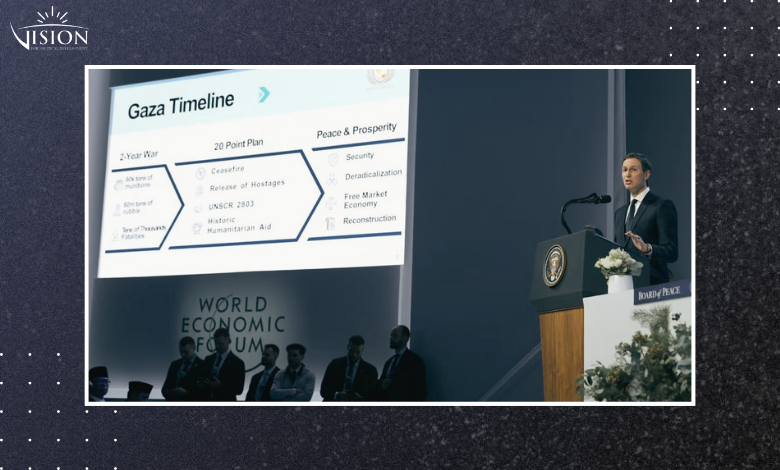
On January 22, 2026, U.S. President Donald Trump announced the launch of the “Board of Peace” as a new international framework for managing the “post-war phase” in the Gaza Strip, alongside a detailed proposal presented by his son-in-law, advisor, and head of his administration’s Middle East team, Jared Kushner, of a comprehensive reconstruction plan titled “New Gaza.” This took place on the sidelines of the World Economic Forum meetings in Davos, at an event that combined the rhetoric of reconstruction with that of global investment.
The announcement came as a single, integrated political-economic event aimed at reshaping the political and security reality in the Gaza Strip, with the Board presented as the overseeing political and institutional body, and the Kushner Plan, formulated with a commercial-investment mindset strongly linked to capitalists and influential circles in political-economic decision-making within the U.S. administration, was presented as the Council’s executive and economic program.
Therefore, the key to understanding it lies in analyzing the backgrounds and roles of the main actors in its proposal and support within a purely developmental and economic discourse, without any reference to the rights of the local population or their potential and roles in it. Consequently, this paper aims to deconstruct the plan in terms of its context, parameters, and open questions regarding the context of Israel’s ongoing genocide in the Gaza Strip, as well as its stated and unstated objectives.
Real Estate Developers and Businessmen as “Patrons” of Peace and Reconstruction
The Trump–Kushner plan was launched against the backdrop of the economic orientations of both men and other members of the “Board of Peace,” a network of businessmen and real estate developers. Kushner is known for his approach of linking politics with real estate investment, presenting his vision for peace in the region since the first Trump administration (2017–2020) according to an economic and commercial model that focused on transforming land into investment zones, as reflected in his design of the “Deal of the Century.” This approach is evident in his announcement of a “New Gaza,” stating: “The plan involves some demolition, followed by the creation of a ‘New Gaza.’” He added: “Gaza could become a tourist destination and include multiple industrial sectors,” echoing previous statements from February 2024, in which he said: “Waterfront properties in Gaza could be highly valuable and exploited.”
Within this framework, the “Board of Peace” included figures from international economic and investment circles, with an executive body comprising representatives of funding countries and requiring financial contributions of one billion dollars for membership, clearly demonstrating the logic of globalized economics and investment in shaping the “New Gaza” plan.
Trump himself had stated in October 2024: “Gaza could be better than Monaco if rebuilt properly.” Then, in February 2025, he declared that he wanted to “own Gaza” and transform it into the “Riviera of the Middle East,” promoting this vision later through an AI-generated video, “Trump Gaza,” which depicted the territory as an investment and tourist destination with skyscrapers, resorts, gardens, and golden statues of himself.
This logic extended to other figures, such as Tony Blair, former British Prime Minister and member of the “Board of Peace” in Gaza. In July 2025, the Financial Times reported that Blair’s TBI Institute contributed to designing Gaza’s reconstruction from an investment and commercial perspective, including the “Gaza Riviera” project and a smart industrial zone named after Elon Musk, with proposals for industrial islands and special economic zones.
Following the announcement of the Kushner plan, Trump reiterated in his capacity as chairman of the “Board of Peace” and as a businessman and real estate investor prior to his presidency, the plan’s investment rationale, stating: “Gaza is a beautiful piece of land by the sea, and it could become a great place if invested in properly,” noting that he is “a real estate man at heart, and that everything starts with location.” This reflects a mindset that treats the Gaza Strip as a capital asset open to investment, development, and operation, without viewing it as a region devastated by genocide or as part of a political issue. It is the same mindset from which Kushner operates, having previously stated that: “Gaza is not a historical precedent; it was the result of a war. A group of tribes that were in different places gathered in one place and formed Gaza.”
Between the Kushner Plan and the Egyptian Plan
Kushner presented his “New Gaza” vision, designed as a plan extending through 2035, though it does not include a detailed timeline for implementation, with promises to transform the Gaza Strip into a promising global economic hub. The plan includes the establishment of strategic projects such as a new seaport, an international airport, road networks, industrial and technological zones, coastal economic and tourist areas, and a complete renovation of residential, educational, and health infrastructure. In addition to the goals of raising Gaza’s gross domestic product to over $10 billion annually by 2035, while increasing the average annual household income to more than $13,000. In addition to creating more than 500,000 job opportunities across various sectors, and building more than 100,000 permanent housing units, 75 medical facilities, 180 cultural, religious, and vocational centers, and 200 educational centers. The presentation indicated that reconstruction will begin in the southern part of the Strip, starting with the Rafah and Khan Yunis areas, followed by expansion into the refugee camps and central areas, and then the reconstruction of Gaza City in the north.
It was also announced that the plan relies on raising over $25 billion by 2035 to cover major projects, and that an international investment conference will be held later in Washington to secure financial commitments from participating countries and private institutions, without specifying the identities of the donors or the size of each commitment. On the implementation side, the presentation emphasized that the plan is closely linked to the process of complete disarmament of the resistance factions in Gaza, and reconstruction will not begin in any area until this has been verified.
It should be noted that Kushner’s plan goes beyond the Egyptian plan for the reconstruction of the Gaza Strip and fundamentally contradicts it, as the latter aims to achieve reconstruction and stability under the supervision of the Palestinian Authority without involving resistance factions in the plan, and in coordination with Arab states and the international community through institutions such as the World Bank and the United Nations Development Programme. While Kushner’s plan reflects a unilateral U.S. vision spanning up to a decade, the Egyptian government proposed a plan that begins with early recovery and aims for full implementation within a shorter timeframe (five years), which was adopted by the Extraordinary Arab Summit in Cairo in March 2025 as a “unified Arab initiative for the reconstruction of Gaza.”
The Egyptian plan is also based on the principles of partnership with the Palestinians and an absolute rejection of displacement and relies on Palestinian and regional legitimacy and multi-source financing, whereas the U.S. plan reflects a focus on security controls and institutional control as a precondition. The U.S. plan seeks, on the condition of disarmament and compliance with U.S. and “Israeli” policies, to turn reconstruction into a tool for reengineering the political reality in the Strip.
Gaps in the “New Gaza” Plan and Its Major Questions
Despite the ambitious goals presented by the reconstruction plan, its actual implementation is far removed from the lived reality in Gaza and faces numerous political and practical obstacles that hinder its transformation from an economic–investment vision into an actionable roadmap. These gaps do not simply render the plan incomplete; rather, they raise fundamental questions about its feasibility under current conditions.
First: Implementation Mechanisms and Their Realism
On the one hand, implementing large-scale development plans and rebuilding infrastructure with international investment requires a degree of political and security stability, which has yet to materialize in the territory. Accordingly, Kushner’s plan appears as a theoretical proposal lacking a material foundation, given the absence of stability in Gaza. The disarmament of Palestinian resistance, deemed necessary for reconstruction under Kushner’s plan, is a complex and unresolved political condition. The Trump plan itself provides no clear mechanisms for resolving the conflict or managing the continuity of a ceasefire on the ground. This is compounded by Israel’s continued violations of the ceasefire, its refusal to fully withdraw from the territory, and the ongoing blockade. Furthermore, there are no real guarantees against the resumption of the genocidal onslaught given Israel’s repeated threats to resume military operations.
On the other hand, there is a significant funding gap between the plan’s stated objectives and the realistic commitments required to implement them. Various international and UN estimates suggest reconstruction needs could reach $80 billion, several times the amount proposed by the plan, which aimed to raise $25 billion by 2035. In contrast, the Egyptian plan had allocated an estimated $53 billion to reconstruct basic infrastructure and housing sectors.
This gap widens when considering the lack of clear, official financial commitments from potential donors that go beyond initial pledges and align with the plan’s timeline. The plan also relies, in part, on attracting private capital, a scenario far from guaranteed for rebuilding politically unstable and besieged areas. Expectations that global private investment will flood into Gaza ignore the risks of ongoing conflict and the associated legal and political consequences, contradicting the adage that “capital is cowardly” and guided by profit and loss considerations.
Moreover, Kushner’s plan drew inspiration from large-scale modern city projects and infrastructure in the region as a model for “New Gaza.” As he stated in announcing the plan: “We asked people what our alternative plan would be. We didn’t have an alternative plan; we had one plan… They were building cities this way in the Middle East, housing two or three million people, and completing them within three years.” A document prepared by a Blair Institute member similarly claimed that the Gaza genocide created a once-in-a-century opportunity to rebuild the territory from scratch. Yet this raises the question of which regional model Kushner’s plan realistically aims to replicate. For example, the Saudi Neom project, announced as a global futuristic city and funded through the Saudi Public Investment Fund with allocations in hundreds of billions of dollars, faced massive implementation challenges, delays and reassessments of initial projects. This highlights that turning an ambitious vision into a tangible reality requires far more time and resources than assumed, with a very high probability of failure, even in a politically and legally stable environment, unlike Gaza.
Finally, the plan’s association with Trump, Kushner, and the current U.S. administration’s vision ties its continuity to the end of Trump’s term and potential shifts in priorities under a new administration in Washington. As seen with the original “Deal of the Century,” the end of Trump’s presidency significantly weakened its practical implementation despite widespread publicity. Any political change in Washington could freeze funding, prompt a reassessment of priorities, or even lead to the plan’s complete cancellation.
Second: The Uncertain Fate of Gazans in the Plan
It can be said that there are no guarantees that the massive investment projects proposed by Kushner’s plan will not become a tool for the displacement of Gaza’s residents, especially since the plan views the territory primarily as an investment opportunity aimed at generating profit for investors. It is unlikely that investors would inject funds only to hand over these large, luxury projects to the people of Gaza without compensation, particularly when residents will not be able to afford, or perhaps even rent these high-end units after the war has devastated their livelihoods and resources.
At the same time, the plan stipulates that its implementation will follow “free market principles similar to U.S. policies.” Within this capitalist framework, The Guardian reported that U.S. companies like Gothams are seeking contracts to manage transport and logistics in Gaza under the “Board of Peace,” with potential profits of up to 300% and seven years of monopoly.
Although the plan does not explicitly propose the displacement of residents, the investment-based approach inherently involves relocating people to make way for its projects. This approach aligns with Trump’s previous plan regarding control over Gaza and the displacement of its population, which Israeli sources indicated Kushner was behind. This is consistent with his later statements in February 2024, where he said that if he were in Israel’s place, he would move as many people as possible from Rafah into Egypt through diplomatic efforts. He also proposed relocating them to an area in the Negev before “clearing” the sector, and regarding whether Israel would allow the Palestinians to return, he stated: “Maybe Netanyahu won’t allow them, but there’s nothing left in Gaza anyway.”
Furthermore, the plan provides no clear guarantees regarding ownership and the legal rights of Palestinians. It lacks mechanisms to compensate local residents for their land or property rights, does not ensure their participation in decision-making, and does not grant them ownership over the anticipated new land and infrastructure. It also fails to commit to rebuilding residential areas on the same sites or protecting the social fabric, which are essential extensions of place, history, and ownership. This effectively becomes a process of materially erasing Gaza’s previous urban and social history.
The plan reorganizes the territory according to an investment logic imposed externally by international powers. Housing is reallocated to specific areas managed under strict security arrangements rather than according to residents’ rights to their land and property. The coastal strip is treated as an international façade, no longer integrated into the fabric of Gaza or as a natural extension of Palestinian society. Instead, it is redefined as a globalized tourist and economic zone, functionally separate from residential areas and directly linked to external investment.
Third: Israel – The Elephant in the Room
Kushner’s plan goes beyond providing answers about the continuation of Israeli control over the Gaza Strip, omitting any discussion of its impact on the fate of the Palestinian population, especially regarding political and humanitarian concerns. The “New Gaza” plan cannot be properly assessed without recognizing that Israel remains the actual authority controlling all aspects of Gaza.
Israel continues to block the entry of construction equipment and machinery needed for reconstruction and rubble removal, effectively preventing any form of rebuilding. Although the Rafah crossing was reopened on February 2, 2026, after being closed since May 2024, a vital lifeline for Gaza’s external relations independent of Israel, it was opened very restrictively, allowing only certain individuals to cross, most of them leaving the Strip for medical treatment. Heavy equipment and construction materials are still prohibited, creating a direct logistical obstacle to clearing debris and reconstruction. This stands in contrast to the Trump plan, which envisioned that part of the rebuilding would begin during the first phase, as outlined in Clause 7: “Full aid will begin to be sent to the Gaza Strip immediately upon approval of this agreement… including the rehabilitation of infrastructure (water, electricity, sewage), hospitals and bakeries, and the provision of equipment necessary for rubble removal and road clearing.”
This approach aligns with the Israeli logic of linking reconstruction to “security necessities” and Israeli conditions, while rejecting any Palestinian demands for meaningful participation in rebuilding efforts that would serve Palestinian goals of maintaining the population on their land.
Accordingly, Israel will remain the decisive actor in determining whether any of the projects are implemented and how. It is unlikely that the U.S. administration will oppose Israeli directions. In October 2025, Kushner confirmed that reconstruction would be limited to areas under Israeli control, emphasizing that “no money will go to reconstruction in areas still controlled by Hamas.”
Conclusion
This paper demonstrates that the members of the “Board of Peace” are primarily motivated by commercial investment and the reconstruction of cities as economic assets, making a profit-driven and investment-oriented mindset a fundamental tool for managing the post-conflict political process, superseding any traditional Palestinian political considerations. Land, resources, and the population are viewed as investment opportunities and productive capacities to be redistributed according to rules that benefit financiers more than the local population, as Gaza becomes a testing ground for the implementation of a global economic-commercial model. From this perspective, the plan reads as a colonial structure and part of a political reengineering of the conflict through a post-conflict lens. This makes reconstruction, according to Kushner’s plan, a process contingent on compliance with Israeli and American conditions that may change from time to time. It underscores that the fate of Gaza’s population, whether politically, socially, or economically, is more closely tied to Israel’s ongoing domination of the Strip, which transcends any reconstruction mechanisms.
NOTE: This text is adapted from original Arabic article.