How Have the Occupation’s Checkpoint Regimes (Re)Engineered Palestinian Everyday Life?

Ansar Tomizy
Karim Qurt
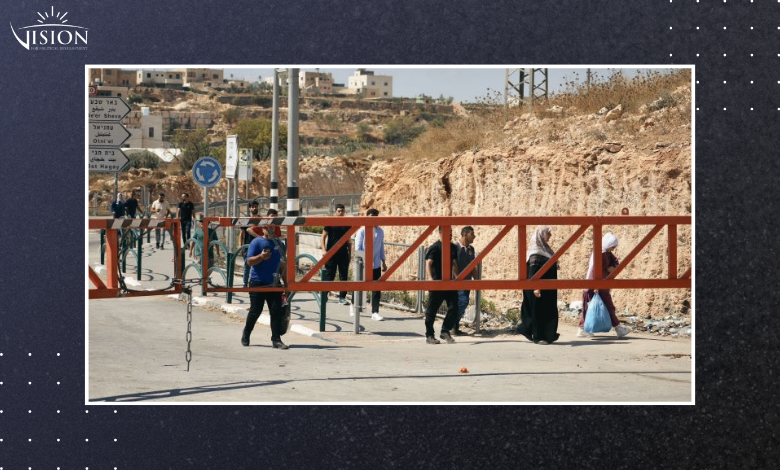
Since the occupation of the West Bank and the Gaza Strip in 1967, checkpoints have become a permanent feature of Palestinians’ daily lives, gradually shifting from an exceptional measure to an imposed routine governing movement and mobility. While the terminology surrounding them has shifted over the years, checkpoints and the deliberate fragmentation of the West Bank have consistently formed a core component of occupation policies. Following October 2023, this system expanded sharply, with an unprecedented increase in checkpoints and restrictions on Palestinian movement. As of the time of writing this paper, their number has reached 916 permanent and temporary checkpoints, according to the latest statistics issued by the Wall and Settlement Resistance Commission.
These checkpoints and restrictions have left profound impact on Palestinian life across economic, social, and cultural dimensions. The heavy presence of checkpoints has cast its shadow over Palestinian literary and artistic production, where themes of siege, waiting, and forced mobility have become strikingly prominent in artistic and literary works. Numerous literary texts have addressed checkpoints for many years; however, following the intensified restrictions after the genocidal war, the checkpoint has emerged forcefully within the cultural scene. Examples include The Arrest of Christ at the Container Checkpoint, Deir Sharaf Checkpoint: Clinical Death, and Checkpoint Tales. Similar themes appear in songs such as “Stuck at Qalandiya Checkpoint” and “My Daily Song”, where the checkpoint has become a tangible symbol reflecting Palestinians’ everyday experiences. This is unsurprising, as literature inevitably reflects lived reality in one form or another.
Decades of Palestinian suffering under the expanding network of Israeli checkpoints have generated diverse modes of interaction with this reality, to the extent that scarcely any Palestinian story or conversation is devoid of reference to a checkpoint or gate. Palestinian experience has evolved along a spectrum, from adaptation and the forced reshaping of daily life through challenge and defiance, to attempts at evasion and circumvention of checkpoints. This article seeks to examine these dynamics, shedding light on the lived consequences of checkpoints, particularly in the aftermath of the genocidal war on the Gaza Strip since October 2023.
Redefining Time, Distance, and Social Life
“Work starts at eight? Then I leave home at four in the morning.”
Through this harsh equation, Palestinians have reorganized their daily lives since 7 October 2023, amid escalating closure policies and intensified checkpoint regimes. This behaviour does not reflect submission so much as it describes an imposed reality for which Palestinians currently have no practical alternative. The distribution of checkpoints and gates across the West Bank isolates villages and cities from one another, effectively transforming the territory into a vast prison. Given that governorate centers such as Ramallah, Nablus, and Hebron serve as hubs of economic, governmental, and institutional activity, residents of villages and peripheral areas are compelled to cross occupation checkpoints daily. In doing so, their lives are reshaped, and their understanding of time and distance is redefined, an unmistakable form of forced adaptation, in which adjustment becomes a necessity rather than a choice.
The impact of checkpoints is not limited to the long hours wasted in waiting and crossing; it extends to the restructuring of economic and social life itself, leaving deep marks on people’s choices and life trajectories. Yet the loss of time alone is no less catastrophic than other consequences. The story of Mohammed Thabet, a young man from the town of Beit Dajan east of Nablus, is one of thousands that illustrate the devastating impact of checkpoints on Palestinian time. Mohammed now needs more than two and a half hours to reach his workplace in the neighbouring village of Qusra, more than double the time he previously required, solely because of prolonged waiting at checkpoints, assuming he is even able to pass without being detained for additional hours. It is important to note here that Palestinian time before the war was far from ideal; checkpoints and the occupation’s engineered control over Palestinian movement in the West Bank had already automatically doubled travel time compared to other parts of the world. What has occurred since the war, however, is a doubling of time that was already doubled.
According to a study conducted by the Applied Research Institute Jerusalem (ARIJ) in 2019, Palestinians lost approximately 60 million working hours annually at checkpoints, then numbering between 500 and 600, at an estimated economic cost of around USD 270 million per year. By contrast, a 2025 study by the MAS Institute, titled “The Policy of Israeli Occupation Checkpoints in the Northern and Central West Bank and the Resulting Loss of Working Hours,” estimated daily lost working hours at approximately 200,000, amounting to nearly 73 million hours annually. This translates into daily economic losses of about 2.8 million shekels (USD 764,600), or roughly 62.2 million shekels (USD 16.8 million) per month.
It must be noted, however, that methodological differences between the ARIJ study and the MAS Institute study mean that the increase in lost working hours is not limited to 13 million hours but exceeds this figure by several multiples. The ARIJ study calculated lost working hours among West Bank workers commuting to occupied Jerusalem and the 1948 territories. Since the outbreak of the genocidal war on the Gaza Strip, these workers have been barred from reaching their workplaces. The MAS study, by contrast, focused solely on lost working hours within the West Bank itself, making the difference both substantial and catastrophic.
According to the MAS study, the additional distances drivers must travel to avoid checkpoints result in extra fuel consumption estimated at approximately 71,000 shekels (USD 19,203) per day, or about 22.2 million shekels (USD 6 million) annually. Economic losses, however, are not limited to wasted time and rising transportation costs. Checkpoints have also contributed to increased unemployment and declining wages due to difficulties workers face in reaching their workplaces, as well as disruptions to the movement of goods, raising transport costs and causing spoilage of some products as a result of prolonged waiting times. Overall, based on an analysis of waiting times at 14 military checkpoints, the MAS study shows that waiting times range between 15 and 50 minutes. The results also indicate that the average delay for trips outside Nablus governorate reaches 42 minutes, an increase of 77.9 percent over the original travel time.
Turning to the social impact of checkpoints, a paper issued in June 2025 by the Palestinian Center for Human Rights and Democracy, SHAMS, titled, ‘Israel’ Besieges Geography: Its Military Checkpoints Suffocate Palestinian Social Life, examined the direct impact of checkpoints on Palestinian society. The paper demonstrates that checkpoints have profoundly affected Palestinian society in multiple dimensions, significantly reducing social interaction during occasions such as celebrations, weddings, funerals, and other activities requiring movement between areas. Family relations have not been spared either; checkpoints have led to a decline in family visits among relatives and even among members of the same extended family, severely undermining family cohesion in many cases. Accordingly, the study concludes that the checkpoint regime in the West Bank functions to fragment Palestinian society and erode its social, national, and organizational bonds.
As a result, checkpoints have driven many Palestinians toward isolation, discouraging inter-governorate movement and prompting people to settle permanently in one location, often far from their families, to avoid constant encounters with checkpoints. This phenomenon is particularly pronounced among groups who must cross checkpoints daily, such as university students, some of whom may have to pass through five or six checkpoints each day, in addition to the possibility of encountering sudden “flying” checkpoints. This has pushed certain groups to change their places of residence, moving from villages to governorate centers, or from northern and southern governorates to Ramallah and al-Bireh, which function as the political and administrative center of the West Bank.
Consequently, movement between governorates, cities, and villages has declined noticeably due to fear of army violence and checkpoint restrictions, as well as the risks posed by settler attacks on roads. The previously cited MAS Institute study, drawing on data collected from taxi offices, shows that transportation activity declined by 51.7 percent after the start of the genocidal war on Gaza in October 2023. Meanwhile, Abdullah al-Halou, head of the Union of Bus Company Owners, that movement within the West Bank has declined by between 60 and 70 percent.
A comparison of public transport vehicle licensing rates in the West Bank further reveals the relationship between movement restrictions and the decline of public transportation. In 2022, public transport vehicles accounted for 4.4 percent of all licensed vehicles; by 2024, this figure had fallen to 2.8 percent. This decline reflects Palestinians’ growing reluctance to travel, one of the direct outcomes of the checkpoint regime and the new way of life it has imposed.
With the decline of the transport sector and people’s retreat from movement, the real estate market in West Bank city centers classified as “Area A” under the Oslo Accords, particularly Ramallah, has witnessed increased demand for rental apartments and houses alongside a reduced supply, leading to rising rental prices. Although no official estimates exist, increases have been estimated at a minimum of 20 percent since the outbreak of the genocidal onslaught on Gaza. Checkpoints have created a perception that certain areas are safer and calmer than others. Ramallah, classified as “Area A,” including Ramallah, al-Bireh, Beitunia, Birzeit, and surrounding areas, colloquially described as stretching from the Qalandiya checkpoint in the south to the Atara checkpoint in the north, is often viewed as more secure and stable, in addition to being the political and administrative center. This perception has driven many public and private sector employees and others to relocate there to escape the daily ordeal and risks of checkpoint crossings. What this means is that checkpoints are quietly reshaping the demographic distribution of Palestinians in the West Bank, in tandem with both declared and undeclared displacement policies pursued by the occupation and settlers.
In conclusion, Israeli checkpoints have restructured the economic and social geography of Palestinian labour by disrupting inter-governorate movement and imposing forced population concentration within specific urban centers. They have also re-engineered the distribution of Palestinian labour, concentrating it within city centers.
The Checkpoint as a Forced Social–Lived Space
Although Israeli checkpoints have deprived Palestinians of their livelihoods, Palestine’s Ministry of National Economy reported a 28 percent contraction of the Palestinian economy in 2024 amid severe restrictions on individual movement, trade, and crossings, causing economic establishments to operate at less than half their productive capacity since the Israeli assault on Gaza began in October 2023. At the same time, these checkpoints have paradoxically generated limited employment opportunities for a small number of Palestinians who became unemployed following the onset of the genocide.
Street vendors have proliferated along checkpoints, positioning themselves in relatively safer areas near long vehicle queues.
Some of these vendors have settled permanently, establishing small-scale businesses near checkpoints. During long waiting periods, travellers can purchase water, coffee, cold drinks, fruits, vegetables, and even children’s toys. Toys are among the most popular items, as they cater to children who grow restless during prolonged waits, offering a temporary means of distraction, though they may also impose an additional financial burden on families. It is important to clarify that these stalls are not “rest stops” as found in other countries; rather, they represent an additional economic burden on drivers, who already incur higher fuel and time costs simply to reach their destinations. This commercial activity is tied to Palestinians’ historical experience with checkpoints, which gradually evolve from simple obstacles into infrastructures of isolation, control, and deprivation, around which attempts to secure a livelihood emerge. Similar experiences can be observed at Qalandiya checkpoint between Ramallah and Jerusalem, where vendors long capitalized on years of crises and extended waiting times before the occupation converted the checkpoint into a terminal, as well as at the Container checkpoint, which derives its name from a vendor’s container that once stood there before the occupation expelled him.
Conversely, long queues, extended waiting hours, and sudden full closures of checkpoints have also fostered social solidarity and generated cooperative initiatives, particularly in hosting stranded travellers when checkpoints are abruptly closed. Villages and towns near checkpoints often rush to announce that they are opening their doors to shelter those stranded until checkpoints reopen. One notable example is the Birzeit Municipality’s initiative in September 2025, following the complete closure of Ramallah and al-Bireh, when the municipality invited stranded individuals to seek shelter at the Popular Committee headquarters in the town center and offered available services. Many villages have followed suit whenever comprehensive closures are imposed. Numerous local initiatives by residents and municipal bodies have emerged to alleviate people’s suffering, with Palestinians hosting one another when city entrances are closed and access to homes becomes impossible. On a personal level, individuals have also volunteered to host strangers in their homes, sharing their phone numbers on social media and messaging groups and offering whatever assistance they can.
Social solidarity also manifests during the holy month of Ramadan. Over two consecutive years, collective iftars were organized amid the siege of cities and areas in the West Bank. Several checkpoints witnessed communal iftars organized by local and grassroots initiatives, most notably the Caravan of Goodness initiative and Life Makers, alongside similar efforts by private companies as part of corporate social responsibility. These initiatives helped ease the burden on citizens and created moments of humanity within an otherwise harsh daily reality.
In other instances, those stranded at checkpoints themselves take the initiative to support one another. One such example is the story of Azzam Hanani from Nablus, who was stranded along with hundreds of others at a military checkpoint at the entrance to Beit Furik. When it came time to break the fast, Hanani shared the dates he had with fellow fasting travellers stranded at the checkpoint, an expression of solidarity and collective care.
In Search of an Escape Route
The continued tightening of restrictions on Palestinian movement through checkpoints has driven many drivers to use alternative routes as a means of circumventing imposed constraints. These routes are neither paved nor suitable for vehicular traffic; Palestinians have resorted to them since the Al-Aqsa Intifada in 2000, and some were originally agricultural paths usable only by animals or farming tractors. Because these dirt and rugged roads are long and dangerous, they have significantly increased travel time and transportation costs, and on numerous occasions have endangered the lives of civilians.
By way of example, Luay Wazwaz, a resident of Hebron, describes present-day mobility as more frightening and complex than ever. Palestinians are now compelled to take unfamiliar routes that are liable to sudden closure, routes that are longer and more hazardous, especially after former alternative roads themselves became substitutes for yet other alternatives.
Given the length and difficulty of these routes, the Ministry of Transport approved a temporary increase in public transportation fares in several governorates affected by occupation checkpoints. This decision followed the forced use of unpaved alternative roads by drivers, which extended travel time and distances and led to a temporary rise in transportation costs and fares. This was essentially the extent of what the Palestinian government could do to adapt to the reality of closed roads and improvised alternatives.
On the other hand, Palestinians have devised a new technological solution to mitigate this reality by creating mobile phone applications and social media groups that provide real-time updates on road and checkpoint conditions. These platforms offer detailed information, including the type of checkpoint (flying, fully closed, or passable), the nature of the situation (severe congestion or difficult passage), the direction of movement (northbound, southbound, inbound, or outbound), and possible alternative routes to avoid checkpoints.
Among the most prominent of these applications are Azmeh (“Crisis”) and ‘A Wein Rayeh (“Where Are You Going?”), both designed by Palestinian volunteers to illustrate traffic congestion at checkpoints. Users continuously exchange information in an effort to reduce the time Palestinians spend waiting to cross. In addition, hundreds of groups have been created on Telegram and Facebook, comprising hundreds of thousands of users who follow road conditions moment by moment. These applications and groups are notably accurate, as most of their information sources are public transport drivers and travellers spread across various roads and checkpoints in the West Bank.
Furthermore, several local radio stations, such as Ajyal Radio, have dedicated daily segments to road updates, highlighting major gates and checkpoints. As a result, information about road conditions has become an essential component of Palestinians’ daily knowledge, perhaps the most important information for those intending to travel between West Bank cities and villages. It can be said that there is hardly any local Palestinian media outlet in the West Bank that does not allocate space to road and checkpoint conditions. This carries profound implications, reflecting the extent to which checkpoints and closures have become an extremely sensitive issue that continuously and daily affects people’s decisions and choices, redefining their perceptions of time, space, and distance.
It is also worth noting that the historically continuous presence of checkpoints at the entrances of villages and towns has endowed Palestinians with extensive experience in dealing with them, including changes in shifts, thorough inspections, random searches, and estimating potential waiting times. Over time, some Palestinians have even developed the ability to recognize soldiers’ practices, and sometimes their names or backgrounds. One soldier may be described as “lenient and lets people pass,” while another is labelled “resentful and aggressive,” and distinctions are sometimes made between Arab or Druze soldiers. This reality requires Palestinians to adapt to the moods of soldiers when crossing checkpoints.
However, despite this accumulated experience, and despite the high accuracy of applications, groups, and radio segments, they often fail to guarantee reliable updates. A checkpoint can be closed at any moment, nullifying within seconds all previous information indicating that “the checkpoint is passable.” This occurs frequently, particularly when an act of resistance takes place or when the occupation suspects an incident, prompting a comprehensive closure based solely on suspicion. This was the case in Ramallah Governorate on January 4, following occupation suspicions of a vehicular attack near the town of Birzeit.
Conclusion
To conclude, Israeli checkpoints and restrictions have profoundly affected Palestinians’ daily lives, imposing modes of coping with this heavy reality that range from adaptation and normalization of imposed conditions, to attempts to avoid checkpoints by moving from villages to cities or refraining from travel altogether, and to efforts to align life circumstances with the nature, number, and types of checkpoints. This has driven Palestinians toward fundamental changes in their lives, such as altering their place of residence or profession. At the same time, these challenges have generated Palestinian strategies for overcoming checkpoints amid the ongoing flow of daily life and its unavoidable demands. Those who have work must go to work, and those with social obligations must fulfil them. Thus, daily suffering at checkpoints has sometimes been transformed into opportunities for adaptation and creativity, without exaggerating the scale of these opportunities, which are ultimately nothing more than harsh responses to an even harsher reality.
Nevertheless, it must be emphasized that the alternative routes Palestinians have devised, whether physical or virtual, should not become permanent substitutes. Adaptation and habituation must not cause Palestinians to forget the original map of the road leading to their homeland.
NOTE: This text is adapted from original Arabic article.