
Benjamin Netanyahu: Reproducing the Zionist Project Within the Framework of a Civilizational Clash

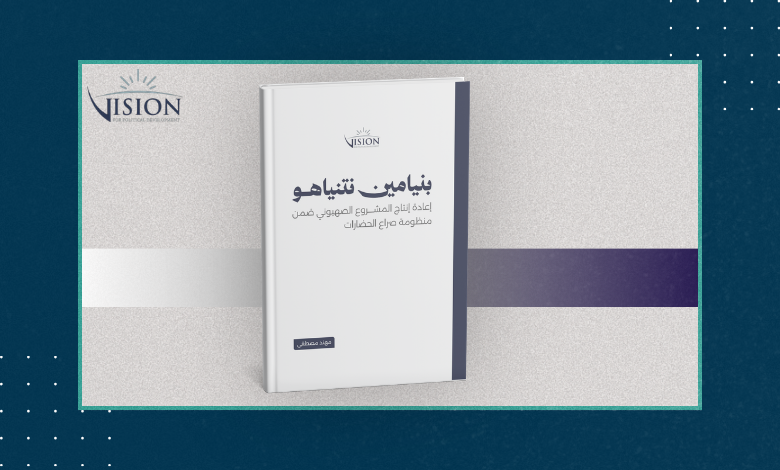
“Benjamin Netanyahu: Reproducing the Zionist Project Within the Framework of the Clash of Civilizations” is a 153-page book recently published by the Vision Center for Political Development. It was written by Muhannad Mustafa, a Palestinian researcher and academic specializing in political science and Israeli affairs.
The second edition builds on the first, published in 2019, which examined Benjamin Netanyahu’s background, ideas, political career, personality traits, and role in the historical development of the State of Israel. The significance of this study lies in Netanyahu’s profound influence on Israel’s political, social, and cultural landscape, as well as his exceptionally long tenure in power, both in terms of the total number of years and the continuity of his rule. Adding to this significance is the rapid succession of events and transformations during his time in office, most notably the October 7, 2023 attack, which changed both Israel and Netanyahu.
This edition comes in the aftermath of Operation Al-Aqsa Flood on October 7, 2023, and amid the continuation of Israel’s war on multiple fronts, particularly the genocidal war in the Gaza Strip, which continued even after the ceasefire agreement based on US President Donald Trump’s plan in October 2025.
One of the consequences of Operation Al-Aqsa Flood was the acceleration of efforts to consolidate control over state institutions and establish what we refer to as “populist authoritarianism.” Netanyahu and the governing right wing seek to build a populist authoritarian republic under a democratic facade represented by elections. Populist authoritarianism does not aim to completely dismantle the political system; rather, it seeks to strip it of its political or liberal substance, establishing a politically and socially authoritarian republic through populist tools and rhetoric. This process also involves reproducing nationalism, and even Zionism, through a discourse that is militaristic on the one hand and Kahanist on the other.
Kahanism is no longer merely a political party but has become a discourse permeating the Likud party with Netanyahu’s consent and approval. It has also evolved into a discourse, ideology, and pattern of behavior prevalent among broad segments of Israeli society.
The book seeks to contribute to a deeper understanding of Israeli policies toward the region and Palestine under Netanyahu.
Chapter One: “A Political Reading of Netanyahu’s Personal Biography”
The first chapter offers a political examination of Netanyahu’s life and background, helping readers understand the personal, political, and historical influences that shaped his political and intellectual identity.
Journalists Ben Caspit and Ilan Kfir, in their book Netanyahu: The Road to Power, identify three figures who accompanied Netanyahu throughout his life and profoundly influenced his worldview: his brother Yoni, his father Benzion Netanyahu, and his grandfather, Rabbi Nathan Mileikowsky. In Netanyahu’s eyes, each of these three figures, individually and collectively, embodies the history of Zionism.
Chapter Two: “The Formation of Netanyahu’s Ideology: Personal, Intellectual, and Political Dimensions”
The second chapter analyzes the roles played by Netanyahu’s father, Benzion Netanyahu, and his brother, Yoni Netanyahu, in shaping his thinking and political orientations.
While acknowledging their considerable influence, the chapter emphasizes that other intellectual and political factors also contributed to shaping Netanyahu’s worldview. As a result, Netanyahu developed an ideological framework that differs from his father’s in certain respects while remaining fundamentally connected to it.
The chapter also examines the authoritarian aspects of Netanyahu’s personality, providing additional insight into the intellectual and personal foundations of his character before moving on to a broader analysis of his thought and ideology.
Chapter Three: “Netanyahu’s Ideology and Thought: Framing the Zionist Project Within the Clash of Civilizations”
The third chapter examines Netanyahu’s thinking and ideological perceptions through an analysis of his own writings.
It proceeds from the book’s central argument: Netanyahu believes that the Zionist project forms part of a broader civilizational conflict between the Judeo-Christian West and Arab-Islamic civilization, and that the Zionist project serves as the spearhead of this confrontation.
Before analyzing Netanyahu’s writings, the chapter reviews debates surrounding his personality and his political and ideological outlook.
Chapter Four: “Netanyahu and the Palestinians: Palestinian Reconciliation Versus an Israeli Settlement”
The fourth chapter analyzes Netanyahu’s political and ideological approach to the Palestinian question.
Although the book devotes a separate chapter to this subject, it cannot be understood independently of the preceding chapter, which examines Netanyahu’s thought and ideology. The two are deeply interconnected, as his position on the Palestinian issue is inseparable from his broader intellectual and ideological worldview.
Chapter Five: “Netanyahu, Operation Al-Aqsa Flood, and ‘Total Victory’”
The fifth and final chapter examines the impact of Operation Al-Aqsa Flood on October 7, 2023, describing it as a seismic event not only for Israel but also for Netanyahu personally.
The event shattered Netanyahu’s psychological self-image, his perceptions of himself and others, and his understanding of the policies he had pursued before October 7.
It transformed Netanyahu from a leader who believed he could manage threats, capitalize on the opportunities they presented, avoid decisive confrontations, and steer clear of prolonged military engagements whenever possible, into a ruthless figure who sees military force as the only solution to threats and challenges.
Since October 2023, Netanyahu has placed Israel in a state of seemingly endless war, moving from one front to another and repeatedly returning to previous battlefronts, while refusing to contemplate a moment when the state of war might end.
Netanyahu became the first Israeli prime minister to be accused of war crimes and wanted by the International Criminal Court on charges of crimes against humanity in Gaza.
He also became the first Israeli prime minister to shift the Zionist settler-colonial project from displacement and ethnic cleansing toward genocide, transforming a strategy of erasure through forced displacement into one of erasure through mass killing.
The second edition of the book is available at Vision Center for Political Development in Istanbul.